PART 1
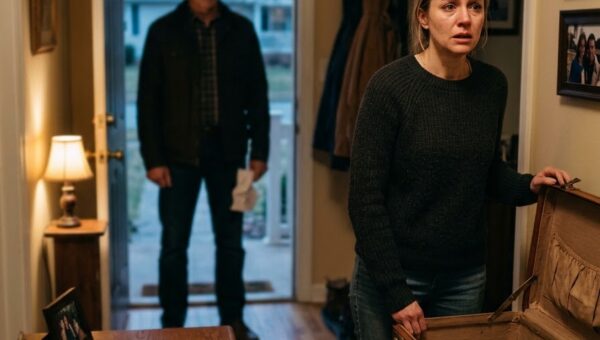
I found the clinic paperwork folded inside the glove compartment of Greg’s truck while looking for the registration renewal.
Right under the line for Primary Emergency Contact, his neat blue ballpoint pen had crossed out my name. In the blank space beside it, he had written Carol Miller, marked her relationship as Personal Assistant, and listed a local cell phone number I had never seen in my life.
We had been married for twenty-nine years. When I walked back into the kitchen that afternoon and laid the paper flat on the counter next to his coffee cup, Greg did not even blink. He took a sip, adjusted his reading glasses, and gave an easy little chuckle that made me feel foolish for asking.
“That clinic is a mess,” he said. “Carol handles my regional scheduling. They were updating workplace injury files last spring, and the intake girl mixed up the corporate form with my personal chart. I already told them to shred it. Don’t go looking for ghosts, Martha.”
He spoke with so much everyday certainty that I let myself swallow the lie. In a long marriage, you tell yourself you are choosing peace when you are really just choosing delay. We lived in a quiet brick ranch outside Richmond, went to church on Sundays, and shared a savings account that had been uncomfortably thin for nearly six years. Greg ran a small independent freight brokerage. Every time I asked why our quarterly transfers into retirement had dropped to almost nothing, he blamed fuel surcharges, rising software fees, and higher insurance premiums. He told me we had to tighten our belts, so I stopped booking our yearly trip to the Outer Banks and started buying generic groceries.
I tried not to think about Carol’s name on that medical form. I buried it under laundry, yard work, and the ordinary routines of thirty years.
Then came a Tuesday afternoon in late October.
I was out on the back patio pruning dead tomato vines when my phone rang from an unfamiliar landline. The woman on the other end spoke in the rushed, steady voice of an emergency room triage nurse. She told me Greg had collapsed in the produce aisle of the Harris Teeter on Ridge Road. Paramedics had brought him into Memorial Hospital with a severe cardiac episode.
“The intake system pulled a different contact number,” the nurse said, her voice dropping slightly. “A woman who works with him was already notified. But while the doctor was examining him, I went through his billfold to confirm his insurance group number. An old laminated index card fell out of the back pocket. It had your name written in blue ink, with ‘Wife’ and an anniversary date written beside it.”
My hands felt cold against the garden clippers. “October 14, 1995,” I said.
“That’s the one,” she replied gently. “You need to come down here, Mrs. Vance.”
I did not bother to wash the garden dirt off my fingers. I grabbed my purse, drove the four miles over the river in heavy afternoon traffic, and parked near the ambulance bay. My mind felt completely blank, running on the automatic instinct of someone whose husband is lying under fluorescent hospital lights.
When I pushed through the double doors into the cardiac waiting room, I expected to find Greg’s sister or his business partner sitting by the television. Instead, only one person was in the room.
She was sitting in a vinyl corner chair, wearing a faded navy cardigan and dark slacks, with her brown hair pulled back in a simple clip. She looked to be in her late thirties, her face lined with the deep exhaustion that comes from years of bad sleep. On the floor beside her worn leather purse was a thick manila folder held together with a thick red rubber band.
She looked up when the door clicked shut. She did not look startled, and she did not look angry. She looked deeply, terribly relieved.
“You’re Martha,” she said. It was not a question.
I stood beside the water cooler with my car keys digging into my palm. “Who are you?”
“I’m Carol,” she said quietly. She did not stand up, but her hands rested flat on the folder. “The paramedics called me from his phone because my number is saved at the top of his favorites. When I got here twenty minutes ago, the receptionist told me another family member was on the way. I knew it had to be you.”
“Greg told me you were just an office temp who helped with his regional filing,” I said. My voice sounded thin in the quiet room.
Carol let out a short, tired breath that was almost a sigh. “I haven’t worked in logistics for five years. Greg has been paying my son’s medical bills every single month because he believes the boy belongs to him.”
The words hit the room like stones dropped into water. Before I could speak, Carol pulled the heavy folder off the floor, stood up, and set it down across my knees.
“He’s awake in room 214,” she said, looking right into my eyes. “The nurse just went in to check his IV. You deserve to know what he promised us both before you walk through that door.”
PART 2
The manila folder was surprisingly heavy. When I pulled off the thick red rubber band, the cardboard covers fell open to reveal a stack of bank receipts, pharmacy printouts, and folded legal-sized documents arranged in neat chronological order.
“Sit down, Martha,” Carol said softly, pointing to the chair beside her. “Your knees are shaking.”
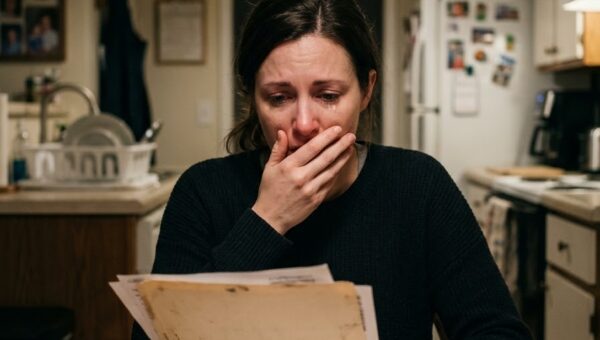
I did not want to sit near her, but my legs gave out anyway. I sank into the vinyl seat, staring at the first paper in the pile. It was an official lab report from Quest Diagnostics, dated three years earlier.
“My son’s name is Toby,” Carol said, keeping her voice low so the receptionist behind the glass partition could not hear. “He was born eleven years ago. I worked as a dispatcher for Greg’s company back then. I was young, I was stupid, and for about four months, we had an affair during an out-of-town warehouse expansion in Roanoke. When I found out I was pregnant, I quit the job immediately. I didn’t want his marriage, and I didn’t want his life. But Toby was born with severe aortic stenosis. He needed two surgeries before his third birthday, and my insurance through my new job wouldn’t cover the out-of-network pediatric specialists.”
I looked down at the lab sheet. Across the bottom, printed in bold black type, was the result of a certified buccal swab paternity test. The probability of Greg Vance being the biological father of Toby Miller was listed as 0.00%.
“He isn’t Greg’s son,” I said. The words tasted like dry paper.
“No,” Carol answered. “He never was. Toby’s father was an electrician I dated for nearly three years before I ever met your husband. But Greg refused to accept that. When Toby got sick, Greg showed up at the hospital with a certified check for seven thousand dollars. He told me God had given him a second chance at fatherhood. He convinced himself that the boy had his chin, his ears, his temperament. When I finally saved enough money to run this DNA test three years ago to make him stop, Greg ripped his copy in half right in my living room.”
“Why would he pay if he had the test?” I asked. “Why keep paying?”
“Because paying meant he owned us,” Carol said. Her face was tight with an old, bitter exhaustion. “Every time I tried to tell him to stay away, he reminded me that Toby’s ongoing cardiology bills were running close to fifteen hundred dollars a month. He paid the hospital directly through cashier’s checks so it wouldn’t show up on your joint statements. Over the last seven years, he paid exactly $146,800 toward Toby’s medical care and my rent.”
I stared at the receipts in the folder. They were all there, stapled to carbon copies of cashier’s checks drawn from a regional credit union account I never knew existed. Each check was dated within two days of the first of the month, right around the time Greg always told me business was too tight to contribute to our retirement fund.
I remembered the winter our heat pump failed, when Greg insisted we buy two ceramic space heaters instead of replacing the unit because our checking balance was under two thousand dollars. I remembered skipping my sister’s fiftieth birthday trip to Nashville because he told me we couldn’t spare four hundred dollars for gas and a hotel room.
“Look at the back pages,” Carol said quietly.
I turned past the medical receipts to a notarized document typed on plain white legal paper. It was an agreement Greg had drafted himself, dated six months ago. In exchange for Carol allowing him to visit Toby twice a month and keeping his contact information primary on all school and medical records, Greg promised to deed over our three-acre river parcel in Goochland County the day he turned sixty-two.
The land had belonged to my father. When Daddy died, Greg had asked me to put his name on the deed so we could secure an agricultural tax credit.
“He told me you were cold,” Carol said, watching my hands turn the paper. “He told me you didn’t care about anything except your garden and your routine. He told me you two hadn’t spoken about anything real in ten years, and that he was leaving you as soon as the land transferred so we could build a house near Toby’s clinic. He put my name on his emergency contact list last month because he wanted to prove to me that he was cutting ties with you.”
She leaned back against the wall, crossing her arms over her chest.
“I didn’t want his house,” she said. “I took his money because my boy needed to breathe, and I hate myself for every single dime. But last week, Greg cornered me at Toby’s middle school soccer game and said he was going to tell Toby he was his real dad on his twelfth birthday, whether I liked it or not. When the hospital called me today, I grabbed this entire file from my safe. I’m done. I’m not hiding his secrets anymore, and I’m not letting him buy his way into my child’s life.”
Before I could answer, the inner hallway door swung open. A young physician in light green scrubs stepped into the waiting room, holding a plastic clipboard.
“Family for Greg Vance?” he called out.
Carol stayed in her chair. She looked at me, gave a single small nod, and folded her hands in her lap.
I stood up, holding the manila folder against my ribs. “I’m his wife,” I said.
PART 3
Room 214 smelled of rubbing alcohol, stale floor wax, and the warm hum of electronic monitors.
Greg was lying back against two flat pillows, his hospital gown tied loosely at the shoulder. He had an IV line taped to the back of his left hand and clear nasal prongs delivering oxygen, but the color had already returned to his cheeks. When the door swung open, his eyes lit up with that familiar, charming relief he always used whenever he needed to talk his way out of a mistake.
“Martha,” he said, his voice a little hoarse from the oxygen. “Thank God. The doctor said it was just a severe arrhythmia brought on by stress and dehydration. I told them you’d be worried sick.”
I did not move toward the bed. I did not take his hand. I walked over to the rolling bedside table, moved his plastic water pitcher out of the way, and dropped the manila folder directly onto the metal surface. The red rubber band landed on his folded blanket.
Greg looked at the folder. The easy, comfortable expression on his face collapsed, replaced by a sudden, rigid stillness.
“Where did you get that?” he asked. His voice dropped to an urgent whisper, his eyes darting toward the open door.
“Carol is sitting in the lobby,” I said. “She’s been there for an hour. The nurse called her first because you put her at the top of your phone. But the triage nurse went through your wallet, Greg. She found the index card I wrote for you back when we bought the house on Ridge Road.”
He reached out an unsteady hand toward the folder, but he didn’t open it. “Martha, listen to me. You don’t understand the pressure I was under. That woman was blackmailing me. She was threatening to bring a scandal to my business, and I was just trying to protect our family name. I did it for us.”
“She didn’t blackmail you, Greg,” I said. My voice was completely steady. “I read the Quest lab results. You knew three years ago that Toby wasn’t yours. You paid $146,800 out of a separate credit union account while you told me we couldn’t afford to replace the roof over our heads. You let me live on canned soup and store-brand cereal while you played savior to a family that wanted you to leave them alone.”
His mouth opened, then closed. For the first time in thirty years of marriage, he had no quick answer. He looked smaller in the hospital bed, stripped of his truck, his leather jacket, and his practiced confidence.
“I wanted a son, Martha,” he said, his voice breaking into a dry, ugly rasp. “We tried for eight years and nothing happened. You stopped wanting to talk about it. You moved on with your garden and your church committees, and I was left with an empty house. When Carol had that boy, I thought it was my second chance. I thought if I took care of him, if I provided for him, it would make up for everything we didn’t have.”
“You didn’t want a son,” I said. “You wanted an audience. You wanted someone who owed you their life, and when Carol tried to walk away, you used my father’s land to buy your way back in.”
“I never signed that deed,” he said quickly, leaning forward until the heart monitor let out a sharp, warning beep. “The land is still in our names. Nothing is transferred. It was just talk, Martha. Just talk to keep her from filing for child support through the courts. I’m sorry. I’ll close the credit union account tomorrow. I’ll get a restraining order against her. We can fix this.”
I looked at him, really looked at him, lying under the harsh hospital bulbs. The man I had spent three decades with was not a monster from a movie. He was just a weak, vain man who would rather hollow out his own marriage than admit he was ordinary.
“You aren’t going to fix anything,” I said. “And you aren’t going to file a restraining order against that woman. She’s already leaving, and she is never going to speak to you again.”
I reached into my purse, took out the set of keys to his truck, and laid them neatly on top of the manila folder.
“The doctor told me you’ll be discharged by tomorrow morning,” I told him. “Call a cab, or call one of your golf buddies. Do not call my phone.”
“Martha, please,” he said, reaching out to grab my sleeve. His fingers grazed my wrist, but I pulled away before he could get a grip. “You can’t just walk out of a hospital room like this. We’ve been married twenty-nine years.”
“Twenty-nine years,” I repeated. “And you were the only one living in them.”
ENDING
I walked out of room 214 and did not look back.
Carol was still sitting in the waiting area when I stepped through the doors. She had her purse over her shoulder and her car keys in her hand, waiting just to see if I was all right. When our eyes met, she didn’t say a word. She just gave me a quiet, understanding nod, turned, and walked out toward the parking deck. We never spoke again, and we didn’t need to. She had her child to protect, and I had my dignity to recover.
The next morning, before Greg was even discharged from the cardiac unit, I sat across from an attorney named David Harris in a brick office building near the county courthouse. I laid out copies of every receipt from the folder, the notarized agreement for my father’s land, and our last seven years of joint tax returns.
It took fourteen months to dismantle twenty-nine years of marriage.
Because Greg had concealed marital assets and funneled nearly $150,000 of marital funds into unauthorized external payments, the family court judge ordered an unequal division of our property. The three-acre river parcel my father had left me was transferred back entirely into my maiden name, free and clear of any claim. Greg had to sell his freight brokerage to pay off his business debts and the legal fees, and the proceeds from our brick ranch were split to reimburse me for the funds he had diverted from our joint savings.
He lives in a rented two-bedroom apartment near the highway now. Sometimes my sister tells me she spots his truck parked outside the diner near the industrial park, looking older and sitting alone at the counter. I don’t harbor any burning anger toward him anymore. Anger takes too much energy, and at sixty-one, my time is worth far more than his excuses.
I bought a small, sunny townhouse three miles from the river. It has a tiny fenced yard with just enough room for four raised garden beds and two hydrangeas. On my kitchen counter sits a little ceramic bowl where I drop my spare change, my sunglasses, and my keys at the end of the day.
At the bottom of that bowl lies the old laminated index card the emergency room nurse had handed back to me before I left the hospital that rainy Tuesday. My name is still written on it in faded blue ink, followed by our old anniversary date.
I keep it there not because I miss him, but because it reminds me of the exact day I stopped accepting a lie just to keep the peace.