“He said if I had been more careful, our child would still be alive.”
Those were the exact words Mark threw at me in the sterile chill of room 412, right after the nurse pulled the sheet up to my chin and closed the door. I did not scream. I did not throw the plastic pitcher of ice water sitting on the bedside table.
I just stared at the beige acoustic tiles on the ceiling because my brain kind of stopped working for a second. My baby girl, our little Clara, was gone. Four days before my due date. The crib was built in the corner of our small room back home, the quilt folded just so, and Mark stood at the foot of my bed with his hands shoved deep into his pockets like my grief was an inconvenience to his afternoon.
We had been married four years. I met Mark when I was working part-time at the county records office, and back then he had this quiet, steady way about him that made me feel safe. I thought we were a team. I thought we were building something solid out of the ordinary pieces of our lives in that little brick house on Walnut Street. But the moment the monitor went flat and the doctor gently laid his clipboard down, Mark did not reach for my hand.
He pulled away. He needed a villain, and because I was the one carrying the baby, I was the only option he had.
Within three months, he had packed his duffel bags, cleared out his side of the closet, and moved back to his first wife, Clara. Not our daughter, but the woman he was married to before me, Elena. She had divorced him five years prior over some vague business argument he never liked to talk about, but the second my world ended, he went running back to the comfort of what he knew. He left me alone in that house with the empty nursery and a stack of medical bills that kept arriving like clockwork every Tuesday morning.
For the next five years, I lived inside a gray fog that never quite lifted. I worked fifty hours a week at the dry cleaners down on 4th Street just to keep the electric on, scrubbing smoke and starch out of other people’s Sunday clothes while my own mind ate away at me from the inside out.
Every time I dropped a hanger or burned dinner, I heard Mark’s voice whispering in my ear. You were too careless. You carried the heavy groceries. You didn’t rest enough. I turned myself into a ghost in my own kitchen, punishing myself for a failure that felt entirely my own.
Then came a Tuesday in late October. The rain was drumming a steady, hollow beat against the single-pane glass of the kitchen window when the phone rang at 6:14 in the evening. It was a lawyer from downtown, formal and polite in that way that usually means bad news. He told me Mark had suffered a massive coronary while clearing out his gutters that morning. He was gone before the ambulance even reached the county line.
I sat at the kitchen table for a long time after I hung up. I did not cry. My chest just felt tight, like someone had wrapped twine around my ribs and pulled it hard.
I went to the funeral three days later, standing near the back of the small gravel cemetery under a black umbrella, watching Elena receive condolences from people who had known us both. She looked tired, her shoulders hunched inside a heavy wool coat that looked too big for her frame. When our eyes met across the open grave, she looked away instantly, like she was holding onto a secret that was burning her palms.
I went home, took off my wet shoes, and put the kettle on. The house was quiet in that heavy, suffocating way that only empty houses get when the sun goes down early. I was just reaching for a mug when someone knocked on the front door.
It was not a polite knock. It was frantic, sharp, three quick raps that made the brass knocker rattle against the wood.
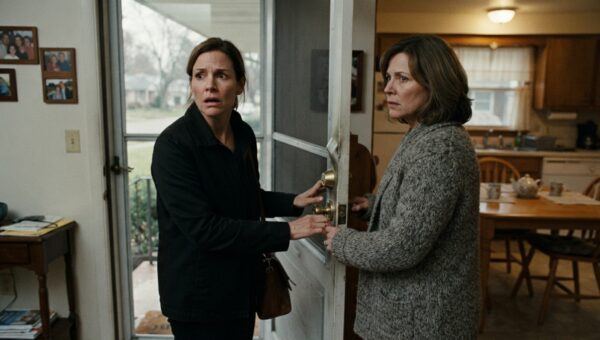
I pulled the door open a few inches, expecting a neighbor or maybe the landlord with a final paper to sign. Instead, it was Elena. Her hair was damp from the drizzle, her mascara tracked in dark streaks down her cheeks, and she was trembling so hard her teeth were almost chattering.
“Can I come in?” she whispered, her voice cracking right down the middle. “Please. I can’t keep it in the car another minute.”
I stood there for a second, my hand frozen on the brass knob. I had every reason to shut the door in her face. She was the woman my husband left me for, the ghost of his past that he went running back to the second things got hard. But there was something in her eyes, a kind of hunted desperation, that stopped me. I stepped back and pulled the door wide. “Come on back to the kitchen. It’s warmer there.”
She didn’t take off her coat. She just set a thick, worn manila folder right down on the oilcloth kitchen table, right next to the salt shaker. The cardboard edges were frayed, held together by a yellowed rubber band that looked like it had been sitting at the bottom of a desk drawer for a decade.
“Mark didn’t die of a sudden heart attack,” Elena said without preamble, her hands clasped tightly in her lap. “Well, he did. But his heart had been giving out for months because he was terrified of what was inside this folder coming to light.”
I pulled out a wooden chair and sat down slowly, keeping my eyes on her face. “What are you talking about?”
“You think you lost your baby because you weren’t careful enough,” she said, and her voice dropped to a rough, broken rasp. “That’s what he told you, wasn’t it? That’s what he told everyone at the diner, at the office, behind your back.”
“He said it to my face in the hospital,” I answered, my own voice sounding thin and small. “He said if I had been more careful, she’d still be here.”
Elena let out a short, bitter breath that wasn’t a laugh. “He knew before you even went to the delivery room. He knew because it happened to us, too, nine years ago before we divorced.”
The kitchen seemed to tilt slightly, the overhead light buzzing in the silence. I didn’t say anything. I just stared at her, waiting for the rest of it.
“Our first baby, a little boy we named Samuel, was stillborn at eight months,” she said, her eyes staring past me at the wall. “And Mark blamed me then, too. He told me I walked too much, that I lifted things I shouldn’t have. I believed him for two years. But when we split up, I went through his old files from his father’s medical boxes. Mark carries a rare genetic translocation. A balanced chromosomal defect that flags incompatible pairings in the third trimester. The doctors told him back then that any full-term pregnancy with his bloodline had an eighty percent chance of fatal fetal termination. He hid it from the doctors. He hid it from you.”
My hands went cold. I reached out and touched the edge of the manila folder. “Why?”
“Because he couldn’t bear to be broken,” Elena whispered, tears finally spilling over her lashes again. “If the baby died because of his genetics, then he was the flawed one. If the baby died because you were careless, then he was just the grieving victim. He chose to break you in half rather than admit the truth to himself. He made me sign a non-disclosure settlement when we divorced the first time so I wouldn’t tell anyone about Samuel’s autopsy report. And when he saw it happening to you, he did the exact same thing to save his own pride.”
She reached out with a trembling hand and slid the folder toward me. “He left this in his safety deposit box with instructions for the bank to hand it to me the day after his funeral. There’s a notarized statement inside, along with the original genetic lab work from nine years ago and yours from five years ago. He knew. He knew the whole time. He knew and he ate dinner at this table every night like nothing was wrong.”
I pulled the rubber band off with a dry snap. Inside were page after page of hospital letterhead, diagnostic charts filled with genetic notations I didn’t fully understand, and a single sheet of lined legal paper covered in Mark’s cramped, familiar handwriting.
*I was afraid,* the letter began, the ink smeared slightly near the bottom. *I couldn’t face the doctors telling me it was my blood that killed my children. I let her take the blame because I didn’t have the strength to carry it. God forgive me.*
I read the words three times, every syllable burning itself into the grain of the table. The five years of gray fog, the endless nights of wondering what I did wrong while lifting heavy linens at the dry cleaners, the crushing weight of a failure I never actually committed, it didn’t vanish all at once, but for the first time since that hospital room, the air in my lungs felt clear.
Elena sat across from me, her head bowed. “I shouldn’t have stayed with him. I came back because I was weak and scared of being alone, but every day I looked at him, I saw your face in the grocery store when he passed you without speaking. I am so sorry.”
“He’s gone,” I said quietly, and the words didn’t feel heavy anymore.
“He’s gone,” she repeated, standing up and pulling her coat tighter around her. She walked toward the front door without looking back, letting herself out into the cold October rain.
I stayed at the kitchen table until the clock on the wall clicked past midnight. Then I stood up, walked down the narrow hallway, and opened the door to the small spare room we hadn’t touched since 2019. The crib was still there, draped in a white sheet that had gathered a thin layer of dust over the years. On the windowsill sat a single pair of tiny white cotton socks I had bought at the local pharmacy the week before she was due.
I reached out, picked up one of the small socks, and placed it gently on the sunlit sill beside a framed photograph of my baby girl. I took a deep, clean breath for the first time in five years, letting the old lie slip away into the dark.