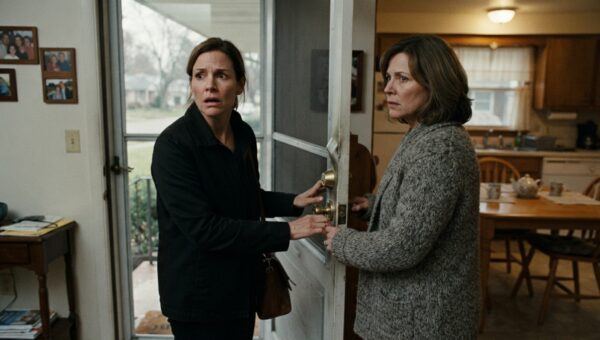
How do you measure the exact distance between an ordinary Tuesday night on the pavement and a polished mahogany conference table on the thirty-third floor? I kept asking myself that question while my fingers traced the edge of my leather portfolio, feeling the cold weight of twelve printed copies of my resume staring back at me. You get used to the quiet rhythm of job hunts after four months of unemployment, but there is something uniquely suffocating about the waiting room of a major architectural firm when your savings account is sitting at $184 and change.
The rain had been hammering against the brick storefronts of downtown Portland for three hours when I ran into that alleyway shortcut back in October. A young woman with a canvas messenger bag pulled tight against her ribs was trying to back away from a bulky man in a tweed overcoat who had her cornered against a brick wall. He was towering over her, his voice rising in that sharp, jagged way that makes the hair on the back of your neck stand straight up. I did not calculate the risks or think about my own safety. I just walked right into their space, stood shoulder-to-shoulder with her, and looked him dead in the eye.
“She’s my sister. Leave her alone,” I said, keeping my voice lower than normal.
He blinked hard, his face turning the color of a bruised plum as he tried to figure out if I was bluffing.
The silence between us stretched out like a tight wire before he finally muttered something vile under his breath, spat on the wet concrete, and walked away down Fourth Avenue. The girl turned to me with wide, shaking eyes, thanked me five times over without stopping for breath, and then vanished into the evening crowd before I could even ask her name. I figured she was just another commuter caught in the wrong part of town, and I certainly never expected to see her again.
Until twelve weeks later, when the receptionist at Sterling Architectural Group called my name and pointed down the long glass hallway toward Conference Room B.
I smoothed down my tie, pushed open the frosted glass door, and stepped into a room filled with the smell of expensive leather and lukewarm drip coffee. There were three people sitting behind the long walnut table. Two of them were middle-aged men in identical charcoal suits shuffling papers with mild boredom.
But the man sitting in the center seat made my blood run completely cold. It was him. The man from the alley.
He looked up from my resume with the exact same heavy-lidded glare, and the sudden drop in my stomach was so sharp I almost lost my breath. He knew who I was instantly. I could see it in the way his jaw tightened and his hand twitched against the wood.
“Mr. Hayes, I believe,” he said, and his voice carried that same oily rasp from the rainy sidewalk. “You can sit down. Or don’t. Frankly, looking at this employment gap, I am not sure why you were brought in for a final round anyway.”
The two other panelists didn’t look up, entirely conditioned to defer to his grating dominance. I stood there with my hand on the back of the heavy leather chair, feeling the heat rush to my face, and realized the entire interview was a sham before it even started. He was going to humiliate me out of this room.
“Actually,” I said, my voice dropping an octave as I reached down to scoop my leather portfolio off the table, “I think I’ll save everyone the time. I’m withdrawing my application.”
I turned on my heel toward the exit, ready to walk back out into the rain and figure out how to pay next month’s rent without dignity or a job.
Then the heavy oak door behind me clicked open.
A sharp click of heels echoed against the polished concrete floor. A woman’s voice cut through the heavy air of the room, crisp and entirely unbothered by the sudden tension.
“Sit back down, Mr. Hayes,” she said.
I froze with my hand on the brass door handle. I turned my head slowly, half-expecting HR, but instead found myself staring directly into the face of the young woman from the alleyway. Her canvas messenger bag was gone, replaced by a tailored charcoal blazer and an executive ID badge hanging from a silver chain around her neck, but those sharp, observant eyes were unmistakable.
Julian Vance, the man who had been terrorizing her months ago, suddenly sat up straight in his chair, his face losing all its color in a single heartbeat.
“Elena,” Vance stammered, his usual arrogance evaporating like steam off a hot sidewalk. “We were just conducting the final technical review for, “
Elena Sterling walked right past him without giving him so much as a sideways glance, her eyes locked entirely on me. She stopped three feet away, leaned slightly against the edge of the table, and let out a small, knowing breath that seemed to deflate the entire room’s manufactured authority.
“I’ve read your résumé,” she said, her voice completely steady as she looked right into my eyes. “Every single line of it. But I already knew you were the kind of person who stands up for people when no one is watching.”
Nobody in the room moved for three whole seconds, and honestly, that felt louder than any shouting match. Vance swallowed hard, his Adam’s apple bobbing violently against his starched white collar, while the other two interviewers looked between the two of us like we were speaking a foreign language.
Elena turned her head slowly toward the center seat, her expression hardening into something cold and absolute.
“Mr. Vance,” she said, her voice dropping to a quiet, lethal register. “Gather your portfolios and clear out your desk by noon. Your consulting contract with this firm was under review for conduct violations anyway, and watching you try to sabotage a qualified candidate just confirmed every single complaint on my desk.”
Vance opened his mouth to argue, but one look at her face shut him down completely. He pushed his chair back with a sharp screech against the floor, grabbed his leather folio, and practically jogged out of the room without looking back once.
The door clicked shut behind him, leaving a profound, humming silence in the wake of his exit.
Elena pulled out the chair Vance had just vacated, sat down, and folded her hands neatly on top of my resume. She looked up at me with a faint, tired smile that reached all the way to her eyes.
“Now,” she said, gesturing to the empty seat right across from her. “Are we going to sit down and talk about your structural engineering portfolio, or are you going to keep standing by that door all day?”
I walked back across the room, pulled out the chair, and sat down. My hands were still shaking just a little bit, but for the first time in four months, the air in the room felt light enough to breathe.