How do you measure thirty years of mornings on a yellow bus? For me, it was always about the cold. I drove route 6 through the hills outside the city for three decades, back when winters had teeth and the county roads stayed packed with gray ice for weeks on end. You learn the rhythm of those kids before the sun is even up.
You watch them stamp their boots on the bottom step and you count heads in the rearview mirror to make sure nobody got left behind in the snowdrifts.
I was just trying to keep my own head above water back then, working two shifts so my husband Arlo could keep his small repair shop afloat before his knees gave out for good. But route 6 had a way of breaking your heart if you let it pay attention. The houses out past the old mill road were falling apart long before the factory closed down for good.
The morning I am talking about was somewhere in January of 1986. The heater on bus 6 was rattling like a tin can full of nails, blowing lukewarm air that smelled like old dust. When the doors hissed open at the crossroad stop by the creek, Daniel Vance climbed up. He was maybe eight years old back then, wearing just a thin cotton button-down shirt with the sleeves rolled up because he was growing too fast, and his lips were already turned that scary shade of bruised purple.
He didn’t have a coat. Not even a sweater. He just stood there shivering so hard his teeth were clicking together.
I didn’t ask questions because out on route 6, questions usually just made kids put their walls up. I told him to slide right up onto the long front seat right next to the engine cover where the heat actually reached. I reached into my canvas work bag and pulled out the spare pair of wool mittens I kept for shoveling snow, plus the brown paper bag with my ham sandwich and a sleeve of crackers.
“Eat those,” I told him, keeping my eyes on the icy road ahead. “And keep those gloves on your hands until they get warm.”
He ate the crackers like he hadn’t seen food in a week, and he kept those oversized wool mittens on all the way to the schoolyard. He did it the next morning, too, and every morning after that for two months straight, until the mud started showing through the snowbanks and the local welfare caseworkers finally showed up at his front door.
Then he was just gone. One day he was sitting by the engine cover, and the next day seat 2 was empty. People move around a lot in towns like ours when things go under. You learn to let them go because you have to keep driving the route.
That was nearly forty years ago. Arlo passed away last October in the upstairs bedroom, right after the leaves turned brown and started sticking to the damp grass. The funeral took what little savings we had left from thirty years of school district paychecks and Arlo’s failing shop. Then the mail started coming.
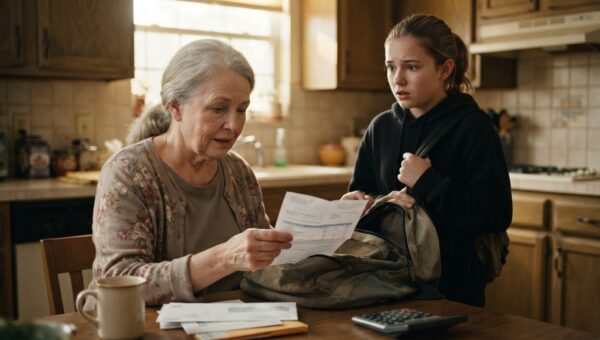
I sat at the kitchen table this morning staring at the latest envelope from the bank, the heavy white kind with the red window. The figures don’t lie. I am nine thousand dollars behind on the mortgage for the little house Arlo built with his own hands back in sixty-four.
My joints ache when the rain starts, and I have been eating toast for three days because the pantry is practically bare. I kept telling myself I would call the bank manager on Monday and ask for another thirty days, knowing full well what they say when you are seventy-three and live on a widow’s pension.
The sound of a heavy engine pulling into the gravel drive made me look up from the table. It wasn’t the mail carrier’s little red truck. It was a sleek black sedan, the kind of fine car you only see parked outside the county courthouse or the expensive restaurants down by the river. It idled softly by the rusted green mailbox, the exhaust turning into white plumes in the crisp autumn air.
I didn’t move for a second. My heart gave a heavy thud against my ribs because you do not get visitors like that unless someone is bringing bad news about taxes or another bill you forgot. I wiped my hands on my apron, smoothed down my gray hair, and pushed the front door open just an inch.
The door of the black car clicked open, and a tall man stepped out onto the gravel. He was wearing a dark wool overcoat that looked expensive and tailored, but as soon as he turned his face toward the porch, I knew the set of his jaw and the way his shoulders carried themselves. He was older, maybe in his late forties, with silver dusting the temples of his dark hair, but those eyes were the exact same pale blue as that freezing morning on route 6.
He walked up the wooden steps slowly, his boots crunching on the loose boards. In his right hand, he held something small and faded. He stopped right at the screen door, looked down at me with a steady, quiet look, and opened his palm.
There they were. The exact same pair of gray wool mittens I had bought at the hardware store in town back in eighty-six, washed thin and worn at the thumbs, but still holding their shape. They smelled faintly of cedar and cold winter air.
“You kept me warm when no one else did,” he said. His voice was deep and steady, but there was a crack right at the end of it that let you know he had carried those years around just as long as I had.
I couldn’t find my voice for a second. I just stared down at the small wool fabric in his large hand. “Daniel,” I whispered. It was the only name that came out of my mouth.
He nodded, and a slow, tired smile crossed his face. He didn’t smile like a stranger; he smiled like someone coming home after a very long trip. He turned back toward the idling car and reached out his hand to help someone else out from the passenger side.
An older woman with silver-white hair and a warm, lined face stepped out onto the driveway. She wore a sensible knitted cardigan and carried a leather portfolio under her arm. Daniel kept his hand on her elbow as she walked up the steps toward us.
“This is Clara Vance,” Daniel said softly, looking between the two of us. “She took me in the spring of eighty-seven, right after the state finally stepped in. She made sure I finished school, and she made sure I never forgot who gave me my first pair of warm gloves.”
Clara reached out and took my free hand in hers, her grip surprisingly strong and warm. “He talked about you every single winter, honey,” she said. “Even when he went off to college, even when he started his work with the youth advocacy programs down in the capital. Those mittens stayed in his drawer like a compass.”
I stood there in the doorway, suddenly acutely aware of the stack of red-windowed bank letters sitting on the oilcloth table just behind my shoulder. The shame of it crept up my neck, hot and heavy, making my face sting. I tried to pull my hand back, but Clara held on.
“I know what’s in your mail, Martha,” Daniel said gently, reading the worry on my face without me having to say a word. He stepped past the screen door into the little kitchen, pulling a thick manila envelope from beneath his coat. “When our state community outreach records flagged the municipal public notices for local foreclosures last week, my foundation coordinator ran the address. It didn’t take me ten minutes to realize whose name was on the default list.”
He laid the envelope right on the oilcloth table, right on top of the past-due notices from the bank.
I looked down at the papers he pulled out. It wasn’t a warning. It was a cashier’s check made out to the mortgage servicer in the exact amount of nine thousand dollars, stamped in bright purple ink with the words PAID IN FULL, alongside a formal lien release signed by the regional bank president himself.
“You can’t do this, Daniel,” I said, my voice shaking so hard the words barely came out straight. “That’s too much money. That’s charity.”
“It’s not charity, Martha,” Daniel said, his hand resting gently on the back of the wooden chair where Arlo used to sit every morning to put on his work boots. “You didn’t give me charity back in eighty-six. You gave me dignity when I didn’t even know what the word meant. You saved my life before the state ever found a place for me. This is just a debt of honor coming home.”
Clara pulled out the heavy wooden chair and sat down at the table, motioning for me to join her. “We called the mortgage office from the car before we pulled into your drive, Martha,” she said, her voice full of that steady, churchgoing gentleness that settles your bones right down to the floorboards. “The account is cleared. The title is safe. You aren’t going anywhere.”
We sat in that small kitchen for hours while the autumn sun moved across the linoleum floor. Daniel talked about the kids he helps now through his foundation, kids who get left out in the cold on rural bus routes just like he did, and how every time he helps one of them find a coat or a hot meal, he thinks about route 6. We drank instant coffee out of chipped mugs that Arlo and I had bought on our honeymoon in the mountains, and for the first time since October, the air in the house didn’t feel thin and sharp. It felt warm. It felt like living again.
After they left late that afternoon, promising to come back Sunday for pot roast, I stood by the kitchen table alone. The house was quiet, but it wasn’t the lonely kind of quiet anymore.
Right there in the center of the table, resting squarely on top of the stamped bank clearance papers, sat the worn pair of child’s gloves. The afternoon sunlight hit the gray wool, catching the tiny fibers where the winter of 1986 still seemed to linger, harmless now, resting at last in the light.