The little farm I bought outside Tupelo, Mississippi, came with a leaning old barn, and under a tarp in the back of it sat a car the previous owner hadn’t touched in thirty years. I had no idea why until the day I finally got the trunk open.
It was a ’60s Chevy, flat tires sunk into the dirt floor, dust an inch thick over the tarp.
The seller, an old man’s son selling off the family land, shrugged when I asked about it. Wayne Vance was his name. He stood by my pickup truck with his arms crossed over his chest, looking like a man who just wanted to sign the papers and forget the whole place ever existed.
“Daddy parked that car in there the year my mother left and never drove it again,” Wayne told me, his voice flat and dry as gravel. “Wouldn’t sell it, wouldn’t fix it, wouldn’t talk about it. We all just stopped asking. It’s part of the property now, so it’s your headache.”
I left the car alone for months. There was plenty to fix up on the house, fences to mend, and a well pump that sputtered every time I tried to draw water for morning coffee. But curiosity finally won out on a humid Tuesday afternoon when the heat in the barn felt thick enough to chew.
I grabbed a crowbar from the toolbox, walked back into the dim shadows, and pried the rusted trunk lid up with a sharp screech of protesting metal.
The trunk wasn’t empty like a thirty-year-dead car’s should be. Pushed to the back, wrapped in a heavy canvas moving blanket and weighted down with a concrete cinder block, was a metal footlocker somebody had padlocked and left in the dark.
A man doesn’t lock up a car and abandon it for three decades over nothing. I cut the lock off right there in the barn using a pair of bolt cutters from the workbench, lifted the lid, and the moment I saw inside, my legs nearly gave out under me.
The box smelled like old mothballs and dry paper, that distinct scent of things locked away from the world for a very long time. Resting right on top was a stack of cassette tapes, each one labeled with neat, careful handwriting in black ink.
The first one said simply, To Wayne on his eighth birthday. Beneath that were others marked for his tenth, his twelfth, his high school graduation, and his wedding day. There were leather-bound journals with yellowed pages, a small velvet box holding a woman’s golden wedding band, and a thick manila folder bearing the letterhead of a medical center in Memphis, Tennessee, dated thirty years ago.
I didn’t touch the tapes at first. I just stood there in the quiet gloom of the barn, listening to the farm dogs barking out in the distance, feeling a cold knot twist up tight in my chest. Wayne had told me his mother abandoned him when he was five years old. He had lived his entire life with that bitter pill lodged in his throat, believing she woke up one morning, packed a bag, and decided he wasn’t worth staying for.
That evening, I sat at my kitchen table with a cup of black coffee that had gone lukewarm while I stared at the manila folder.
I opened it because I had to know what kind of secret warranted locking a car away for thirty years.
The papers inside told a quiet, brutal story. Eleanor Vance had not run off with another man, and she hadn’t packed a bag for a new life across state lines. The hospital receipts and clinical admissions records showed an aggressive, fast-moving illness that didn’t leave much room for hope back in the autumn of ninety-four. There were letters between Thomas Vance and a specialist in Memphis, discussing treatments that failed, palliative care, and the agonizing decision they had made together.
One handwritten letter from Eleanor to Thomas caught my eye. Her handwriting was shaky, the ink bleeding slightly near the bottom of the page where a tear had fallen. She wrote about five-year-old Wayne building block towers on the living room rug, and how she couldn’t bear the thought of him watching her waste away day by agonizing day. She chose to leave for the facility in Tennessee not to escape her family, but to shield her little boy from the haunting, hollow ghost she was becoming. She wanted his last memories of her to be whole, bright, and warm, not tangled up in hospital bedsheets and morphine drips.
Thomas had kept the secret to honor her final, desperate wish. He had paid every medical bill out of a meager dairy farmer’s savings, locking the Chevy away because it was her car, the very vehicle that had carried her away from home for the last time. He had kept the footlocker hidden in the trunk because Wayne wasn’t ready to carry the weight of that sacrifice, and perhaps Thomas wasn’t strong enough to explain it.
I knew I couldn’t just keep the box in my closet. I had to call Wayne.
When my phone picked up on the third ring, Wayne sounded annoyed, probably thinking I found termites in the back room or a well that needed digging.
“Yeah? What is it now?” he asked, his voice rough.
“Wayne, it’s the new owner. From the farm,” I said, leaning against the kitchen counter. “Look, I finally opened that old Chevy in the barn. You need to come back over here.”
There was a long, heavy pause on the other end of the line. The kind of silence where you can practically hear a man jawing his teeth, debating whether the drive out was worth the trouble.
“I told you, whatever is in that car is trash,” Wayne snapped. “Sell it for scrap metal or burn it. I don’t care.”
“It’s not trash, Wayne,” I said quietly, keeping my voice steady. “It’s your mother’s footlocker. She didn’t leave you.”
Another silence followed, much longer this time, heavy enough to sink a ship.
“Don’t play games with me,” Wayne whispered, the hard edge suddenly cracking right down the middle.
“I’m not playing games. Get in your truck and come out here. I’ll have the coffee pot on.”
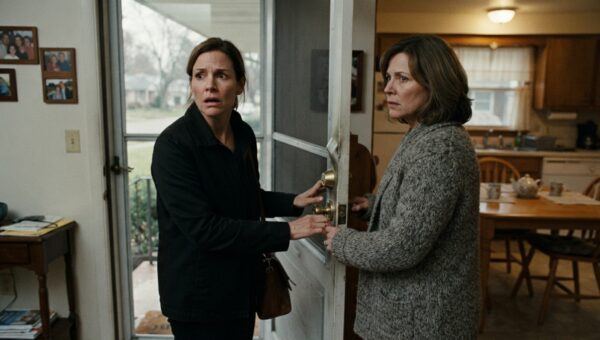
He arrived twenty minutes later. His pickup kicked up a cloud of white dust as he slammed on the brakes near the side porch, killing the engine before the dust even settled. He didn’t wait for an invitation; he pushed through the screen door with his jaw clenched so tight the muscles bunched up near his ears. He looked older than his years, carrying the permanent stoop of a man who had worked himself to the bone trying to outrun a ghost.
“Where is it?” he demanded, standing right in the middle of my kitchen without taking off his dusty jacket.
I didn’t answer with words. I just pointed toward the back porch, where I had set the open footlocker on the wooden table, with the cassette tapes spread out beside the velvet ring box and the hospital folder.
Wayne walked over slowly, like a man approaching a rattlesnake in tall grass. His calloused fingers hovered over the edge of the metal box for a long second before he touched anything. He picked up the top cassette tape, staring down at the faded black marker reading To Wayne on his eighth birthday. His hand started trembling, just a little bit, right there where the cuff of his flannel shirt met his wrist.
“She left these,” he whispered, his voice cracking into something small and broken. “She… she made these?”
“She made them for every major milestone,” I said softly, stepping back to give him some air. “Thirty years of things she wanted to tell you, Wayne. Your dad kept them safe right here in her car because he couldn’t bear to look at them, but he couldn’t bring himself to throw them away either.”
Wayne sank down slowly onto one of the wooden kitchen chairs, staring at the small plastic tape player I had borrowed from my truck. He looked down at the velvet ring box, opened it with a thumb that wouldn’t stop shaking, and pulled out his mother’s golden wedding band. He turned it over and over in his palm, catching the light from the kitchen window.
“He never talked about her,” Wayne muttered, almost to himself. “Not once in my whole life. I thought he just didn’t care. I thought she broke his heart and he just locked his feelings away in the dirt.”
“He locked the car away because it was all he had left of her,” I replied, leaning against the counter. “He carried the whole burden so you wouldn’t have to watch her die in a sterile room fifty miles away.”
Wayne looked up at me, his eyes red-rimmed and swimming with tears he had clearly held back for three decades. He didn’t try to hide them. He reached out and picked up the small portable tape player, sliding the first cassette into the slot until it clicked shut. His thumb pressed down on the play button with a soft mechanical snap.
The kitchen went dead quiet except for the low, fluttering hiss of magnetic tape rolling over a read head. Then, out of the small speaker, a soft, clear woman’s voice filled the room, sounding young and vibrant and impossibly near.
“Hello, my sweet boy,” the tape whispered through the decades. “If you’re listening to this, you’re eight years old now, and I hope you’re still chasing grasshoppers in the back pasture…”
Wayne closed his eyes tight, his shoulders shaking as he lowered his head toward the kitchen table, clutching his mother’s wedding ring in his fist while her voice filled up every empty corner of the old house.