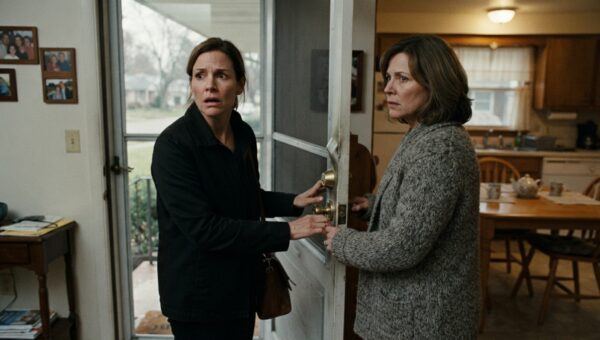
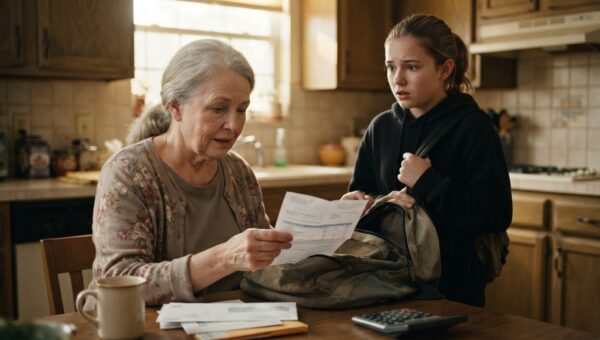
The heat in the kitchen always lingered too long after a Sunday roast, that heavy smell of scorched fat and old linoleum that never quite washed out of the walls no matter how many times I scrubbed them with lemon ammonia.
I was the difficult one growing up. That was the label pinned to my collar before I was old enough to know what it meant, just because I asked why the rules only bent one way and why my brother Arthur never had to help clear the table.
In a house like ours, silence was considered a virtue and any raised voice was a sin.
When Dad’s breathing started to rattle in his chest back in January, Arthur was too busy closing a commercial real estate deal three states over to answer his phone past six in the evening. I packed a single duffel bag, moved back into the spare room that still smelled faintly of mothballs, and spent four weeks wiping his forehead and turning him every two hours so his skin wouldn’t break down.
Dad died on a cold Tuesday morning in February when the frost was still clinging hard to the windowpanes. Arthur flew in twenty-four hours later wearing an expensive charcoal suit that didn’t have a single crease in the trousers.
The reading of the will took place in a carpeted conference room downtown that smelled of stale coffee and expensive paper. The lawyer adjusted his glasses, cleared his throat, and read off the tidy division of assets like he was reciting grocery prices.
The house went to Arthur because he had a growing family and needed the stability. The bank accounts were split down the middle on paper, though somehow Arthur managed to claim the greater share for executive expenses. When it came to me, the lawyer paused, frowned slightly at the single handwritten codicil, and read out my legacy.
“To my daughter Clara, I leave the old upright piano in the front room.”
A couple of distant cousins chuckled softly into their palms, treating it like some kind of family joke. Arthur leaned back in his leather chair and shook his head with a patronizing smirk.
“You always did make a lot of noise,” Arthur said, not even looking at me. “Suits you.”
I didn’t argue. I just signed the papers, rented a flatbed trailer, and hauled that heavy, scarred instrument to my own house myself, because Arthur couldn’t be bothered to help load it.
For nearly eleven months, that piano sat against my living room wall like an uninvited guest. I couldn’t even bring myself to lift the lid to check the keys. Every time I walked past it, I heard Arthur’s voice echoing in the hallway, and behind it, Dad’s quiet, disapproving cough from the armchair he sat in for twenty years.
The wood was dark walnut, scratched along the left side where the vacuum cleaner had banged into it during a dozen spring cleanings I remembered from childhood. Dust settled thick on the music desk, forming gray crescents where the brass hinges met the grain.
By January, the silence in my house had grown too heavy to carry around anymore. I called Mr. Vance, an old-timer who still tuned uprights by ear using a heavy steel fork and a wooden wedge, hoping to at least get the thing into some kind of shape so I could sell it off and be done with it.
Mr. Vance arrived on a rainy Thursday morning carrying a worn leather case that looked older than I was. He didn’t say much, just pulled off his wet canvas cap, set his tools on the coffee table, and walked straight over to the instrument with his head tilted like a robin listening for worms.
He struck middle C, and the sound that came out was a flat, dying thud that made us both wince.
“She’s tight,” Mr. Vance muttered, running a calloused thumb along the edge of the lower knee board. “Real tight down here. Something’s wedged behind this panel. Won’t let the soundboard vibrate right.”
“Just tune the top half if you can,” I said, standing by the radiator with my arms crossed over my chest. “It hasn’t been opened in thirty years.”
“Can’t fix what’s choking her from the inside,” he said, pulling a short-handled screwdriver from his belt loop. “Hand me that small flathead off the tray, will you?”
I knelt down on the worn rug, my knees clicking against the floorboards, and handed him the tool. He worked the brass screws out one by one, dropping them into his palm with small metallic clicks. The wood panel didn’t want to give way at first, stuck fast by decades of varnish and humidity, but with a sharp tug from his pocket knife, it popped free.
A smell rolled out of that dark cavity that stopped my breath. It wasn’t the expected scent of dry felt and aged pine. It smelled of old paper, heavy machine oil, and peppermint tobacco, the exact brand Dad used to smoke out in the shed when he thought nobody was watching.
Mr. Vance shined his penlight into the lower cavity where the pedals and dowels should have been clear. Instead, the entire space was packed tight with a heavy, bulky shape wrapped in a faded green moving blanket tied shut with twine.
“Well,” Mr. Vance whispered, straightening up and wiping his hands on his trousers. “Looks like your old man used this for more than playing hymns.”
I reached out and hooked my fingers under the rough wool of the blanket, my hands shaking slightly against the damp wool. “Help me pull it out.”
Together, we dragged the heavy bundle out onto the middle of the living room rug. It weighed thirty pounds if it weighed an ounce, sagging awkwardly in the middle like a body wrapped in a shroud.
Mr. Vance packed up his tools without another word, sensing the shift in the air, took his cash from the counter without counting it, and let himself out the front door into the gray drizzle.
I sat alone on the floor for ten minutes staring at that green blanket before my fingers finally found the knot in the twine. I pulled it loose, folded back the heavy woolen flap, and stared down at what my father had hidden away from the world for half a century.
There were twelve heavy leather-bound ledger books, their spines cracked and filled with dense, hurried handwriting in black fountain pen ink. Stacked beside them were bundles of hand-copied sheet music, the paper yellowed and brittle at the edges, bearing titles I had never seen before in my life. And right at the bottom, resting on a flat wooden tray, was a small portable cassette recorder with a microtape already slotted into the deck.
I reached out and picked up the top ledger book, my thumb tracing the embossed leather cover. The first page was dated June 1954, long before Arthur or I were born, written in Dad’s sharp, precise hand.
“They want me at the plant,” the first entry read. “The pension is steady. The insurance is covered. A man doesn’t get to keep his own rhythm when there are mouths waiting for bread.”
I sat there on the rug as the rain tapped against the glass, turning the pages of a life I never knew existed. Dad hadn’t just given up his music when he took the management job at the mill; he had buried it alive inside this very instrument, storing every composition, every frustration, and every secret doubt inside the hollow belly of the piano he eventually willed to the daughter he called difficult.
One of the ledger books from the mid-seventies caught my eye because a folded piece of heavy cardstock was jammed between the pages. I opened it carefully, and a photograph slid out onto my lap. It was a picture of Dad taken in some smoky basement club, sitting at a grand piano with his head thrown back, laughing with a cigarette between his fingers, looking lighter and freer than I had ever seen him in my entire life.
On the back of the photograph, he had written in pencil: “Clara has my hands. God help her.”
My throat tightened so hard I couldn’t swallow. I reached over, picked up the small cassette recorder resting on the tray, and pressed the play button with a trembling thumb.
The machine clicked, a low hiss of static filled the room, and then Dad’s voice came through the small internal speaker, sounding raspier than it had in life, but unmistakably him.
“Clara,” his recorded voice said, the microphone picking up the scrape of his sleeve against the desk. “If you’re hearing this, it means Vance finally got the panel off and you found the boxes. Your brother thinks he won the house, and in his mind, he did. He wants things he can measure and sell. But he doesn’t know the first thing about weight. I gave him the mortgage because that’s all he understands. I gave you the piano because you’re the only one in this house who ever had the courage to make a real sound. Don’t let them quiet you down.”
The tape clicked off, leaving only the hum of the refrigerator in the kitchen and the sound of my own ragged breathing.
I sat there on the floor for a long time, holding that small plastic recorder in my hand like it was something fragile enough to break if I squeezed too hard. The bitterness that had sat in my chest for eleven months didn’t vanish all at once, but it shifted, settling into something clear and hard as flint.
I didn’t cry. I just stood up, walked to the kitchen, and picked up my phone from the counter.
I dialed Arthur’s number before I could talk myself out of it. It rang four times before his voicemail picked up with that crisp, efficient greeting he used for clients.
“Arthur,” I said when the beep sounded, my voice sounding steadier than I expected. “Get in your car and come over here. I have something of Dad’s you need to see.”
“Clara, I’m in the middle of a zoning meeting,” Arthur sighed down the line, the background noise of a boardroom humming faintly behind him. “Can this wait until the weekend? I’ve got three properties closing on Friday.”
“No,” I said, looking down at the open ledger books spread across my living room floor. “It can’t wait. And if you don’t leave right now, I’m taking the cassette tape straight to the probate judge and filing to reopen the entire estate.”
There was a sharp silence on the line, followed by the sound of a chair scraping back against a conference room floor.
“What are you talking about?” Arthur asked, his voice dropping an octave into that cold, defensive register he used when things weren’t going his way.
“Just get in the car, Arthur,” I said, and hung up the phone.
An hour later, the tires of his black sedan crunched up the gravel driveway. The front door swung open without a knock, and Arthur stepped into the hallway, pulling off his leather gloves and glaring at me like I was an unruly employee wasting his time.
“This better be good,” Arthur said, shedding his coat onto the back of the sofa. “You have no idea how much money I’m losing sitting here in the middle of the afternoon.”
“Shut up and listen,” I said, pointing toward the open cavity of the upright piano where the moving blanket still lay crumpled on the floor.
Arthur walked into the center of the room, his eyes dropping to the leather-bound ledgers, the piles of yellowed sheet music, and the small black tape recorder sitting on the coffee table. He picked up one of the ledger books, flipped through a few pages of dense musical notation, and frowned.
“What is this junk?” he asked, tossing the book back down onto the rug. “Old papers? Dad didn’t leave any liquid assets in here. This is just trash.”
I walked over to the coffee table, picked up the cassette recorder, and pressed play.
Dad’s voice filled the room again, clear and unmistakable, bouncing off the plaster walls. “I gave your brother the house because he only cared for material things. I gave Clara the piano because she was the only one worthy of my truth.”
Arthur went completely still, his jaw tightening until the muscle in his cheek twitched once, twice. He looked down at the recorder, then up at me, his face flushing a dull, angry red.
“That doesn’t mean anything,” Arthur snapped, stepping forward. “The will is filed. The house is mine. A tape recorder doesn’t change property law.”
“It changes what people know,” I said, stepping right into his space without flinching for the first time in my life. “And if you ever call me a noise again, or tell anyone I don’t belong in this family, I’m publishing every single journal Dad wrote about how he spent forty years watching you turn into a carbon copy of everything he hated about himself.”
Arthur stared at me for three long seconds, his chest heaving under his expensive shirt, searching my face for some sign that I was bluffing. He found nothing.
“You’re crazy,” he muttered, turning on his heel and grabbing his coat off the sofa. “Keep your junk. Keep the damn piano. See if I care.”
The front door slammed behind him so hard the windowpanes rattled in their frames.
I stood alone in the quiet center of the room for a long moment, listening to the silence settle back down over the house. Then I walked over to the kitchen drawer, pulled out a clean white cloth, and wiped the dust off the piano keys one by one.
The afternoon sun cut through the front window, striping across the scarred walnut case and the empty lower panel where the wood had been removed. I sat down on the matching wooden bench, pulled the heavy oak chair closer so my feet could reach the pedals, and let my fingers settle onto the yellowed ivory.
I pressed down on middle C. The sound that came back wasn’t a flat thud anymore; it was clear, ringing, and loud enough to fill every corner of the room.