The bathroom tile was ice against my bare back, and the radiator in the hallway was knocking with that dull, rhythmic clank it always made when the old boiler struggled against a cold Iowa wind.
Marcus was kneeling between my knees on the linoleum, his face slick with sweat, his fingers slippery where he tried to keep his grip on the slippery little bundle he had just pulled into the world.
Our daughter was screaming that bright, angry newborn scream that means everything is working right, and Marcus was laughing and crying at the exact same time, his shoulders heaving.
“She’s here, Arlene,” he kept saying, his voice cracking right down the middle. “Look at her. She’s right here.”
I couldn’t even answer him. I was too dizzy, too wrung out from thirty minutes of frantic labor that had moved like a freight train, tearing through us before we even had time to grab the hospital bag by the front door.
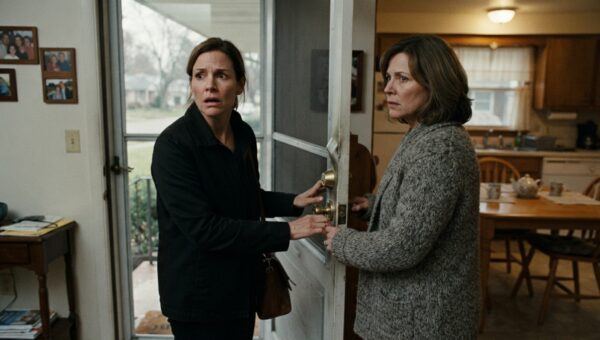
Seventeen minutes after she let out that first cry, the front door rattled open and the paramedics rushed down the hallway with their heavy kit bags, shouting for clear space in our tiny hallway. Dave, the lead paramedic who had answered our panicked ninety-one-one call three times before for our elderly neighbor down the lane, knelt beside Marcus and took charge with the steady, practiced calm of a man who had seen everything the county could throw at him.
They cut the cord right there on the bathroom floor, wrapped our little girl in a warmed blanket, and hoisted me onto the stretcher with professional efficiency. While his partner checked my blood pressure and Dave jotted notes on his clipboard, Dave paused, glanced down at Marcus, and then motioned for me to lean closer before we wheeled out.
“Ma’am, I need to tell you something about your husband’s hands,” Dave murmured, his voice dropping below the hum of the hallway heater.
I gave a weak, breathless little laugh, leaning my head back against the pillow of the stretcher. “He was terrified, Dave. He’s never even delivered a calf before.”
Dave slowly shook his head, his expression dead serious. “No… those weren’t the shakes of fear.” He glanced back at Marcus, who was standing by the door holding the baby bundle against his chest like he was afraid the world might snatch her away. “I’ve seen those tremors before.
There’s another reason they happen, and I think your husband has been hiding it from you.”
The words sat in the cold hallway air between us, heavy and sharp, while the paramedic team wheeled me out toward the rattling doors of the ambulance.
By two in the morning, the hospital room was quiet except for the steady, rhythmic beep of the monitor and the soft snuffling breaths of our daughter in her rolling plastic bassinet. Marcus sat in the vinyl armchair beside my bed, slumped over with his elbows on his knees, staring down at his empty hands as if they belonged to a stranger.
Every time he reached out to adjust the edge of the blanket over the baby, his right fingers fluttered with that same fine, rhythmic vibration I had tried to brush off as adrenaline on the bathroom floor.
“You should go home and sleep, Marcus,” I said softly, my voice raspy from exhaustion. “They’re keeping us until tomorrow afternoon anyway.”
Marcus jerked slightly, pulling his hands back into the pockets of his fleece jacket. “I’m fine right here,” he said, though his voice sounded thin, stretched tight like wire before it snaps. “I’m not leaving you two.”
I watched him tuck his thumb deep into his palm, hiding the tremor against the warm denim of his jeans.
I didn’t push him then, because my bones felt like lead and our daughter needed me to nurse her, but Dave’s warning stayed in the back of my mind, buzzing like an insect against a windowpane.
We had been married for six years, living on the edge of town where the gravel road turns into dirt fields, and Marcus had always been our rock, the one who fixed the truck transmission in the sleet and carried feed sacks without breaking a sweat.
When we finally got discharged the next afternoon, the autumn wind was cutting straight down Main Street, carrying the smell of burning corn stalks from the nearby fields. Marcus carried the car seat out to the truck with exaggerated care, keeping his right elbow pressed tight against his ribs the entire way.
Once we got home, the house felt too warm and too quiet, smelling faintly of bleach from the bathroom floor where our daughter had made her dramatic entry into the world. Marcus busied himself setting up the bassinet in our bedroom, hauling boxes from the hallway, and making a pot of chamomile tea that neither of us touched.
Around ten that night, after the baby had finally drifted off to sleep, Marcus went down to the basement to check the furnace pilot light, leaving his work briefcase sitting open on the dining room table where he had dumped his mail.
I didn’t mean to look through his things, but as I walked past to close the window against the draft, a stray white envelope caught my eye, wedged halfway beneath his laptop charger. It wasn’t a bill or an invoice from the lumberyard where he worked as an assistant manager.
It was a heavy cardstock appointment reminder from the neurology department at the regional medical center in Des Moines, dated nearly eight months ago, with three handwritten follow-up dates scribbled across the bottom margin in Marcus’s neat, careful handwriting.
My breath caught in my throat, and the kitchen around me seemed to tilt just an inch to the left. Eight months ago. That was right when we found out we were expecting, right when we painted the nursery a soft, buttery yellow and talked about how we were going to build our life around this new little soul.
When I heard his heavy boots on the bottom basement stair, I quickly shoved the card back where I found it and walked into the hallway, leaning my shoulder against the doorframe to steady my knees.
Marcus came up the stairs carrying a load of firewood, his face flushed from the basement chill, but the moment he saw me standing there waiting, the color drained right out of his cheeks.
“Arlene,” he said, stopping dead on the second step. “You should be lying down. You had a rough twenty-four hours.”
I didn’t move away from the doorway. I stayed right there, watching the way he instinctively shifted the firewood to his left arm while keeping his right hand tucked firmly behind his back, hidden from view.
“Marcus,” I said, and my voice didn’t shake nearly as much as I expected it to. “Why did Dave say those weren’t the shakes of fear?”
Marcus flinched like someone had struck him across the face, his jaw clenching so hard I could see the muscle twitch near his ear. He didn’t drop the firewood, but his fingers slipped slightly against the rough bark before he managed to regain his grip.
“He doesn’t know what he’s talking about,” Marcus muttered, staring down at the braided rug near his boots. “First responders think they know everything because they see people on their worst days.”
“I found the card from Des Moines, Marcus,” I said quietly, letting the words drop into the space between us with the weight of a stone falling into deep water. “From eight months ago. The neurology clinic.”
The silence that followed was heavier than the old house, heavier than the cold Iowa wind outside against the glass.
Marcus let out a long, shuddering breath, the kind of breath a man takes right before he lets go of something he has been carrying across a burning field for miles. He dropped the bundle of firewood onto the hallway floor with a loud, hollow thud that made the knick-knacks rattle on the side table.
“I didn’t want to ruin it,” he whispered, his voice cracking completely as he slumped down against the wall, sliding down until he was sitting right there on the hard oak floorboards of the hallway. “When my hand first started doing that weird little flutter during the inventory counts at the yard, I thought I was just working too many hours. But it didn’t stop.”
I walked over to him, my slippers making no sound on the wood, and knelt down right beside him on the floor where he sat.
“Why didn’t you tell me?” I asked, my voice softening as the anger melted away, leaving only that raw, aching ache of shared pain.
“Because you were pregnant,” he said, burying his face in his hands, his shoulders shaking with silent, ragged sobs that he had kept bottled up for the better part of a year. “Every time I looked at you growing our baby, I felt like a failure. The doctor said it’s early-onset Parkinson’s, Arlene. He said my nervous system is breaking down, and all I could think about was how I was supposed to be the one taking care of you and the baby, not turning into a burden before she even took her first breath.”
He looked up at me then, his eyes red and swimming with tears, holding out his right hand toward me. The fingers were trembling visibly, a small, relentless motion that he could no longer pretend was just exhaustion or fear.
“I was so scared you’d look at me and see a half-broken man,” he whispered.
I didn’t say a single grand speech. I didn’t offer any empty platitudes about how everything was going to be easy or how the doctors could fix it all with a pill.
Instead, I reached out and took his trembling right hand in both of mine, holding it tight against my chest right over my own heart, feeling the rapid, uneven beat of his skin against mine.
“Marcus,” I said softly, looking straight into his eyes. “Those hands were strong enough to catch our daughter on a cold bathroom floor when I needed you most. They were steady enough to bring her safely into this world, and they are more than strong enough to hold our family together through whatever comes next.”
Marcus let out a ragged sob, leaning his forehead against my shoulder, and for the first time in eight months, the heavy, lonely secret he had carried in the dark was finally shared between us.
We sat together there on the hallway floor for a long time, listening to the soft, even breathing of our baby girl coming through the monitor in the next room, while the house slowly warmed up around us.