I bought the cargo van on an overcast Tuesday in October because the price was right and my lower back was tired of sleeping on a camp pad in the back of my Subaru. Fifteen hundred dollars cash took it off the hands of a family who just wanted the driveway clear. It was a white Ford, scuffed along the rocker panels and sun-bleached on the roof, with half the plumber’s logo scraped off the driver door.
Clara Vance stood on her front porch while I loaded the spare tires into my truck bed, her arms crossed tight against a cardigan that had seen better days. Her son Mark was standing beside her, holding a clipboard with the last of the estate sale receipts.
“Forty years he ran his routes in that van,” Clara told me. Her voice didn’t shake, but it had that flat, worn-down quality people get after a hospital bed leaves the living room. “After he got sick it just sat in the driveway. The boys cleaned out the front, but nobody touched the back. Couldn’t bring ourselves to. Take it as it is.”
I hauled the van back to my uncle’s barn down near Shelbyville where I had the space to pull the old metal parts shelving out of the cargo bay. Arthur Vance had built those shelves himself out of heavy-gauge steel and painted them battleship gray, bolting them right through the floorboards.
It took three hours with an impact wrench and a pry bar just to get the first side unit to budge, sweat running into my eyes while the farm radio droned about soybean futures. When I finally yanked the rear-most rack free, something heavy slid out from the dark gap against the wheel well and clattered against the ribbed metal floor.
It was an old metal toolbox, the kind with a latch that had long since lost its spring, locked up tight with a brass padlock about the size of a plum. There were no wrenches rattling inside when I tipped it, just a dull, dead shifting of weight that sounded like paper and iron. I didn’t think much of it at first. Estate sales are full of forgotten junk, old drill bits and rusted pipe fittings that people leave behind in corners. But the lock bothered me. Nobody puts a padlock on an empty box of scrap copper.
I grabbed a pair of bolt cutters from my workbench, clamped the jaws over the brass shackle, and squeezed until it snapped with a sharp, dry pop.
The lid came up heavy. Inside, wrapped in brown butcher paper tied with gray twine, sat three neat stacks of hundred-dollar bills and a dozen pocket ledgers with black oilcloth covers. I sat back on my heels on the cold concrete floor and stared at the top ledger. The name Arthur Vance was written on the flyleaf in fountain pen, the ink faded to a soft violet. The date in the corner was from the spring of 1983, back when hair was big and Louisville was still full of machine shops that smelled like hot cutting oil.
I opened the book to the middle pages, where the grease smudges were thickest. Arthur’s handwriting was neat, slanted forward like he was in a hurry to get to the next job.
Row after row of street names and account numbers filled the lines, but every third or fourth entry had a red pencil mark drawn straight through the total with two words written beside it in capital letters. Grace Account. No Charge.
Down the block from my own place in the Highlands, an old woman named Mrs. Hattie Miller lived in a little saltbox house with peeling yellow paint and a porch roof that sagged toward the driveway. Back in the winter of 2014, Arthur had spent three solid days down in her crawlspace replacing a rusted cast-iron stack that had split in the freeze. I knew about that house because my brother used to do odd jobs for her. According to the ledger on my workbench, the bill came to twelve hundred and forty dollars for labor and pipe. Across the column, Arthur had written fifty-two dollars paid, and then underneath it, in that same hurried hand, settled in full by trade of home-baked peach preserves and prayer.
I sat there in the quiet of the barn for a long time, listening to the gravel crunch outside as a tractor went down the road. It didn’t make sense for a working plumber with three kids to put himself through forty years of crawling under rotting floorboards just to write off half his tickets. Plumbers don’t get rich doing charity work. They live on trade credit and bad knees.
The money in the box wasn’t a fortune. Counting the banded stacks and the loose bills tucked into the back pocket of the last ledger, it came out to sixty-three hundred dollars in mixed twenties and hundreds, most of it old series with the small portraits. Beside the cash sat a pink official notice from the Jefferson County Water District, stamped past due and dated October of 2020, right before Arthur had his first stroke. It was made out to Hattie Miller for twelve hundred dollars, threatening a tax lien on her property if the balance wasn’t cleared by the end of the month.
That was the last thing Arthur Vance ever wrote down. The page after that was blank, waiting for a route that never happened.
The next morning, I drove down to the Jefferson County Clerk’s office on Liberty Street. The linoleum floors were worn smooth by a million boots, and the air smelled of floor wax and old paper. I didn’t want to get involved in family business, but you don’t find six grand and a stack of unpaid tax notices without feeling like somebody left a door open in the dark. The clerk at the records desk looked through the microfiche files while I waited on a bench with my hat in my hands.
“The Miller property?” she asked, not looking up from her screen. “Yeah, it went to tax sale status last year, but the county put a temporary hold on it because of the homeowner’s age. Why? You family?”
“No,” I said. “Just trying to return something that belongs to them.”
She gave me a long look over her glasses, then printed out a yellow slip showing the balance still sitting on the county books. Twelve hundred dollars even. Exactly what was clipped to the pink notice in the toolbox.
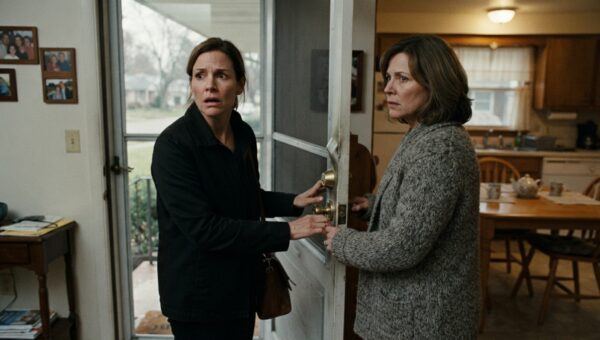
I drove straight out to Clara’s house in the valley. The white van was still gone, but Mark’s pickup was parked in the gravel drive behind a faded Buick. When I walked up the porch steps, the screen door was hooked open, and I could smell coffee coming from inside. I didn’t knock long before Clara appeared behind the mesh, her hands wiped clean on a dishtowel. Her eyes went straight to the metal toolbox I was carrying by its broken latch.
“You left something in the back,” I said. I didn’t try to make it sound casual.
Clara unhooked the door and pushed it open, her chin coming up just a fraction. She looked older in the morning light, her hair uncombed and her shoulders slightly rounded. “The boys cleared out the drawers, mister. Anything in there is just old trash.”
“It’s not trash, Mrs. Vance,” I told her, setting the box down on the porch table. I flipped the lid open so the ledgers and the stacks of banded cash lay right there between us. “Your husband kept some records.”
Mark came out from the kitchen then, wiping his hands on a rag, his face set for an argument. But when he saw the black oilcloth books and the rubber-banded money sitting on the cedar table, he stopped dead in the doorway. He didn’t say anything for a long time. The only sound was the refrigerator humming through the kitchen window.
“What is all that?” Mark finally asked, his voice dropping into that low, flat register men use when they are trying not to be angry about something they don’t understand. “Dad didn’t have savings. We paid for the headstone out of our own pockets.”
“He had this,” I said. I pulled out the ledger from 1983 and laid it open to the first page where he had jotted down his supply costs. “He wasn’t hiding money from you, Mark. He was running a second route nobody knew about.”
Clara reached out slowly, her fingers trembling just a little as they touched the corner of the top book. She didn’t pick it up right away. She just stared at the handwriting, her thumb tracing the edge of the cardboard cover where Arthur had reinforced it with green friction tape back when Ronald Reagan was in the White House.
“He used to leave the house at five in the morning,” she whispered, her voice barely louder than the cicadas in the maples. “Even after his knees started going bad. I told him he was working himself into an early grave for people who couldn’t even pay their parts bill.”
“They couldn’t pay,” I said. “So he didn’t charge them.”
Mark stepped closer, leaning over the table to look at the columns of figures. His hand went out, hovering over the stack of cash before he pulled it back like the paper might burn him. He picked up the pink tax notice from the very bottom of the box and read it twice, his lips moving silently over the numbers.
“Hattie Miller,” Mark said, his head coming up sharply. “That’s old Mrs. Miller down on Tenth Street. Dad fixed her water heater back when we were kids. I thought she paid him.”
“She paid him in jars of preserves,” I said. “At least that’s what the book says.”
We didn’t talk much after that. Clara sat down in the wooden rocker by the porch rail, her glasses sliding down her nose while she turned the pages one by one. She didn’t cry, but every now and then her breath would catch in her throat like she was swallowing a seed. She found entries for people we both knew from the parish, names of families who had lost their husbands in the steel mills or their savings in the nineties, people who thought they had settled their accounts with a handshake and a sack of garden tomatoes. Arthur had kept the books balanced down to the last copper penny, but the money never came out of his customers’ pockets. It came out of his own.
An hour later, Mark and I drove down to the county office together in his truck. We didn’t talk about the weather or the price of copper pipe. He kept the metal toolbox on the floor between his feet, his right hand resting on the latch like he was afraid it might blow away.
We paid off Hattie Miller’s lien right there at the counter with the cash Arthur had set aside seven years ago. The clerk gave us the stamped release form in a manila envelope, and Mark stood outside the courthouse on Liberty Street for a long time, looking up at the gray limestone pillars with his hands shoved deep into his pockets.
“He never bought a new truck in twenty years,” Mark said, his voice thick. “We always wondered where the money went from the big commercial jobs down at the brewery.”
“He spent it on your neighbors,” I told him.
We drove back to Clara’s house and sat on the porch until the sun dropped below the roofline, turning the maple leaves the color of old copper. Clara had the last ledger open on her lap, and she was reading an entry from the winter of 1998, back when the ice storm took out half the water mains in Jefferson County. She didn’t say a word about me taking the van, and I didn’t mention the camper conversion.
The next morning, I went back out to the barn and finished pulling the rest of the shelving out of the Ford. The metal was heavy and scarred with forty years of grease and lime, but I stacked it neatly against the back wall where nobody would throw it away. When I backed the van out into the bright October sun, the old faded lettering on the driver’s door caught the afternoon light just right, the gold paint shining through the gray primer like it had something left to say.