Forty years he ran his routes in that van, and nobody ever thought to look behind the back shelf. I bought the thing for fifteen hundred dollars in October of 2021 at a small-business estate sale out past Louisville, mostly because I needed something to haul lumber for a cabin renovation and my old pickup was dying on every hill.
The widow, Clara Vance, was standing by the driveway with her eldest boy, Thomas, watching the neighbors load out the power tools and copper fittings. She had a handkerchief balled up in her hand, and her eyes were the sort of tired that sleep doesn’t fix.
“Forty years he ran his routes in that van,” she told me when I handed her the cash envelope. “After he got sick it just sat in the driveway. The boys cleaned out the front, but nobody touched the back, couldn’t bring ourselves to. Take it as it is.”
I didn’t think much of it at the time. The cab smelled like stale cigarette smoke and PVC cement, and the odometer had rolled past three hundred thousand miles somewhere around the Bush administration. The company name, Vance Plumbing & Heating, was still faintly visible on the side doors where someone had tried to scrape the vinyl lettering off with a putty knife.
I drove it home, parked it by my shed, and spent the weekend tearing out the wooden shelving the old man had built into the cargo bay back when Reagan was in office.
That was when I found the box. It was wedged down hard against the passenger-side wheel well, jammed into the hollow space where the frame curved over the axle. It was an old steel job box, gray paint flaking off in dry curls, locked with a brass Master Lock that had turned green around the shackle. Everything else in the van had been cleared out or rusted through, but that one box had been shoved so far back into the ribs of the van that it had probably ridden out thirty potholes an hour without shifting an inch.
I went into the garage, grabbed my pair of bolt cutters, and snipped the shackle. The metal popped with a dry snap.
I flipped the lid back, and the smell of old paper and copper dust came up out of the dark.
I just stood there in the dust motes because my brain kind of stopped working for a second.
The box wasn’t full of socket sets or pipe wrenches. It was packed tight with fifteen leather-bound ledger books, each one labeled on the spine with a black Sharpie and a year ranging from 1981 to 2011. Right on top, tucked under the steel lip of the lid, was a navy blue bank passbook from a credit union downtown. I picked it up with two fingers, like it might blow away if I breathed too hard, and opened the cover.
The balance listed on the bottom line made me whistle low through my teeth. It was well over six figures, sitting in a joint account under the names Arthur and Clara Vance, untouched for nearly a decade.
I sat down on the edge of the van’s steel bumper, letting my legs dangle over the gravel. The sun was getting low behind the neighbor’s barn, throwing long, cold shadows across the grass. I flipped open the top ledger, the 1981 book, and saw Arthur’s handwriting for the first time. It was sharp and neat, the kind of penmanship you only get from men who learned to write with a fountain pen in the fifties. Every page was a grid of addresses across Jefferson County, client names, dates, and what looked like charges.
Except the numbers didn’t add up.
I turned to a page from November 1994. Under an address on Oak Street, Arthur had written the name Mrs. Evelyn Gable. The column for labor said two hundred dollars. The column for materials said eighty-five dollars. But under the total line, Arthur had scribbled two words in heavy black ink.
No charge.
Beside it, in the margin, he had added a tiny note: Replaced kitchen stack, trap was rusted clean through. Left two gallons of milk and a sack of flour in the pantry. She tried to give me her silver spoon set. Told her to keep it.
I flipped to another page. Then another. The further I went, the clearer the pattern became. Every few pages, right alongside the normal commercial jobs he did for restaurants and strip malls that kept his business afloat, there was an entry marked in red pencil. Elderly widows. Young couples with newborn babies listed next to notes about frozen pipes bursting in the middle of January. Single mothers on the east side whose water heaters gave out in the dead of winter. He had done the work, cleared the lines, soldered the joints, and then marked them down as zero balance in the book nobody else was ever supposed to see.
The money he made from the big jobs, the commercial contracts with the dry cleaners and the small grocery stores, must have gone into the bank book. Not into his pocket for new trucks or fancy vacations, but straight into that credit union account, piling up quietly year after year while his family thought he was just another struggling local tradesman trying to keep the lights on.
I sat there until the light turned gray and the mosquitoes started biting through my jeans. I knew I couldn’t just keep the box in my shed. It felt like holding someone else’s diary, or worse, holding a secret that didn’t belong to the earth anymore.
The next morning, I picked one of the addresses from a ledger entry dated March 2008. It was a small, white-sided bungalow over off Dixie Highway with a porch rail that looked like it needed a coat of paint about ten years ago. I pulled the old white van up to the curb, killed the engine, and walked up the concrete path.
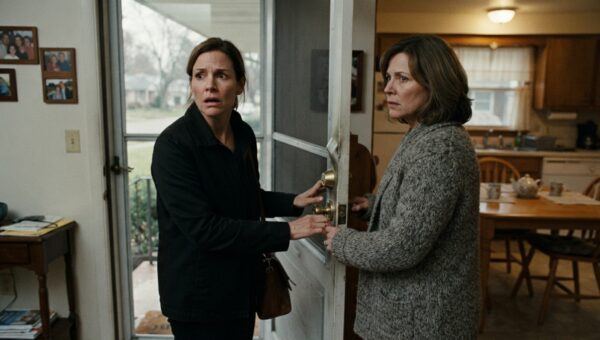
An elderly woman with a cane and thick glasses answered the door on the third knock, peering out through the screen with a suspicious squint.
“Can I help you?” she asked, her voice dry as autumn leaves. “I already told the church group I don’t need any more casseroles.”
“Mrs. Gable?” I asked, holding my cap in my hands. “Or maybe… are you Margaret Higgins?”
Her eyebrows went up. “Margaret Higgins. That was my name before my husband passed twenty years ago. Who’s asking?”
“My name is Luke,” I said, stepping back a half step so she didn’t feel crowded. “I bought Arthur Vance’s old work van a few days back. Out at the estate sale.”
The old woman went completely still behind the screen. Her knuckles tightened around the handle of her wooden cane until the skin turned white. Nobody said anything for a second, and honestly that felt worse than if she had slammed the door in my face.
“Artie’s van?” she whispered. Her voice sounded thin, like paper tearing. “Is he… is he all right?”
“He passed away last year, Mrs. Higgins,” I said gently. “That’s why they were selling the property.”
She lowered her head, staring down at the porch boards for a long time. When she looked back up, her eyes were bright behind her thick lenses.
“He came out here in the middle of an ice storm back in two thousand and eight,” she said, her voice shaking just a little bit. “Our main sewer line cracked right under the basement floor. I didn’t have two nickels to rub together, my husband was six months in the ground, and I thought I was going to have to pack up and move into public housing. Artie spent twelve hours down in that freezing hole in the dark. Put in all new PVC, cleared the whole line.”
She reached out and touched the wooden frame of her screen door.
“When he finished, I asked him what I owed him. I had my checkbook out, my hands shaking so bad I could barely write the numbers. He looked at the checkbook, looked at me, and then he closed my hand right over the pen.”
She paused, swallowing hard.
“What did he tell you, Mrs. Higgins?” I asked.
“He told me, ‘Margaret, you keep your money for groceries,'” she said softly. “‘The good Lord takes care of plumbing bills through other folks.'”
I stood there on that porch for a minute with the spring wind blowing through the maple trees, and I knew right then I wasn’t going to turn that van into a camper. Not yet, anyway.
I drove straight out to the Vance place on the county line, the little brick ranch where Clara and her boys still lived. Thomas answered the door this time, looking bigger than he had at the estate sale, wearing a grease-stained t-shirt and work boots. He crossed his arms over his chest the second he saw me coming up the drive in his father’s van.
“Look, mister, if there’s something wrong with the motor, we sold it as-is,” Thomas said, his voice dropping into that defensive register sons use when they think someone is coming to complain about a dead man’s business. “We don’t do refunds.”
“It’s not about the motor, Thomas,” I said, lifting the heavy steel toolbox out from under my arm and setting it right down on the concrete porch step between us. “You guys missed something in the back.”
Clara appeared behind her son, wiping her hands on a dish towel. She looked down at the gray steel box with the rusted latch and the clean cut on the brass shackle.
“What is that?” she asked, her voice barely a breath.
“That’s forty years of your husband’s work,” I said.
I didn’t say another word. I popped the lid open and pulled out the top ledger book, handing it to Thomas, and then I laid the navy blue bank passbook right on top of it in Clara’s hands.
Thomas opened the book, his big thumb brushing over his father’s neat, sloping handwriting on a page from 1995. He read two lines, and then his jaw tightened. He looked up at me, then down at the book again, and I could see the exact moment the realization hit him. He didn’t say anything about the old man being stubborn, or secretive, or crazy for working himself into the grave. He just stared at the page like he was seeing his father standing right there in the driveway.
Clara opened the passbook. She turned to the back page where the current balance was stamped in heavy black ink by the teller downtown. Her lips parted, and she pressed her fingers against her mouth to keep from making a sound.
“He never said a word,” she whispered, her voice cracking right down the middle. “He complained about the parts prices every single night at the dinner table. He told me taxes were eating us alive.”
“He was paying for other people’s pipes, Clara,” I said quietly. “And he was tucking away enough to make sure you never had to worry about a thing when he was gone.”
Thomas reached out and put his arm around his mother’s shoulders, pulling her in close against his chest. Neither of them looked angry anymore. They just looked hollowed out and impossibly proud, like people who had just found out a stranger they loved had lived a whole secret life as a saint and never bothered to tell anyone about it.
“Thank you,” Thomas muttered, his voice thick. He didn’t look at me when he said it; he was staring down at the steel box like it was the most precious thing in the world.
I left them there on the porch with the ledgers and the bank book, walking back down the gravel drive toward the old white van.
By late afternoon, I was back home. I climbed up into the empty cargo bay of the van, sitting right where the toolbox had rested for forty years against the passenger-side wheel well. The sun was warm through the open rear doors, smelling of dust and old rubber. I pulled a steel tape measure out of my pocket, hooked the metal tab over the edge of the floor rib, and pulled it out across the plywood.