We were sitting on the porch steps when the first heavy frost of October touched the tomato vines, and Martha had her tea in that cracked ceramic mug she refused to throw away.
That was the last normal evening we had before everything shifted.
Fifteen years ago, the ground opened up and swallowed our world whole. Our only son Barry died of a sudden, brutal infection before he could even string two words together, and the silence in our house after that was heavier than any winter snow.
We never had more kids. The doctors told us the window closed, and Martha just went quiet inside herself, locking her grief away in the dark corners of her cedar chest.
I kept running the hardware store down on Miller Street because the saws needed oiling and the local farmers needed their bolts, even if my hands were shaking half the time I poured nails into the scale.
A man doesn’t get over losing a child. He just learns to walk around the empty space in the hallway without bumping into the walls.
Then came Tuesday afternoon, exactly three weeks ago, when I sat at the back desk sorting through applications for a part-time janitor to handle the heavy lifting.
The stack was thin. Most of them were kids looking for summer money who would quit by September, but near the bottom was a folded yellow sheet from a guy named Leo.
He was twenty-six. Under work history, there was a gap that spelled out a two-year sentence for car theft down in Racine, a stupid mistake from when he was just a kid running with the wrong crowd.
I almost tossed it into the recycling bin with the rest of the reject pile.
Then I looked at the little passport-sized photo stapled to the corner.
My hand froze right there over the blotter. The world narrowed down to the gray linoleum floor and the hum of the old soda cooler by the front window.
The jawline, the set of the brow, the way the left earlobe curved just a little bit out, it was like looking at a ghost printed on cheap copy paper.
If our Barry had lived to be twenty-six years old, he would have looked right back at me from that exact square of paper.
I didn’t call the references. I didn’t care about the prison record or the gap in his work history or what the neighbors might say when they saw an ex-con sweeping our front porch.
I picked up the black desk phone and dialed the number at the top of Leo’s application.
“Can you start tomorrow morning at six?” I asked him when he answered on the third ring, his voice sounding tired and thin through the bad receiver.
He showed up at 5:45 am sharp, wearing a faded canvas jacket with frayed cuffs and boots that had seen better winters.
Martha found out about the hire when she walked down to bring me my thermos at ten o’clock and caught him hauling bags of concrete mix out by the loading dock.
She stopped dead on the gravel driveway, her face going stark white under her straw garden hat.
“Who is that?” she whispered, her fingers digging so hard into the wicker basket she was holding I thought the handle would snap right in half.
“That’s Leo,” I told her, wiping sawdust off my palms. “He’s helping with the heavy stock.”
“Get rid of him,” she said, her voice dropping into a register I had never heard in thirty years of marriage. “Send him home right now, Arthur.”
I told her no. I told her we needed the help and the boy had a clean record with the parole board, but Martha wouldn’t listen.
She turned on her heel and walked straight back to the house without another word, and for the next month, she stayed away from the store entirely.
Leo turned out to be the hardest worker I ever hired in thirty-two years of running that shop.
He didn’t complain about the dust or the heavy lifting, and when he wasn’t sweeping, I caught him organizing the bolt bins by thread size without anyone asking him to do it.
He had a quiet way about him, moving through the aisles with a steady, deliberate pace that reminded me so much of my own father.
We started eating lunch together on the lumber crates behind the register, sharing ham sandwiches and talking about nothing much at all, just farm prices and the way the weather was turning.
“You remind me of someone,” I told him one Thursday while we were splitting a thermos of black coffee.
Leo just smiled, tracing the rim of his paper cup with a scarred thumb. “People usually say I look like trouble.”
“Not trouble,” I said, looking away toward the parking lot. “Just… family.”
He didn’t say anything to that, but he looked down at his boots, and for a second, his expression caught the afternoon light in a way that made my chest ache.
At home, things were growing brittle. Martha barely spoke across the dinner table, pushing her peas around her plate while the grandfather clock in the hall ticked off the slow, heavy hours.
She kept her purse locked in the bottom drawer of the maple sideboard, and I started noticing the small signs of panic every time Leo’s name came up in conversation.
If I mentioned how well he fixed the back gate, her shoulders would tighten up until she looked like she was bracing for a blow.
“He’s just an ex-con, Arthur,” she snapped one night while she was doing the dishes with the water running at full blast. “You don’t know what kind of blood runs in those people.”
“He’s a good kid, Martha,” I said, leaning against the doorframe. “Why are you so scared of him?”
She didn’t answer. She just scrubbed the same cast-iron skillet until the metal was nearly bare, her knuckles red from the scalding water.
The breaking point came on a rainy Sunday evening in November.
We had pot roast on the table, the gravy thick and smelling of rosemary, and I had invited Leo over to eat with us because he didn’t have anywhere else to go for the weekend.
He sat awkwardly on the edge of the dining room chair, his hands clean but scarred, looking around our polished room like he was afraid he would knock something over.
Martha sat at the head of the table, her face carved out of stone, hardly touching her food while Leo tried his best to make polite conversation about the high price of firewood.
“My mother always said winters in this county were long,” Leo muttered, cutting a small piece of meat with his fork.
Martha’s fork hit the porcelain plate with a sharp, ugly crack that made us both jump.
She pushed her chair back so hard it left a black streak across the hardwood floor.
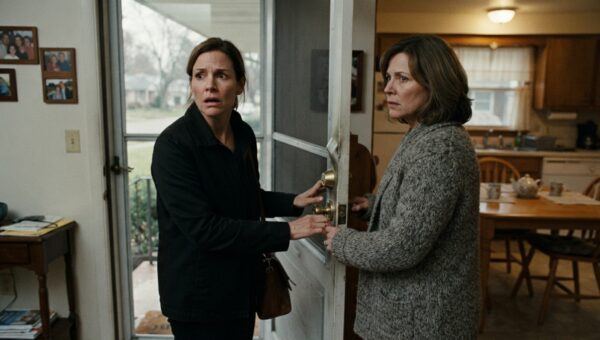
“Tell him what you did to his real son!” she screamed, her voice tearing through the quiet room like a jagged saw blade.
The silence that followed was heavier than anything I had felt since the day we buried our baby.
Leo dropped his fork. It clattered against the table leg and rolled under the sideboard.
“What did you say?” I whispered, my chest tightening up until I couldn’t draw a clean breath.
Martha was shaking from head to foot, tears finally spilling over her eyelids as she pointed a trembling finger straight at Leo’s face.
“He’s not a stranger,” she sobbed, her voice breaking into a ragged cry. “Fifteen years ago… when Barry was sick… I couldn’t bear the thought of empty arms. There was another baby. Born the same night down in Madison. A twin.”
The room tilted sideways. I grabbed the edge of the mahogany table to keep from falling out of my chair.
“What are you talking about?” I managed to get out, my throat burning like I’d swallowed hot coals.
Martha rushed to the sideboard, unlocked the bottom drawer with a key she kept on her charm bracelet, and pulled out a heavy, yellowed manila envelope that had been hidden behind our marriage certificate all these years.
She threw it across the table. It slid right past Leo’s water glass and stopped against my bread plate.
“I arranged it through a private clinic,” she cried, covering her face with her hands. “When our baby passed away in the crib, I already knew. I knew there was a brother left behind in the foster system because the birth mother couldn’t keep both. I was drowning in grief, Arthur. I kept the records hidden so you would never go looking for what I broke.”
Leo sat there like he had been struck by lightning, staring at the papers scattered across the linen tablecloth.
I pulled the top document toward me, my fingers shaking so badly I could barely unfold the certified birth records stamped by the state of Wisconsin.
There were two names written in faded blue ink on the adoption transfer sheet.
Barry James Miller. And Leo James Miller.
Identical twins, separated by fifty miles of highway and a desperate lie that lasted a decade and a half.
Nobody said a word for a long minute, and honestly, that felt worse than the shouting.
Leo slowly reached out, his hand steady even though his lower lip was trembling, and picked up the adoption decree with his real birth name typed right there at the top.
“You knew?” Leo looked up at me, his eyes wide and dark with a mix of fury and raw, open confusion. “You knew I was looking for work down at your store?”
“I didn’t know a blessed thing, son,” I said, my voice cracking right down the middle as I reached across the table and caught his wrist. “I swear to God in heaven, I didn’t know.”
Leo pulled back for a second, his jaw clenched tight, looking like he wanted to run straight out the front door into the rain.
Then he looked at Martha, who was huddled against the corner of the china cabinet, crying harder than I had ever seen her cry in thirty years of marriage.
The anger drained right out of his face, leaving behind that same tired, hollow look I had seen in the mirror every morning since our world stopped turning fifteen years ago.
“You hired me because I looked like him,” Leo whispered, looking down at the photograph still clipped to his original employment application.
“I hired you because I couldn’t help it,” I told him, my voice barely a rasp. “Something in my bones knew.”
We didn’t finish the pot roast.
Later that night, long after the rain had stopped drumming against the kitchen window, the three of us were still sitting around that same wooden table.
The old framed photograph of little Barry was resting right beside a fresh snapshot Leo had pulled out of his wallet, showing the two of us standing together by the lumber racks outside the hardware store.
Martha didn’t say another word about the past, and I didn’t ask any more questions about how she survived the dark years when the house was empty.
Some things don’t get fixed with a clean apology or a neat ending.
Some things just stay broken until you find a way to live around the jagged edges, together, in the quiet light of the kitchen.