PART 1
The dinner was supposed to be a peaceful Sunday evening. It had been fourteen months since I buried my husband, Arthur, and my daughter, Clara, had spent half of that time worrying that I was spending too many hours alone in our four-bedroom house out by the lake. When I met Harold at the county botanical gardens three months back, it felt like an easy grace.
He was seventy-one, quiet, walked with a slight limp, and always remembered that I took my black tea with a thin slice of lemon. He lived in a rented brick bungalow two towns over and spent his afternoons volunteering at the local library, repairing torn book spines.
Clara was the one who insisted on having him over. She wanted to see who was taking her mother out for Sunday drives. Her son, Toby, who was seventeen and obsessed with scanning old family albums for a local history project at school, sat across from Harold at the dining table.
Everything seemed ordinary until Toby set his water glass down and just stared across the table. He did not touch his pot roast for ten minutes.
“Why do you call him Mr. Bell?” Toby asked suddenly.
The dining room went completely silent. Harold’s fork slipped from his fingers, clattering against the edge of his porcelain plate before hitting the lace tablecloth with a muffled thud. A small smudge of brown gravy soaked into the fabric.
I looked at Harold, surprised. “Mr. Bell? Honey, his name is Harold Vance. What are you talking about?”
Harold did not answer. He bent over slightly, picking up his fork with fingers that trembled so visibly that he had to brace his wrist against the wood.
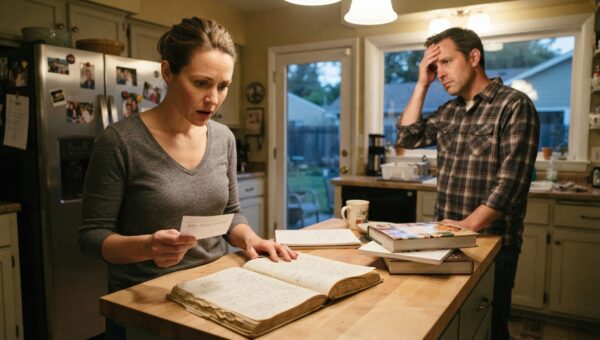
Toby did not blink. He reached down beside his chair, unzipped his canvas backpack, and brought out an old, stiff cardboard sleeve. He slid a glossy black-and-white photograph across the tablecloth.
It stopped right beside my salad plate.
I stared down at it. It showed two men standing in the harsh afternoon sunlight on the steps of the municipal courthouse downtown. The date stamped along the white lower border was October 14, 1987. One of the men was Arthur, twenty-six pounds lighter than when he died, wearing his gray woolen overcoat. Beside him, with an arm slung around Arthur’s shoulder, stood a younger version of the man sitting right across from me.
He had dark hair then, but the crooked bridge of his nose and the distinct squint in his left eye were unmistakable.
I flipped the photograph over with cold fingertips. In Arthur’s heavy, deliberate handwriting, penned in faded blue ballpoint ink, were seven words:
*Do not let him near the family.*
My breath caught in my throat. I looked up at Harold. “Harold? What is this?”
Before Clara or I could say another word, Harold leaned across the table, his hand shooting forward to grab the photo. His knuckles turned bone-white as his fingers dug into the paper.
He looked right into Toby’s eyes, his voice cracked and hollow. “Your grandfather promised he would never tell you.”
Clara stood up so fast her dining chair screeched against the hardwood floor. “Promise who? Why would my father promise that, and why on earth have you been going by a fake name for thirty-six years?”
PART 2
Harold didn’t pull his hand back from the photograph, but he stopped trying to yank it away from the table. The silence in the room felt heavy, suffocating every scrap of warmth left from dinner.
“Arthur wrote that because he was terrified,” Harold said quietly. His voice was barely above a whisper. “He was terrified of what would happen if anyone ever found out what we did on that courthouse step.”
“What you did?” Clara’s voice shook with rage. She stepped around the table, placing herself between Harold and her son. “My father was a county surveyor for thirty years. He never had a record. He never cheated anyone. You walked into my mother’s life claiming to be an old widower from New Market, and now you’re sitting in his chair telling us he made backroom promises with a man he warned us against?”
Harold looked at me, his eyes pleading. “Martha, listen to me. My real name is Harold Bell. In 1987, Arthur and I were partners in an independent land assessment firm. We were hired by the county prior to the state reservoir expansion.”
The memory hit me like ice water. In the autumn of 1987, Arthur had spent weeks sleeping on the couch, waking up drenched in cold sweat, muttering about boundary markers and municipal liens. We had just put a down payment on this very house. Then, abruptly in November, Arthur announced he was leaving private partnership forever to take a salaried county desk job. He had told me his partner moved west after a bad investment.
“You didn’t move west,” I said, my voice shaking.
“No,” Harold whispered. “I went to prison.”
Clara gasped. Toby reached out and pulled the photograph back toward his chest, holding it flat against his ribs.
“The county board discovered that six commercial parcels along the proposed river basin had been forged into agricultural deeds to drive down the acquisition price for private developers,” Harold explained, staring down at his plate. “Arthur brought the records home first. He altered three of the survey ledgers at our kitchen table while you were asleep upstairs, Martha. When the state auditors showed up, Arthur had a mortgage, two toddlers, and an elderly mother in assisted living. I had no family. I was twenty-eight years old, reckless, and I owed money to people who didn’t take checks.”
Harold swallowed hard, his Adam’s apple bobbing. “Arthur came to me on the steps of that courthouse forty-eight hours before the grand jury convened. He begged me. He said if he went down, his family would lose the roof over their heads. He offered to wire forty thousand dollars from his father’s estate into a blind trust for me, provided I took full responsibility for the doctored survey maps and entered an immediate guilty plea under my name.”
“That is a lie,” Clara shouted. “My father would never bribe someone to take a criminal sentence for him!”
“Check the county clerk archives for October 1987,” Harold said, looking steadily at Clara. “State versus Harold Bell. Case number 87-CR-4412. I served three years at Marion Correctional. When I came home in 1990, the money Arthur promised was gone. He had closed the account, taken the county supervisor role, and left a cashier’s check for five thousand dollars in my lawyer’s drop box with a note saying that if I ever spoke his name or approached his family, he would file a secondary fraud report with the state licensing board using the backup field journals he still kept locked in his safe.”
PART 3
I sat there, my hands resting limp on the linen cloth. For thirty-five years, Arthur had kept a heavy, fireproof safe in the floor of the utility closet behind the water heater. He had told me it only held old tax filings and title deeds for our burial plots. Whenever I asked for the combination, he would laugh gently, kiss my forehead, and tell me not to worry my head over old paperwork.
“Toby,” I said softly, the room tilting around me. “Go into the utility room. Arthur’s key ring is hanging on the peg behind the laundry door. The small brass key with the square head opens the inner lock on the floor safe.”
“Mom, don’t indulge this criminal,” Clara cried out. “He’s making up a smear campaign to save his skin!”
“Get the box, Toby,” I repeated, firmer this time.
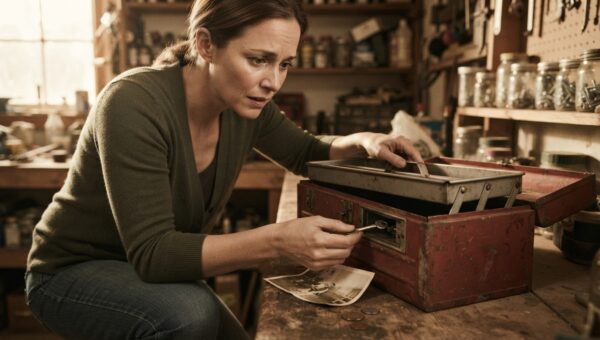
Toby didn’t hesitate. He ran down the hallway, his socks slipping on the boards. We sat in total silence for four minutes until he returned, carrying a rusted metal filing tin, its lid heavy and scratched. He set it down right in front of me.
My hands shook so hard the brass key rattled against the lock before catching. The latch popped open with a dry metallic click.
Inside lay three thick, leather-bound surveyor’s notebooks with Arthur’s initials embossed in gold on the spines. Tucked beneath them was a yellowed carbon copy of a bank withdrawal slip dated October 12, 1987, showing forty thousand dollars transferred from Arthur’s personal account to an escrow ledger under the name *Bell Holdings*. Right beneath the withdrawal slip was an unopened legal letter from Harold’s original defense attorney, dated March 1991, pleading for the remaining balance so Harold could pay his medical bills after being released.
Across the front of that envelope, Arthur had scrawled in red grease pencil: *Ignored. Never contact again.*
The room seemed to lose all its air. Clara stared at the grease-pencil writing. She knew her father’s handwriting as well as I did. He had written her college tuition checks with that exact same hand.
“Why now, Harold?” I asked, looking him dead in the eye, tears burning my cheeks. “Arthur has been dead for over a year. Did you track me down at the gardens to extort me? Did you come here for the thirty-five thousand dollars he stole from you?”
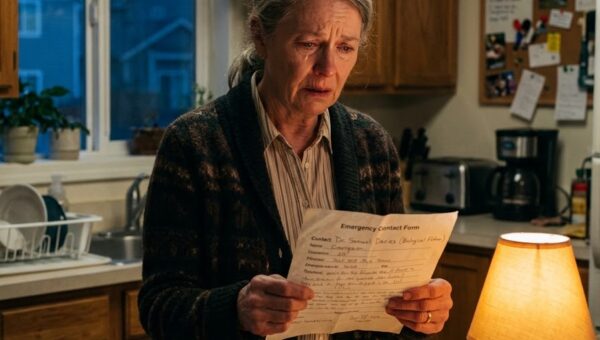
Harold shook his head slowly. He pulled a worn leather wallet from his jacket and took out a folded piece of white paper. He laid it gently on the table.
It was an obituary clipping from the local paper, dated fourteen months ago.
“I didn’t know Arthur was dead until I read this at the library,” Harold said, his eyes rimmed with red. “For thirty years, I worked odd jobs under my mother’s maiden name, Vance, because no engineering firm would ever hire a convicted felon named Harold Bell. I never married. I never owned a home. I spent half my life hating your husband with every fiber of my being. When I saw that he died peacefully in his bed surrounded by his grandchildren, I drove out here intending to confront you. I wanted to show you the documents, tell you what kind of man you lived with, and demand what was left of that money.”
He stopped, his voice catching. “Then I saw you at the botanical gardens. You were sitting by the perennial beds, holding Arthur’s old woolen scarf against your face, crying so hard your shoulders were shaking. You looked just as ruined by grief as I was by prison. I didn’t see an accomplice, Martha. I just saw an innocent woman who had loved a ghost.”
ENDING
Harold stood up slowly, smoothing the wrinkles from his trousers. He did not ask for money. He did not ask for pity.
“I stayed because you were kind to me, Martha,” he said softly, looking down at his worn dress shoes. “For three months, you talked to me like I was a decent human being, not an ex-con with an erased life. That was the only peace I had felt since 1987. But your grandson is right. Harold Bell had no right to sit at Arthur’s table under another man’s name.”
He turned and walked toward the front entryway. None of us moved to stop him. The heavy oak front door clicked shut, followed by the faint sound of his sedan starting in the gravel driveway and fading down the road.
Clara sat down beside me and wrapped her arms around my shoulders, sobbing quietly into my neck. Toby slowly gathered Arthur’s field journals, placing them back into the metal tin and sliding the lock shut.
The next morning, I drove down to the county clerk’s office myself. I spent three hours in the records basement with a young clerk who pulled the microfilm for October 1987. Every word Harold spoke was there in black and white. The court transcript showed Harold entering his guilty plea alone, without a character witness, while Arthur sat in the gallery, listed merely as an observer for the municipal survey board.
I took five thousand dollars out of my personal savings account, along with the original surveyor journals and the 1987 courthouse photograph. I hired a private attorney to review the records and draft a formal statement documenting Arthur’s handwriting and the financial ledger. We sent the entire parcel to Harold’s bungalow address with a certified bank draft for the full balance Arthur had withheld thirty-six years ago, adjusted for the three decades he was forced to live in the dark.
Inside the package, I wrote him a short note:
*Arthur built our life on your silence. I will not spend the rest of mine living on stolen peace. You do not need to hide behind Vance anymore, Mr. Bell.*
Two weeks later, the signature card for the certified mail arrived back in my mailbox. I haven’t seen Harold at the gardens since, and I don’t expect he will ever return. But every Sunday evening when Clara and Toby come over for dinner, the front hallway feels a little lighter, stripped clean of the lie that held up our roof for half a lifetime.