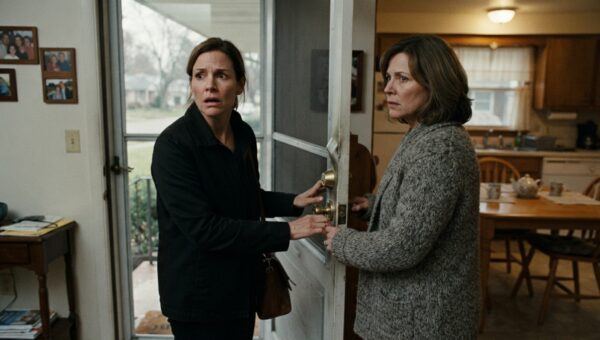
The broom handle hit the high shelf with a sharp clack that made the whole pantry frame rattle. Dust came down first, gray and dry after nearly a year of being ignored, followed by a light thud against the kitchen tile.
I didn’t bend down right away. My hip was giving me trouble, that dull ache that always acted up when the damp air rolled off the ridge, and I just stood there leaning on the broom like an old fool.
The little bluebird lay in two pieces right by the toe of my house shoe. It was cheap hollow ceramic with a painted glaze that had already started chipping when Walt handed it to me in a greasy brown paper bag from the dollar store.
“Happy forty, honey,” he had said, setting it right next to my coffee mug while the morning news droned on about some bridge repair down in Kingsport.
I remember staring at the thing. I had spent eight months hiding twenty-dollar bills inside an old Crisco tin in the back of the pantry, saving every penny I could scrape together from selling extra jars of canned peach preserves and mending clothes for the church ladies, just so I could pay cash for that big leather recliner with the lumbar support. His spine had been giving out on him for three years, every step a slow grumble down the hallway, and I wanted him to have something that didn’t make him groan when he sat down to watch the evening weather.
All Walt gave me was a two-dollar bird.
I had been dropping broad hints about a ring for months, pointing out the jewelers’ window when we went in for his blood pressure pills, wondering if after four decades he might finally surprise me with something that wasn’t a practical kitchen gadget or a new pair of garden shears. When I pulled that shiny blue trinket out of the bag, something in my chest just went cold.
“Thank you, Walt,” I told him, and my voice sounded flat enough to skim milk with.
I walked straight past him into the kitchen, climbed up on the step stool, and pushed the little bird all the way to the back of the top shelf behind the canning jars where I wouldn’t have to look at its stupid painted eyes.
Three weeks later, his heart gave out in his sleep.
Sixty-two years old, and I woke up next to a man who was already gone.
One minute he was breathing with that little rattle in his throat he’d had since the pneumonia back in ninety-four, and the next minute the room was just too quiet.
The house stayed that way for eleven months. People brought casseroles until the refrigerator was bulging, and then they stopped coming. My sister Clara called every Tuesday for a while, asking if I wanted her to come over and help go through his winter coats, but I kept telling her I wasn’t ready yet. I couldn’t bring myself to touch his boots by the back door, let alone the tools in the garage.
The bird stayed up on that shelf through the whole bitter winter. Every time I reached for a jar of pickled beets, my fingers would brush against the smooth glaze, and a fresh wave of that old petty resentment would flare up in my throat.
“Cheap to the end,” I muttered to myself more than once, staring up at the dark corner.
Which was a lie, and I knew it. Walt wasn’t a cheap man.
He was just a man who didn’t know the first thing about romance, or so I had convinced myself to keep from crying. He grew up on a hardscrabble farm outside of Abingdon where nobody bought anything unless it kept the tractor running or put meat in the skillet.
This morning the sun was coming through the kitchen window sideways, hitting the dust motes in a way that made me feel like I was living in an attic. I told myself the pantry needed clearing out before the spring humidity set in.
That was when the broom handle caught the edge of the shelf.
The bird didn’t just crack. It shattered clean into three jagged pieces across the linoleum, sharp enough to slice right through a thin sock if I wasn’t careful.
I let out a short, frustrated breath and reached down to sweep the mess into the dustpan, but something dark fell out of the hollow belly of the ceramic toy. It wasn’t dust. It was a square of thick dark blue jeweler’s felt, folded over once and held shut with a strip of yellowed masking tape.
My hand stopped inches from the floor.
The paper inside had that heavy linen texture they only used at Miller’s Fine Jewelry down on Broad Street in Kingsport. Mr. Miller had retired five years back, his son taking over the counter, but the name was stamped right there on the corner in faded purple ink.
I peeled the tape off with my thumb, my fingernails clicking against the brittle paper.
There was a layaway receipt dated four days before our anniversary. The balance listed at the bottom wasn’t fifty dollars or a hundred. It was four hundred and eighty-two dollars, paid off in four separate weekly installments of fifty or seventy-five dollars each, the last one stamped paid in full two days before Walt passed.
Attached to the ticket was a small scrap of lined notebook paper torn from the pad we kept by the landline. It had his awkward, heavy-handed penmanship, the letters leaning hard to the right like he was fighting the paper to make them stay straight.
“Found the stone that looks just like your mother’s,” he had written. “Miller says it’ll take four weeks to mount it right. Bird’s just holding your place till our anniversary of the first dance at the VFW hall.”
I sat down hard on the kitchen floor, right there among the gray dust and the sharp little pieces of blue pottery.
My knees hit the cold tile, but I didn’t feel it. The kitchen seemed to tilt sideways for a second, the stove blurring into the refrigerator as my breath caught high in my throat.
“Oh, Walt,” I whispered to the empty room. “Oh, you old fool.”
The date he had written on the bottom of the note was coming up this coming Friday. Exactly one year since we buried him out behind the Methodist church where the ground stayed damp under the cedar trees.
I didn’t sweep up the mess. I left the shards right there on the floor, stood up on trembling legs, and walked out to the truck without even grabbing my purse from the hook by the door.
The drive down to Kingsport took twenty minutes. My hands were shaking so hard on the steering wheel of the old Ford that I had to keep the speed down to forty, watching the white lines blur past while the heater clicked and clattered underneath the dash.
Broad Street hadn’t changed much. The brick buildings still had that sooty look from the old coal trains that used to run through town before I was even old enough to drive. Miller’s Jewelry was still there, the gold lettering on the glass faded to a dull copper where the afternoon sun hit it hardest.
I pushed the door open, the little brass bell above the frame chiming just like it used to when Walt and I went in there to buy my mother’s silver butter knives back in sixty-eight.
A young man with glasses and a clean white shirt looked up from behind the glass counter where he was polishing a tray of gold chains. He had Arthur Miller’s nose, same sharp bridge and slight crook at the tip.
“Morning, ma’am,” he said, polite as could be. “Can I help you find something special today?”
I laid the creased yellow receipt and the scrap of lined paper right on top of the glass case, smoothing the wrinkles out with my palm.
“My name is Martha Vance,” I said, and my voice sounded thin, like dry leaves scraping across a porch. “My husband was Walter Vance. He passed away last spring.”
The young man looked down at the receipt, and I watched his expression shift from polite retail cheer to something much quieter, something heavy and recognizing. He didn’t pick up the paper right away. He just stared at the purple stamp in the corner.
“Mr. Vance,” he murmured. “I remember him. He came in here every Tuesday for a month during his lunch break from the highway department. Back was giving him fits, I could tell. He’d lean right here against this corner case while we looked through the catalog.”
“He didn’t tell me,” I said, and my chin started to wobble in a way I hadn’t done since I was a little girl standing in front of my father after dropping a crate of canning jars. “He bought me a two-dollar ceramic bird from the store down by the highway and I put it on the high shelf and left it there.”
The clerk looked up, his eyes softening behind the thin wire frames. “He told me you had a way of spotting things you liked from three aisles away. He wanted it to be a real surprise. He said you talked about your mother’s ring every time her birthday came around.”
He turned around, unlocked the back wooden cabinet behind him, and pulled out a small black velvet box with the Miller’s logo stamped in silver on the satin lining inside.
“He paid the last twenty dollars in cash,” the young man said softly, setting the box on the counter between us. “Said if anything ever happened to him before he could pick it up, I was to hold it right here until you came for it. He knew you’d find your way here eventually, Mrs. Vance.”
I lifted the lid with one finger.
Inside, resting against the dark cloth, was a sapphire set in white gold with four small diamonds cradled on either side, catching what little light came through the dusty storefront window. It looked exactly like the one my mother had lost down in the well back when we were girls, the blue deep and clear as river water after a rain.
I didn’t cry in the store. I just stood there with my fingers resting against the edge of the velvet box, feeling the shame and the love twist together in my chest until there wasn’t room for anything else.
“Thank you,” I told the boy.
He didn’t charge me another dime. He just handed me a small paper bag with the box inside and told me to take my time walking out to the truck.
When I got back home, the house was just as quiet as I had left it. The gray dust was still settling around the broken pieces of the bluebird on the kitchen floor, but I didn’t reach for the broom just yet.
I went into the bedroom, sat down on the edge of the quilt Walt’s mother had pieced together out of old feed sacks, and slid the ring onto my left ring finger. It fit like it had been measured by someone who had been holding my hand for forty years.
Then I walked into the living room, sat down in the big leather recliner Walt had wanted so badly, and rested my hand on the smooth armrest right where his thumb used to wear the leather shiny. On the side table next to the lamp, sitting right beside the framed photograph of us on our wedding day at the courthouse in Bristol, I set one small, unbroken piece of the bluebird’s wing.