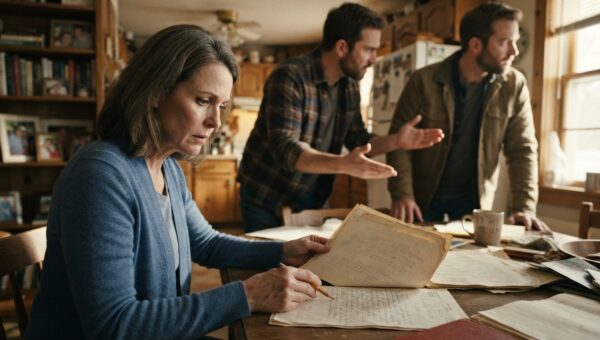
Thirty-four years of marriage is a long time to spend looking at the back of the same head across a kitchen table, learning the exact rhythm of a man’s breathing when he is sleeping, and never once suspecting that the stranger you love is running a second life right under your nose.
It was a Saturday morning in late October. The air had that sharp, dry bite to it that makes you want to pull your flannel tighter around your chest and get the storm windows up before the first real freeze hits the ridge.
Marshall had left early to pick up feed grain at the co-op in town, and I needed to haul three bags of black mulch from the garden shed to the perennial beds before the rain started. His Ford truck was parked right out by the pump house, keys sitting in the ignition just the way he always left them. I climbed up into the cab, smelling that familiar mix of stale chewing tobacco, diesel fumes, and old peppermint lozenges, and shoved the gearshift into neutral so I could roll it down the slope toward the shed.
The glovebox had been swollen shut since the humidity got to the particleboard back in August. I had to plant my heel against the passenger seat and give the handle a hard, angry jerk with both hands. It dropped open with a hollow pop, spilling out a mess of yellowed registration cards, empty gas station receipts, and a crumpled white envelope that didn’t belong there.
When I reached in to scoop everything back up, a small, stiff piece of yellow paper slid out from underneath a crumpled pack of matches. It was a pawn ticket from Miller’s Exchange downtown. Three hundred dollars. The description written in shaky ballpoint pen read plain as day: lady’s platinum diamond solitaire.
I stopped breathing. My hand started shaking so hard I dropped the receipts right back onto the rubber floor mat. That ring had belonged to my mother. I had spent three days crying last November turning the entire house upside down because I thought I dropped it down the bathroom drain while scrubbing grout. Marshall had spent an hour holding my coffee cup, patting my shoulder, and telling me not to beat myself up because things got lost and money wasn’t everything. He had looked right into my eyes with that steady, kind gaze he used whenever the world got heavy.
And then I saw the other thing tucked right behind the ticket.
It was a plastic room keycard sliding out of a paper sleeve stamped with a faded red cardinal. Room 118. The Cardinal Inn, out on Route 9 past the old limestone quarry where nobody from our township ever went unless they were hiding from something.
I didn’t scream. I didn’t throw anything against the windshield. I just sat there in the quiet cab of that truck with the engine off, listening to the radiator ticking as it cooled down, and reached for my cell phone. My fingers felt like ten cold sticks of wood dialing the seven digits printed on the motel sleeve. I told myself I was just checking on a reservation for my sister’s upcoming visit from Dubuque, letting a clumsy lie form in my throat just in case someone picked up.
A woman answered on the second ring, her voice flat and tired like she had been sitting under fluorescent lights for twelve hours straight.
“Cardinal Inn, desk,” she said.
“I need to check a booking,” I said, and my voice sounded like somebody else’s, thin and dry. “My husband reserved a room for next weekend. Marshall Miller.”
There was a short pause on the line, just the sound of a pencil tapping against a laminate counter and the low hum of a television playing in some back office.
“Marshall Miller?” the clerk asked, her tone shifting from bored to something entirely too familiar. “Honey, he doesn’t have a booking for next weekend. Every other Saturday since March, ma’am. Same room. Room 118. He’s usually here with…”
“Thank you,” I cut her off. I didn’t need to hear the rest. The click of the disconnect button sounded like a pistol shot in the small cab.
I sat there in the driveway for a long time, watching a blue jay hop along the cedar fence line. It was funny how the mind works when the floor drops out from under you. You don’t shatter all at once. Instead, your brain just grabs hold of the nearest stupid detail and refuses to let go. I kept thinking about the way Marshall always volunteered to take the truck to the hardware store on alternate Saturdays, always dressed in his clean blue chambray shirt, smelling faintly of that expensive cedarwood soap my sister had given us for Christmas two years ago. I had always thought it was sweet that a man in his late fifties still cared enough to smell nice just to go buy PVC pipes and galvanized nails at Rural King.
I got out of the truck, forgot all about the mulch, and walked back toward the house. The screen door gave its familiar, sagging squeak on the top hinge, a sound we had talked about fixing every spring since the Reagan administration.
Inside, the kitchen was warm and smelled faintly of the sourdough starter I had fed an hour earlier. Everything looked exactly the way it had for ten thousand mornings. The copper kettle on the stove, the blue ceramic crock holding our wooden spoons, the framed photograph of our daughter’s college graduation sitting right beside the napkin holder. Thirty-four years of eggs on Sundays, quiet evenings listening to the weather report, and tending the tomatoes out back. It was all built on a foundation of air.
I didn’t cry. The tears didn’t come because I was too busy calculating. If he had been pawning my mother’s ring last November, what else had vanished while I was down at the co-op or helping out at the church basement?
I walked straight down the narrow hallway to our bedroom, opened the cedar-lined blanket chest at the foot of our bed, and reached under the heavy wool quilts where I kept my old lockbox. The brass key was right where I always left it behind the spare Bible on the top shelf of the closet. My hands were steady now, that cold, hard kind of steady that comes when you realize there’s nothing left to save.
Inside the box, the velvet slots told the rest of the story without needing a single word from him. My grandmother’s gold locket with the tiny hair braid inside? Gone. The sapphire tennis bracelet Marshall gave me for our twentieth anniversary when we didn’t have two nickels to rub together? Gone, replaced by an empty velvet indentation that looked like a little grave. Even my mother’s garnet brooch that I wore to her funeral was missing from its corner.
He hadn’t just been visiting a motel on Route 9 every other Saturday. He had been funding his little life out on the county road by stripping our history out of the bedroom one small piece at a time, betting that I was too scatterbrained, too busy putting up green beans and keeping the books, to notice what was disappearing right out from under my nose.
I locked the metal box, set it back on the dresser, and walked out to the kitchen to wait.
It was almost noon when I heard the low rumble of the Ford turning into the gravel drive. I watched through the gingham kitchen curtains as Marshall cut the engine, climbed out of the cab with that easy, practiced stride of his, and hoisted a brown paper sack from Rural King under one arm. He looked like an honest, hardworking country man coming home to a hot lunch and a faithful wife. He even stopped to check the oil level in the lawnmower before he mounted the back porch steps, whistling some old tune he couldn’t ever quite get right.
The back door opened and he stepped into the mudroom, kicking off his work boots with a practiced thud against the cedar threshold.
“Morning, honey,” he called out, his voice rich and steady as he unbuttoned the cuffs of his shirt. “Traffic down at the co-op was backed up clear to the highway. Took me an hour just to get the seed loaded.”
I was sitting at the oak kitchen table with my hands folded neatly over a small white envelope. I hadn’t turned on the overhead light, and the gray October light coming through the window made the room look like an old black-and-white photograph.
Marshall walked into the kitchen, tossed his keys onto the counter with a cheerful jingle, and stopped dead when he saw me sitting there. The easy smile stayed frozen on his face for half a second before it started to twitch at the corners, dying a slow, ugly death.
“Martha?” he said, his voice dropping an octave. “What’s wrong? You look like you seen a ghost.”
I didn’t raise my voice. I didn’t yell or wave my arms. I just slid the white motel keycard and the creased pawn ticket across the scarred wooden surface of the table until they stopped right next to the salt shaker.
“Room 118,” I said. My voice sounded like gravel being crushed under a heavy tire. “The Cardinal Inn. They remember you there, Marshall. Every other Saturday since March.”
He didn’t move. He didn’t rush forward to explain or fall to his knees. He just stared at that little piece of red-and-white plastic like it was a venomous snake coil on the oak boards. The color drained out of his face so fast it looked like someone had snapped off a light switch behind his eyes.
“Martha, let me…” he started, his hands coming up in that familiar, soothing gesture he used whenever a calf got sick or a tractor broke down in the lower forty. “Let me explain how that… that’s not what you think it is.”
“Every other Saturday,” I said, cutting right through him. “While I was canning tomatoes, while I was sitting up with my sister when her hip went out, while I was keeping the books for this farm. You were out on Route 9 with a girl young enough to be our daughter, paying for your little weekends by selling my mother’s jewelry to Miller’s Exchange.”
“It was just a mistake,” he stammered, taking half a step toward the table before my look stopped him cold. “Things got complicated. You don’t understand the pressure I’ve been under down at the township…”
“Shut up, Marshall,” I said. It was the quietest word I had ever spoken in my life, but it hit the walls of that kitchen like a hammer. “Just shut your mouth.”
I reached down beside my chair and pulled up the heavy canvas duffel bag I had packed twenty minutes ago from his side of the closet, along with his heavy winter coat. I set them right on the floor by the back door.
“You’re not sleeping in this house tonight,” I told him, looking straight into his eyes for the first time in thirty-four years and seeing nothing at all looking back at me. “I called the bank an hour ago. The accounts are frozen, and our lawyer is drawing up the papers for the homestead separation by Monday morning. You can go stay in Room 118 for all I care, but you aren’t spending another minute under my roof.”
He tried to say something else, some pathetic half-formed lie about thirty years and how we could work things through, but his voice cracked right down the middle. He looked small standing there in the middle of our kitchen, smaller than the man who had built our porch and carried our babies across this very threshold. He looked like what he was: a small, cheap thief who had spent his life pretending to be a good man.
When he finally realized there was no performance left that would work on me, he picked up his duffel bag without another word, let the screen door slam behind him for the last time, and climbed back into his truck. I watched from the window as he backed down the long gravel lane, his brake lights flashing red against the gray autumn brush until he turned onto the highway and disappeared.
I didn’t cry then either. I walked over to the kitchen sink, turned on the tap, and rinsed the dirt off my hands. Then I reached into the pocket of my cardigan, pulled out the platinum diamond ring I had fished out from the bottom of my old sewing box after finding the pawn ticket, and slid it back onto my left ring finger where it belonged. The metal was cold against my skin, sharp and real and entirely my own.