PART 1
The survey stake sat less than six feet from the trunk of our oldest honeycrisp tree, its plastic neon ribbon snapping sharply in the November wind blowing off the ridge. I found it on a Tuesday morning while carrying my bucket of feed down to the old henhouse. It was knocked into the frost-hardened soil with a heavy sledge, right on the boundary line where my property meets the municipal right-of-way.
I knew who put it there before I even crouched down to pull the wooden marker out. Nobody else in the township of Oakhaven possessed both the arrogance and the municipal equipment to stake out my orchard without an explanation.
Bradley Ross, my thirty-two-year-old son-in-law, had taken the oath of township supervisor four months ago. He married my youngest daughter, Chloe, six years back, and ever since he won the election on a platform of economic revitalization, he had started walking around our dirt roads like he owned the county clerk’s office and every acre attached to it.
Two hours after pulling the stake, I drove my old Dodge pickup down to the township water authority office where I had spent thirty-four years as senior system engineer before my retirement. The linoleum floors still smelled of the same pine cleaner, and behind the front counter sat Brenda, who had processed my retirement papers three years ago.
“Calvin,” Brenda said, looking up from her stack of billing notices with a sympathetic frown. “You looking for Bradley? He is in the back conference room with some folks from out of town.”
I walked past her desk without knocking and pushed open the frosted glass door. Bradley was leaning over a large topographical map spread across the oak table, pointing a silver pen at a blue line that represented Mill Creek. Two men in expensive wool overcoats stood across from him, sipping coffee from paper cups.
“Bradley,” I said, my voice cutting through whatever deal they were sketching out. “You mind telling me why your road crew jammed an engineer stake six feet inside my orchard this morning?”
Bradley looked up, adjusting his silk tie with a practiced, politician’s smile that did not reach his eyes. He didn’t invite me to sit down. He just leaned back against the edge of the table.
“Calvin, good morning,” Bradley said, pitching his voice so the two men in coats could hear every word. “We were actually going to send you a formal notice this afternoon. The township planning board is moving forward with the headwaters realignment project. We need to widen the drainage easement along your southern boundary to accommodate runoff for the new logistics park going in off Route 44.”
I stood my ground near the doorway, resting my hand on the wooden frame. “That creek has run through my bottomland since before this state was mapped. My late wife Martha’s grandfather cleared those banks by hand in 1912. You cannot just reroute a protected watershed through an apple orchard.”
“Times change, Calvin,” Bradley said, his smile tightening into something cold. “The board voted on the variance last Thursday. And according to our municipal zoning assessment, your property line falls within the condemnation zone for public infrastructure.
We are filing for an eminent domain review next week. You will receive a fair market valuation settlement for the affected acreage of two hundred fourteen thousand five hundred dollars, and the matter will be closed.”
Two hundred fourteen thousand five hundred dollars. That exact number hit me like a splash of cold well water in January. It was roughly a third of what the homestead and the surrounding fifty acres were actually worth on the open market, and it conveniently wiped out my family’s entire historic acreage to make room for a commercial warehouse loading dock.
“You did not notify me of a public hearing, Bradley,” I said quietly. “By town charter, any variance within the historic watershed district requires a sixty-day public notice posted at the town hall and mailed directly to affected landowners.”
Bradley walked around the table, stopping a few feet from me. He lowered his voice, dropping the public relations tone entirely. “Look, Calvin, you are retired. You live out here alone with your trees and your memories. The township needs tax revenue, and the developer has pledged substantial support for the upcoming county commissioner race. You can either take the buyout peacefully, or we can declare your homestead structurally non-compliant due to well-head proximity and condemn the whole parcel. Either way, the creek moves.”
He turned his back on me and walked back to his developers. I did not yell, and I did not slam the door. I simply turned around and walked out of the office, but as the glass door swung shut behind me, the last fifteen years of trusting that local government procedures would protect a citizen’s rights evaporated into thin air.
PART 2 + PART 3 + ENDING
PART 2
The drive back up to the homestead took ten minutes through the gray November slush. I parked the truck by the barn, but I did not go inside the house. Instead, I walked out past the old pump house near the lower pasture.
The pump house had been decommissioned back in 1994 when the township tied our section into the municipal grid, but the heavy iron door had remained locked with a brass padlock ever since. Bradley assumed I was just an old man who would grumble on his porch until the bulldozers arrived. What Bradley did not know, because he never bothered to check the foundational administrative files from the seventies, was that I was the engineer who helped build the original water authority infrastructure, and I kept a lifetime master key ring in my desk drawer.
The brass key slid into the rusted padlock with a dry click. Inside, the small concrete block building smelled of damp earth and old iron. In the corner sat a heavy steel floor safe that Arthur Higgins, the legendary town clerk back in 1978, had bolted into the foundation.
I knelt down, dialed the old three-number combination Arthur had given me when I started working for the water board as a young man, and pulled the heavy steel handle. Inside sat three metal canisters sealed with rubber gaskets to protect against dampness.
I pulled out the middle canister, popped the latch, and tipped out a thick sheaf of parchment papers yellowed at the edges.
Right on top was the original 1978 municipal land covenant and state environmental protection deed restriction, signed by the entire town council of that era and countersigned by the state Department of Environmental Conservation. I spread the document out under the dusty window light. Paragraph three explicitly barred any commercial rezoning, water diversion, or infrastructure encroachment within two miles of the historic watershed district, carrying a permanent non-waivable conservation easement held in trust by the property owners along the creek.
Stapled to the back of the deed was a carbon copy of the town council meeting minutes from November 1978, proving that the land covenant was tied permanently to the deed of my exact homestead parcel, rendering any future municipal rezoning variance legally void from its inception.
I slid the documents into my coat pocket, but as I stood up, a loose sheet of paper fluttered out of the canister and landed on the concrete floor.
It was a printed email printout, apparently left behind in a file folder someone had tossed into the storage box years ago, but it had recent handwritten sticky-note markings on it. No, looking closer at the date at the top, it was not an old printout at all. It was a recent printout from the public server that Bradley had somehow misplaced during his office consolidation last month. It was an unrecorded email thread between Bradley Ross and the executive vice president of the logistics corporation, discussing secret developer escrow deposits routed through a secondary municipal account to fund his campaign war chest.
Bradley had intentionally omitted the 1978 land covenant from the public board docket, hiding the state deed restriction so the planning board would approve a variance they had no legal authority to touch.
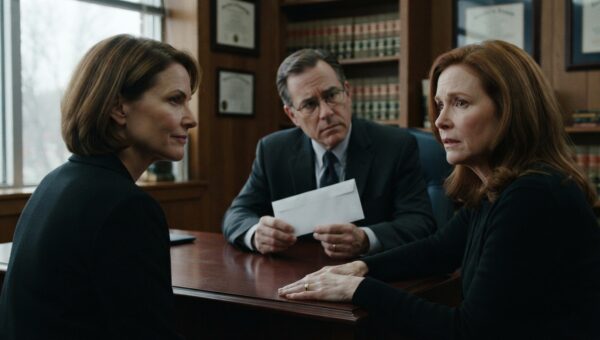
I didn’t call Chloe, and I didn’t drive back down to confront Bradley at his office. Instead, I drove thirty miles south to Kingston and sat across a polished mahogany desk from Sarah Vance, an environmental land-rights attorney whose father had fished with my own dad in these very streams.
Mrs. Vance read through the 1978 deed restriction twice, adjusting her reading glasses, then looked up at me with a slow, sharp smile.
“Calvin,” she said, tapping a fingernail against the state seal. “This covenant is ironclad. The state DEC never revoked this protection. If Bradley’s planning board pushed through a variance overriding this, they didn’t just violate your property rights. They committed official misconduct by knowingly suppressing an active state environmental restriction.”
PART 3
The public zoning council hearing was held on a Thursday evening in the municipal auditorium on Main Street. The room was packed with local business owners, town council members, and three executives from the logistics corporation sitting in the front row. Bradley sat at the center of the elevated dais, wearing his dark blue supervisor suit, looking confident and relaxed as he gaveled the meeting to order.
When public comment was called, I walked down the center aisle carrying a single manila folder. I did not wait to be announced. I stepped up to the podium, placed my folder on the oak shelf, and looked straight up at the dais.
“My name is Calvin Brooks,” I said into the microphone, my voice echoing off the high gymnasium ceiling. “Former senior municipal engineer, and lifelong resident of the Oakhaven watershed district. I am here to formally enter into the public record an emergency injunction filed this afternoon in county superior court, halting the Mill Creek rezoning project.”
Bradley’s gavel hovered mid-air. A flush of dark red crept up his neck, matching the color of his tie. He leaned into his microphone, his voice sharp and dismissive. “Mr. Brooks, the planning board already evaluated the site logistics. Your personal property objections were addressed during the executive review. You are out of order.”
“I am not out of order, Bradley,” I said steadily, opening my manila folder and laying the original 1978 municipal land covenant flat on the podium. “You told the board last week that no prior environmental restrictions existed on this parcel. But according to the original state environmental protection deed restriction signed by the town council on November 14, 1978, any commercial rezoning or water diversion within two miles of this watershed is strictly illegal.”
I held up a certified copy of the state registry filing alongside the deed. “Furthermore, my attorney has submitted copies of this document, along with unrecorded server emails detailing developer escrow deposits routed to your personal campaign accounts, to the state ethics commission and the district attorney’s office.”
The room went dead silent. The three executives in the front row exchanged sharp, panicked glances, whispering furiously among themselves before standing up and walking briskly toward the exit doors.
Bradley gripped the edges of the dais so hard his knuckles turned white. He looked around the room for support, but the other council members were already leaning away from him, staring down at their desk tablets in sudden, intense concentration.
Within seventy-two hours of the hearing, the legal reality caught up with the paperwork. The state environmental protection board formally struck down Bradley’s rezoning variance with prejudice. Faced with an immediate state ethics investigation for official misconduct and conflict of interest, the commercial logistics corporation abruptly canceled the development contract due to title failure and breach of statutory disclosure.
ENDING
The morning sun filtered softly through the branches of the honeycrisp trees as I walked out onto my back porch with a ceramic mug of black coffee.
The survey stake was gone, hauled away by the township maintenance crew early Saturday morning under the watchful eye of a county inspector. The developer’s heavy machinery had been loaded onto flatbed trailers and hauled off the ridge, leaving our quiet gravel road back to the way it had always been.
Chloe had called once, crying softly, trying to explain how stressed Bradley had been about the election and the debts he had accumulated trying to maintain appearances, but I had stopped her gently, telling her that some lines cannot be uncrossed. Bradley was currently facing a formal board review and the quiet collapse of his political ambitions.
I took a slow sip of my coffee, leaning my shoulder against the weathered cedar pillar of the porch that Martha’s father had hewn out of local timber over a century ago. The creek down in the hollow ran clear and steady over the smooth river stones, undisturbed and protected by the quiet strength of the law.
My home was safe, the water was running pure, and my late wife’s legacy remained untouched under the open sky.