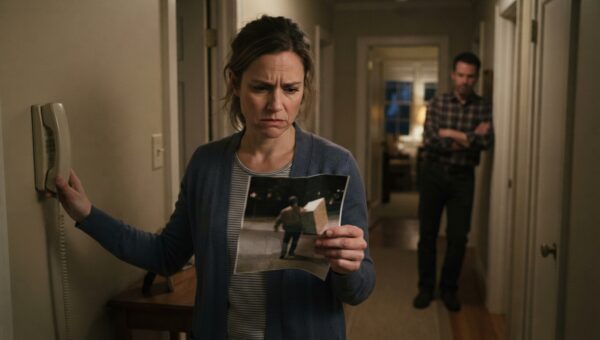
Sixteen years is a long time to keep a lie polished. You tell it enough Sundays after church while the gravel crunches under your tires, and eventually the fiction starts to feel like bone. You tell the ladies in the parish hall that your boy is out west doing well in construction, that he writes letters he is too busy to mail, that his silence is just proof of a busy, prosperous life.
You say it because the alternative is admitting you were a hard-hearted woman who slammed her own front door on a seventeen-year-old kid because your pride mattered more than his survival.
The parish hall always smelled of damp wool and weak coffee on Tuesday mornings. Mildred liked to keep the soup stock thin to stretch the church budget, and my job was standing behind the stainless steel counter with the heavy metal ladle, doling out three scoops to anyone who handed over a yellow ticket. My apron had a grease stain near the pocket from the morning I dropped a jar of pickled beets, and I remember thinking how ordinary everything felt.
The line was moving slow. A man in a faded blue work jacket stepped up to the sneeze guard, holding a little boy who looked about four years old with his face buried right in his father’s collar.
Another little girl, maybe two, had both tiny hands twisted tight into the hem of her dad’s frayed jeans.
I didn’t look at his face right away. You get used to looking at hands in that line, at calloused knuckles and cracked cuticles and the way people hold their breath while they wait to see if you are going to smile or look right through them. I scooped the broth. I reached for the bowl.
Then he cleared his throat, and the sound of it scraped right down my spine like a piece of dry chalk.
I looked up. The metal ladle slipped right out of my fingers and hit the bottom of the stockpot with a loud, hollow clang that echoed off the cinderblock walls.
It was David. He looked older, so much older, with deep lines carved around his eyes and a sharp, gaunt hollow in his cheeks that made his jawline look like broken stone.
His hair was dusted with gray at the temples, though he was only thirty-three. He stood there blinking against the steam rising from the kettle, his shoulders slumped inside a jacket that had seen ten too many winters.
He didn’t run. He didn’t yell. He just met my eyes across that greasy metal counter for the first time since October 2009, and the silence in the room suddenly felt heavier than lead.
“Mom,” he said. His voice cracked right down the middle, thin and dry as autumn leaves. “I just need one thing.”
Those six words didn’t just break my heart. They tore it right out of my chest and left me standing there empty, gasping for air in a room that suddenly felt five sizes too small.
My mind flashed backward, violent and uninvited, to the exact afternoon I became a stranger to my own flesh and blood. It was raining hard enough to drown the porch steps back in 2009.
David had stood right in our entryway, dripping water onto the hardwood floor, holding a frayed canvas duffel bag that belonged to his grandfather. He had that same terrified look in his eyes then, just a boy himself, telling me his girlfriend Sarah was expecting a baby.
I hadn’t offered them a seat. I hadn’t asked how scared they were. I had walked straight to my purse, pulled out two hundred-dollar bills, and dropped them onto the entryway table like grease money.
“If you’re old enough to be a father, you’re old enough to live on your own,” I had told him, my voice cold and righteous enough to freeze water.
He hadn’t argued. He had picked up his duffel bag, turned around, and walked straight out into the freezing rain without looking back. And I had stood behind the lace curtains watching him go, telling myself I was building character, telling myself I was a good Christian mother teaching her son a hard lesson about consequence.
Now, here he was, standing across the soup line with two innocent children clinging to his clothes, having walked through sixteen years of quiet agony while I sat in my Sunday pew and lied to everyone about how well he was doing out west.
“David,” I choked out. My own name for him tasted foreign on my tongue, like something I hadn’t used in a lifetime.
He flinched back half a step, tightening his grip on the little boy in his arms. The toddler stirred, whimpering softly against his chest, and David whispered, “Hush now, Leo. Daddy’s right here.”
He looked down at the empty soup bowls on the counter, and I saw the terrible, crushing weight of a proud man who had finally run out of every other door.
“We don’t need your charity, Mom,” David said, his voice dropping to a rough, desperate gravel. “We had savings. We had a little house in town. But the plant closed down back in November. And then Sarah got sick with pneumonia, and the clinic bills took everything we had left. I wouldn’t be here. I swear to God I wouldn’t be standing in this church basement if my babies had anything in the cupboards this morning.”
He swallowed hard, his Adam’s apple bobbing under his rough skin, and then he said the thing that finally shattered my last remaining piece of pride.
“Just don’t turn my babies away,” he whispered, looking right at me with tears standing bright and unashamed in his red-rimmed eyes. “I know how you are. I know what you think of people who fail. But they didn’t do anything. Please. Just give them a bowl of soup.”
He thought I was going to judge him. He thought I was going to use my ladle and my volunteer badge to slam the door in his face all over again, just like I did when he was seventeen. He had carried that fear with him for sixteen years, walking through grueling manual jobs, marrying Sarah, raising their eldest through high school, and keeping his family afloat through sheer, bloody-minded perseverance, all while believing his own mother considered him garbage.
The room seemed to tilt sideways. Mildred was staring at us from the other end of the counter, her mouth half-open, holding a loaf of sliced white bread frozen in her hands.
I didn’t care about Mildred anymore. I didn’t care about what the church ladies would say at Bible study tomorrow. I didn’t care about the sixteen-year lie I had built brick by brick to protect my own spotless reputation.
I reached out and unlatched the swinging service gate beside the coffee urn. It stuck on the linoleum, and I had to yank it twice with my shaking hands until it squeaked open.
“Get in here,” I said. My voice wasn’t righteous anymore. It was just broken.
David didn’t move. He stood frozen, waiting for the blow.
“I said get in here, David,” I whispered, and I walked around the counter, my knees trembling so hard I thought I might hit the floor.
I didn’t go to him. I went straight to little Leo, who was staring at me with big, frightened eyes that looked exactly like David’s used to look. I reached out, my hands shaking like autumn leaves, and lifted the little boy right out of David’s arms. He was light, far too light, smelling of laundry soap and cold morning air.
“Grandma’s got you,” I told the child, and my voice cracked right down the middle as a tear finally spilled over and ran hot down my cheek.
Little Maya let go of her father’s jeans and grabbed my apron strings instead, looking up at me with solemn, quiet dignity.
I looked past the children at my son. He was staring at me as if he were looking at a ghost, his chest heaving under the worn blue jacket.
“You lied to them, didn’t you?” David asked quietly, the words hanging between us like a physical weight. “At church. You told everyone I was successful. You couldn’t even admit I was living right here in the county.”
I couldn’t look away from him. I couldn’t hide behind my church hat or my volunteer work or my pious excuses.
“I lied because I was a coward, David,” I said, my voice shaking so hard the words barely came out. “I was too proud to admit what I broke. I threw you out into the rain because I cared more about what people thought of me than I cared about my own boy.”
Mildred dropped the loaf of bread. The plastic bag crinkled loud in the quiet basement.
“Martha?” Mildred said, stepping forward. “Is this…”
“This is my son,” I said, turning to face the whole room, lifting my chin even though my face burned with shame. “This is my son David. And these are my grandchildren. And for sixteen years, I told you all a lie because I was ashamed of my own cruelty.”
Nobody said a word. The old coffee urn hissed in the corner, bubbling water against the heating element, and honestly that sound felt louder than thunder.
David let out a long, ragged breath, and the tension that had held his shoulders rigid for the last ten minutes seemed to melt away just a fraction. He reached down and scooped little Maya up into his arm, holding her close against his chest.
“She’s in the county clinic, Mom,” David said, his voice dropping low. “Sarah. They’ve got her on oxygen, but the bills are stacking up so fast I don’t even know how we’re going to pay for the discharge meds next week.”
I reached out and took David’s rough, calloused hand in mine. His skin felt like sandpaper, scarred from heavy labor, entirely different from the soft hands of the men I usually sat with at church socials. Those hands were proof of everything he had survived without me.
“We’re going to the clinic right now,” I told him, wiping my face with the corner of my apron. “We’re going to load up every box of food in this pantry into your trunk, and then we’re going to pay whatever that clinic asks for, and then you’re all coming home with me.”
David stared at me, his eyes swimming with tears he refused to let fall. “We can’t just move into your house, Mom. We have our own place. We just need a little breathing room.”
“We are going to take it one step at a time,” I said, squeezing his rough fingers. “That’s all I’m asking for. Just a chance to start paying back sixteen years of missed dinners.”
An hour later, the trunk of my sedan was packed so full of canned peaches, flour, and dried beans that the back bumper nearly dragged on the gravel as we pulled out of the church lot. Mildred didn’t say goodbye, but she handed me a brown paper bag stuffed with leftover ham sandwiches through the car window and gave my shoulder a quiet, understanding squeeze.
We drove out to the small, drab brick apartment complex on the north side of town where the grass was thin and brown. The hallway smelled of old linoleum and fried cabbage, a stark contrast to the quiet comfort of my own home, but when David unlocked door 4B, it was clean. The small kitchen table was wiped down to the bare wood, and a single green crayon lay beside a coloring book on the floor.
The next few days were a blur of hospital waiting rooms and pharmacy lines. I sat beside Sarah’s metal-framed cot in the county clinic while she slept fitfully against the pillows, her chest rattling with every breath. When the head nurse brought in the bill for her oxygen tanks and prescriptions, I didn’t hesitate. I pulled out my checkbook and wrote the numbers right there on the little laminate counter without looking at the balance, feeling every single dollar as a small down payment on my own redemption.
By Saturday afternoon, the sun had finally broken through the gray autumn clouds, casting a weak, golden light across the linoleum floor in David’s kitchen. Sarah was resting in the bedroom down the hall, her breathing steady and deep for the first time in a week.
I sat at the small wooden table, watching little Maya carefully try to button up her brand-new yellow cardigan that was a little too big in the sleeves. My fingers were stiff, but I reached out, took the small plastic button between my thumb and forefinger, and worked it slowly through the fabric loop.
David walked out from the kitchen counter carrying a steaming mug of tea, the ceramic cup warming his palms. He set it down gently on the worn wood right in front of me, the steam curling up into the quiet air between us.
“Careful,” David said softly, pulling out the chair opposite mine and sitting down with a quiet sigh. “It’s hot.”
I wrapped my hands around the warm mug, feeling the heat soak straight through my skin into my bones, and for the first time in sixteen years, I didn’t feel the need to say a single word to fill the silence.