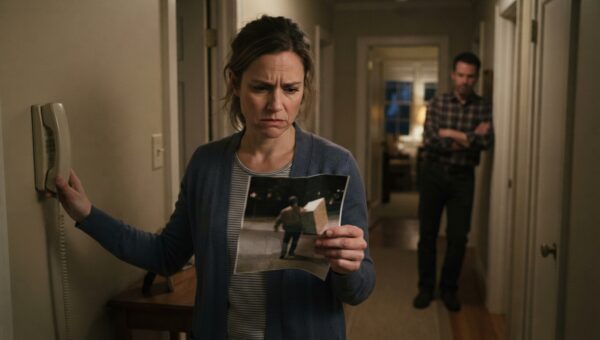
Fourteen months. That is four hundred and twenty-six days of thinking my mother was simply too tired, too confused, or too fragile to receive visitors. I spent every single one of those weeks blaming myself, wondering if my thirty years in clinical nursing had somehow made me cold, or if I had missed some subtle sign when her memory first started slipping.
I drove forty minutes past the county line every Sunday morning, sat in my sedan in the gravel lot of Oakridge Manor, and turned the engine off when my phone would not ring with a call from her room.
The front desk clerk at Oakridge didn’t even look up from her computer screen when I walked in that morning. She had short, bleached blonde hair and wore a lanyard covered in plastic smiley faces that felt entirely wrong for a nursing home lobby. I gave her my name, smiling the way I always did, waiting for her to check me off the visitor list so I could take the elevator to the second floor and bring Mama her favorite peppermint lozenges.
“You’re not on the approved list,” she said, her fingers still clicking away on the keyboard like she was typing out an inventory report for office supplies.
“There must be some mistake,” I told her, leaning slightly over the high wooden counter. “I’m Evelyn’s eldest daughter. I come here every week.”
She finally stopped typing and turned the laminated monitor toward me with a tired sigh that signaled I was just another annoying routine interruption. “Janet’s listed as sole guardian. Only immediate family cleared by her can enter past the lobby.”
My sister Janet. Since when? Since fourteen months ago, according to the system notes. Fourteen months my mother had been sitting in that building without me walking through the door, believing I had abandoned her to focus on my own life. I stood there because my brain kind of stopped working for a second, the harsh fluorescent lights overhead buzzing quietly against the drop ceiling.
The glass front doors swung open behind me, letting in a sharp gust of November wind that smelled of dead oak leaves and wet asphalt. A hand tapped my shoulder gently, and I turned to find Nurse Beth standing there in her navy blue scrubs with her fleece jacket zipped halfway up.
I trained Beth twenty years down at St. Jude’s when she was just a nervous twenty-two-year-old trying to figure out how to start an IV without bruising the patient. Now she had silver streaks in her hair and worry lines around her mouth that looked too deep for her age.
“Step outside with me for a second, Martha,” Beth whispered, glancing nervously back toward the front desk.
We walked out onto the cold concrete porch where the wind cut right through my sweater. Beth reached into the deep pocket of her fleece and pulled out a folded sheaf of white paper, handing it to me without a word. It was a photocopy of the internal facility visitor log for the past fourteen months, along with a yellowed administrative restriction form bearing Janet’s sharp, sloping signature. There was no court order attached, no judge’s signature, and no probate stamp in the corner.
Just a blank reason line filled out in Janet’s handwriting that read family conflict, guardian’s discretion.
I stared down at the paper as my hands began to shake against the cold. Beth looked away toward the parking lot, her voice dropping to a low, steady murmur. “Your mother asked for me by name every Sunday for fourteen months. Every single one. She thought you were angry with her, Martha. She sat by that window every Sunday afternoon waiting for your car.”
Nobody said anything for a second and honestly that felt worse than shouting. All those Sundays I sat in the parking lot for ten minutes before driving home, assuming my absence was giving her peace, while inside that brick building Mama was sitting by the glass wondering why her oldest daughter had dropped out of her life. Janet had exploited every bit of administrative complacency in the building, convincing the intake staff that I was an overworked nurse who had voluntarily stepped back from caregiving duties to avoid emotional strain.
“She doesn’t even have legal guardianship,” I said, my voice sounding thin even to my own ears. “This is just an intake preference sheet.”
“The front desk doesn’t check probate files unless someone kicks up a fuss,” Beth replied, squeezing my arm briefly before turning back toward the automatic doors. “Go talk to Vance. He’s in the administrative office down the hall. Don’t let them brush you off this time.”
I didn’t go home. I sat in my car for twenty minutes with the engine running and the heater blowing lukewarm air across my knees, staring at the parking lot log where the night nurses had scrawled my mother’s name week after week with little notes beside them. Asking for Martha again today. Told her traffic was bad. Told her you’d try next week. Janet had engineered a quiet, invisible prison using nothing more than a clipboard and a facility receptionist who didn’t want to deal with paperwork.
Three days later, I was back in the building with a thick manila folder tucked under my arm containing certified copies of our mother’s actual medical power of attorney documents, state long-term care ombudsman regulations, and the exact statute numbers highlighting unlawful visitor suppression in assisted living facilities. Director Vance looked up from his cluttered desk with the practiced, weary expression of a man who spent his entire work week mediating family squabbles over laundry and missing sweaters.
“Mrs. Holloway, I understand you’re upset,” Vance said, folding his hands over a half-eaten tuna sandwich on a paper plate. “But your sister filed the proper intake paperwork when Mrs. Vance, excuse me, when your mother was admitted fourteen months ago. We have to respect family boundaries.”
“You have an administrative restriction form signed by a sibling with zero judicial oversight,” I said, dropping my folder onto his desk with a sharp slap that made him blink. “That isn’t a boundary, Mr. Vance. That’s a liability. Look at the signature block. There is no probate court seal, no docket number, and no judge’s order. Under state health code section twelve, an assisted living facility cannot bar an immediate family member without a protective injunction from a judge.”
Vance adjusted his wire-rimmed glasses and pulled the papers toward himself, his eyes scanning the first page slowly before stopping at the empty jurisdiction line. He didn’t say anything for a long moment, his thumb tracing the edge of his paper plate. Before he could answer, the door behind me pushed open and Janet walked into the office, her heavy wool coat swinging open to reveal her purse clutched tightly against her chest like a shield.
“What is she doing here?” Janet demanded, her voice sharp enough to rattle the cheap picture frames on the wall. “You told me this woman was barred from the premises.”
Vance looked up at her with a distinctly different expression now, one of bureaucratic self-preservation. “Mrs. Miller, it appears there was an oversight in the intake documentation from fourteen months ago. Without a formal court-ordered guardianship, our internal restriction policy doesn’t hold legal weight against an immediate family member requesting access.”
Janet turned her fury on me, stepping close enough that I could smell her familiar lavender perfume, the same scent she wore every Thanksgiving while she quietly took over every decision about Mama’s life. “You have no right to come in here and stir things up. Mama is fragile. You’ll only confuse her with your work schedule.”
“She asked for me by name for fifty-six Sundays straight, Janet,” I said, my voice dropping into the quiet, flat register I used when I had to tell a patient’s family the worst news imaginable. “Every single Sunday. I saw the logs.”
Janet’s face didn’t go pale, but her jaw tightened until the skin around her mouth went hard and white. “She doesn’t know what she’s saying half the time. You weren’t here. I was the one handling the doctors, the bills, the room changes, while you were busy with your hospital shifts.”
“You wanted control of her pension and her apartment sale,” I said plainly. “You didn’t want anyone checking your math.”
“That is a lie,” Janet snapped, looking toward Vance for backup. “Mr. Vance, tell her she has to leave right now.”
“The restriction is rescinded, Mrs. Miller,” Vance said quietly, standing up from his desk and closing my folder with a definitive thud. “Effective immediately. Your sister’s visitor privileges are restored, and we will be auditing our intake files this afternoon.”
Janet stared at him for three seconds, realized she had lost her administrative leverage, and turned on her heel, storming out of the office without another word. The heavy oak door clicked shut behind her, leaving a silence in the room that felt heavier than all fourteen months combined.
I didn’t wait for Vance to offer an escort. I walked out of the administrative office, bypassed the front desk where the blonde receptionist looked down quickly at her screen, and took the elevator up to the second floor. The hallway smelled of floor wax and stale instant coffee, the same neutral scent every care facility shared, but as I reached room 214, my heart beat against my ribs like a trapped bird.
I pushed the door open without knocking. Mama was sitting in her floral armchair by the window, her hands resting in her lap over a folded pastel blanket, staring out at the parking lot where the cars moved by like distant toys. She looked older, her hair thinner and whiter than I remembered, but when she turned her head and saw me standing in the doorway, her eyes didn’t hesitate for a single second.
“Martha?” she whispered, her voice cracking slightly as she gripped the armrests of her chair to push herself up.
I crossed the room in two long steps, dropping my bag onto the floor, and knelt down right beside her chair, burying my face against her shoulder while she wrapped her thin, trembling arms around my neck.
“I’m right here, Mama,” I told her, my voice breaking as the tears finally came hot and fast down my cheeks. “I’m right here. I’m not going anywhere.”
We sat together in that quiet room for a long time as the autumn sun dipped lower behind the treeline, casting long amber shadows across the linoleum floor. The visitor log stayed at the bottom of my bag, forgotten and irrelevant, while outside the window the Sunday evening traffic hummed quietly along the highway, carrying the rest of the world past a window that would never be closed against me again.