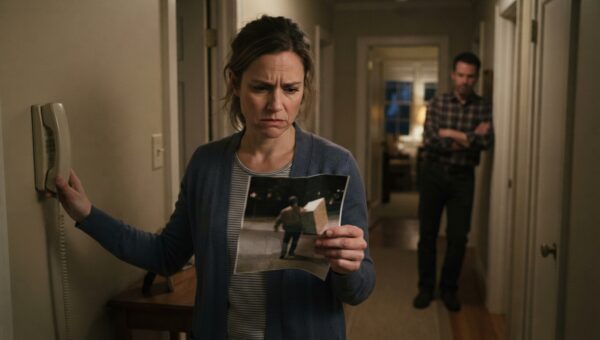
“How do I get in? Where are you?”
That was the exact string of words Evelyn shrieked through my phone speaker at 9:42 on a Tuesday morning while I was sitting out on our back porch with a lukewarm cup of chicory coffee. I did not answer right away. I pulled the phone away from my ear, pressed the little red mute button on the screen, and let out a laugh that had been building up inside my ribs for about six solid years.
My husband Mark was standing right beside the patio table, leaning his hip against the wrought-iron railing with a gray ceramic mug in his hand. He took a slow sip, watching my shoulders shake with silent amusement, and then raised his eyebrows just a fraction.
“Is she at the main boulevard gate yet?” Mark asked, his voice entirely too calm for a man whose mother was currently losing her mind two hundred yards away.
I unmuted the call just in time to hear Evelyn banging a heavy silver ring against the commercial-grade glass of the front double doors. “Claire! Pick up the phone right this second! The doors are locked, the keypad is rejecting my code, and there is a man in a gray suit sitting at a reception desk eating a turkey sandwich who just told me I don’t belong here!”
I cleared my throat, pasting on the most helpful, innocent tone I could manage. “Well, Evelyn, you’re at the front grand estate on Elmwood Avenue. That’s the commercial lease side. We live around the back.”
“Around the back?” Her voice reached a pitch that could have cleared the robins out of our apple trees. “What do you mean, around the back? I sold my entire house on Cedar Street for thirty-two thousand dollars under asking just so I could get here before the moving truck unloaded! Open this door right now!”
The truth was simple, beautiful, and entirely of her own making. For six years, ever since Mark and I got married in a small Methodist church down in Sevier County, Evelyn had treated our marital privacy like a shared community garden. She had a duplicate key to our old suburban townhouse, which she used mostly to rearrange my spice rack by alphabetical order and critique the way I folded bath towels. Whenever Mark tried to gently hint that we needed a little breathing room, she would wave her hand dismissively and say, “Don’t worry, children.
The moment you buy that big forever home you keep talking about, I’ll sell my place, move right into the master suite, and manage the household so you two don’t have to stress.”
She said it so often it started to feel like a weather pattern. You couldn’t stop it; you just had to buy an umbrella and wait for it to pass.
Except Mark got tired of getting wet. And honestly, so did I.
Three months before that phone call, Mark and I drove out to look at the old Davenport Manor. It was a sprawling, historic property with an imposing brick colonial main building sitting right on the main thoroughfare, backed by two acres of old-growth oak trees and, tucked discreetly behind a tall brick wall and a heavy wrought-iron sliding gate on a quiet parallel dirt lane, a newly renovated, sun-drenched two-bedroom carriage house.
The real estate listing called it a rare live-work investment opportunity. Mark called it an answer to a prayer.
“If we buy the whole parcel,” Mark had whispered to me while we stood on the gravel driveway behind the main house, listening to the hum of traffic fade away entirely, “we can register the main manor address as the commercial front. We can lease the whole front building to an architectural firm or a design agency. And we live out here in the carriage house.”
“And your mother?” I had asked, leaning against the fender of our Subaru.
Mark had smiled a slow, wicked smile that I hadn’t seen since we were dating in college. “My mother thinks every luxury house we talk about is just one big open-plan ranch waiting for her to conquer. Let her think it.”
We closed on the property on a rainy Friday in March. We immediately signed a five-year commercial lease on the main manor house with a reputable local graphic design company owned by a quiet man named Arthur who loved antique moldings and didn’t mind a separate entrance. Then, Mark and I quietly moved our bed, our books, and our coffee maker into the carriage house at the back, installing a heavy-duty security gate on the rear lane that didn’t even have a buzzer connected to the front street.
We knew Evelyn would bite the hook the second she heard the words luxury estate. We didn’t even have to push her.
“I found a buyer for Cedar Street,” Evelyn had announced over Sunday pot roast two months prior, her chin lifted with that familiar martyr-like pride she wore like a Sunday hat. “Cash offer. Closing in thirty days. I told them I needed to clear out the attic fast because my son and his wife just bought that massive place on Elmwood, and I’m needed to supervise the landscaping.”
Mark had just nodded, cutting his roast beef with agonizing slowness. “That’s quite a move, Mom. Make sure you read the closing documents carefully.”
“Oh, don’t you worry about my paperwork,” she had snapped back. “I know how the world works. I’ll have my bags packed by the first of the month.”
And she did. She packed every single knickknack, every framed portrait of Mark winning a high school track ribbon, and every heavy velvet armchair she owned into a massive orange moving van, pointing the driver straight toward the grand stone pillars of Elmwood Avenue while Mark and I sat two hundred yards away behind a wall of mature boxwood hedges, drinking our coffee in peace.
Which brings us back to the front door, where Evelyn was currently pounding her fist against reinforced commercial glass while Arthur the graphic designer politely ignored her from behind his reception desk.
“Mark!” she screamed into the phone, having switched targets when she realized I wasn’t going to roll over. “Get your father, well, get yourself down here right this instant! There are strange men in suits walking around my sunroom!”
“Mom,” Mark said, taking the phone from my hand with a quiet sigh. “That’s not a sunroom. That’s a conference room. And you don’t live here.”
“What are you talking about? I sold my house! I have the cashier’s check sitting right here in my pocketbook!”
“That was your choice,” Mark said, his voice dropping into that low, flat register that meant the conversation was officially over before it started. “We told you we were buying a home. We never invited you to move in. Walk around to the back lane, Evelyn. We’ll meet you at the gate.”
Fifteen minutes later, the moving truck had to awkwardly back out of the narrow commercial driveway, blocking three lanes of Elmwood traffic while the driver muttered colorful phrases under his breath. Evelyn marched down the sidewalk on foot, her sensible walking shoes clicking furiously against the concrete, her face flushed the exact color of a ripe plum.
She stopped at the wrought-iron gate of our carriage house lane, glaring through the black bars at us as if we were zoo animals who had forgotten how to behave.
“Open this gate,” she demanded, her hands planted firmly on her hips.
Mark didn’t reach for the remote. He just walked slowly down the gravel path until he was standing a few feet from the iron bars, looking out at her with a steady, tired patience. I stayed a few paces back near the porch steps, my arms crossed over my light linen cardigan.
“We told you years ago, Mom, and we told you again last month,” Mark said, his tone entirely level. “We love you, but we are never living under the same roof again. My marriage is my own. My home is my own.”
Evelyn’s lower lip actually trembled, though whether from genuine heartbreak or pure, unadulterated rage was anyone’s guess. “After everything I gave up? After I sold my home of thirty years?”
“Nobody asked you to sell your house,” I finally spoke up, my voice cutting cleanly through the morning air. “You did that all by yourself because you assumed you could walk right into our lives without asking.”
She stared at me then, her eyes wide and dark behind her tortoiseshell glasses, finally realizing that the game she had been playing for a decade had just hit a brick wall that didn’t move.
Mark reached into his jacket pocket and pulled out a small, glossy tri-fold brochure, sliding it carefully through the bottom bars of the gate so it fluttered down onto the dusty pavement near her sensible shoes.
“There’s a lovely two-bedroom unit available over at Oakridge Senior Village,” Mark said quietly, pointing down toward the brochure. “It’s got brand-new wall-to-wall carpeting, a nice little balcony that looks out over the maple trees, and a full kitchen where you can arrange your spice jars however you like. You’ve got more than enough cash from the Cedar Street sale to buy it outright.”
Evelyn looked down at the paper on the ground, then back up at her son, her mouth opening and closing once or twice like a fish out of water. For once in her entire life, she didn’t have a single dramatic speech ready.
“You’re actually doing this,” she whispered, the fight suddenly leaking right out of her shoulders.
“We already did it,” Mark said.
She stood there for another long moment, the morning sun glinting off the metal roof of the big manor house behind her, before she turned slowly on her heel and walked back down the lane toward where the moving van was idling by the curb, waiting to take her belongings down to a climate-controlled storage unit three miles away.
Mark watched her go until the orange box truck turned the corner out of sight. Then he pressed the button on the wall keypad, sliding our heavy iron gate shut with a solid, satisfying metallic click that locked securely into place.
We walked back up the wooden steps to the carriage house porch together without saying a word. The wisteria vines overhead were just starting to bud in the warm spring air, smelling faintly of sweet grass and damp earth.
I sat back down in my wicker rocking chair, picked up my lukewarm coffee cup, and watched the shadows of the oak branches stretch quietly across the clean, empty gravel below us.