The forty-third entry of the purple journal ended with a sentence that still sits behind my ribs like a cold stone. I put this journal in the attic because someday Mom will find it. And when she reads it, she’ll know she had a choice. She chose wrong.
I sat there on the rough plywood subfloor of our attic for a long time after reading those words.
The air up there always smelled like dry cedar and old insulation, that particular warm dust that settles over a house when you stop paying attention to what is hiding in the corners. Outside, the northern Michigan wind was rattling the branches of the oak tree against the eaves, making that dry scratching sound that used to keep me awake back when I worked the third shift at the county hospital.
Fourteen years had passed since my daughter Maya stood in our kitchen shaking so hard she could barely keep her tea mug steady. Back then, I was tired from twelve hours on my feet, and my brain was fogged from too much coffee and too little sleep. Rick had come down the hallway in his flannel pajama pants, rubbing his eyes like a man waking from a deep, honest sleep, and told me she was making it up.
“She’s done this before,” Rick had said, crossing his arms right there by the pantry door.
Except she hadn’t. Not once. But I looked at Rick, and then I looked at Maya, and I chose the easier thing.
I chose the life I had built, the man who kissed my forehead when I came home at dawn, and the quiet comfort of believing my own house was safe. I asked her if she was sure. And when Rick shook his head with that wounded, innocent expression he wore so well, Maya set her mug down on the counter without another word.
The next morning, her bedroom was empty. She had taken her old blue backpack and forty dollars in quarters from the glass jar we kept by the laundry detergent. No note. Just gone into the gray September dawn.
I spent three years calling police stations across three states, handing out faded school photographs of a fifteen-year-old girl with dark hair and quiet eyes. When the investigators finally tracked her down in Portland, Oregon, living with a soft-spoken church family who had taken her in, I drove four hundred miles just to sit in a parish office and hear her tell the youth pastor she didn’t know me.
The police chief told me she was legally old enough to refuse contact, and I went home with my hands empty.
Rick was there when I got back. He made coffee. He told me time heals everything and that she would come around when she grew up.
So we went back to our routine. We worked on the house. We replaced the old drafty windows, we painted the trim, and eventually, we decided to insulate the attic crawl space to lower the heating bills. Rick had been busy down at the hardware store buying rolls of pink fiberglass, so I went up alone with a utility knife to clear out the old debris near the chimney stack where the mice had nested years ago.
That was when my hand hit the corner of something stiff tucked deep behind the wooden braces where the roof meets the floorboards.
It was a spiral notebook with a faded purple cover. The cardboard was warped from the seasonal damp, but when I pulled it out into the shaft of light coming through the gable window, I saw Maya’s handwriting.
Small, neat, and careful, the way she used to write out her spelling words at the kitchen table.
I didn’t open it right away. I just sat there holding it, feeling the strange, heavy weight of a ghost coming back into the room. Then I opened to the first page. September 4, 2012. Today I told Mom.
I read every single entry over the next two hours, not moving an inch as the light shifted across the attic floor. There were forty-three pages in total. She had logged dates, times, specific phrases Rick used when the house was quiet and I was away punching the clock at the hospital. She wrote about the hallway, the lock on the guest room door, and the constant, grinding fear of what he would do if she tried to tell anyone else.
And near the middle, a sentence jumped out at me that made my breath catch in my throat. If you tell her, I’ll say you started it. And you know who she’ll believe. Everyone does.
He knew me better than I knew myself. He knew I was a coward who loved her comfort more than her safety.
When I finally climbed down the attic stairs, my knees were stiff and my hands were shaking so badly I could barely hold the notebook. The house was quiet in that way it always was when Rick was out in the garage tinkering with his old outboard motor. I walked straight into the kitchen, right to the spot near the pantry where Maya had stood fourteen years ago, and I placed the purple journal flat on the laminate counter.
I didn’t have to wait long. The back door clicked open, and Rick walked in carrying a greasy wrench and smelling of two-stroke engine oil.
“Dinner’s going to be late,” he said, tossing his keys onto the counter right next to the notebook. “That carburetor is shot.”
He didn’t look at the book at first. He just reached for the coffee pot like he always did, moving with that heavy, unbothered confidence of a man who thought he had won the game for good.
“Read page twelve, Rick,” I said. My voice didn’t shake. I was surprised by how flat and quiet it sounded.
Rick paused, his hand hovering over the ceramic mug. He glanced down at the purple cover, and I saw the familiar, practiced look of injured innocence settle across his face. He let out a short, dry laugh and shook his head.
“What is this nonsense? Where did you dig this up?”
“Page twelve,” I repeated. “And then read page forty-three.”
Rick didn’t touch the book. He crossed his arms, exactly the way he had done fourteen years ago in that exact same spot, and his jaw tightened.
“She’s making it up,” he said, the old words tumbling out of him without a second thought. “She was a troubled kid, and she’s always hated me. You know she just wants to break us up.”
He said it with the same casual certainty that had destroyed my family a decade and a half ago. But this time, the spell was broken. I didn’t look at him with doubt. I didn’t ask if he was sure. I looked at a man who was small, desperate, and entirely transparent.
“You’re not staying here tonight,” I said.
Rick’s face flushed dark. “Don’t be ridiculous. After all these years, you’re going to listen to some old diary from a runaway?”
“I checked my old work calendars from the hospital,” I said quietly. “Every single date she wrote down matches the exact shifts I worked that year. Every single one.”
He tried the anger then, raising his voice the way bullies do when their corners get crowded. He told me I was ruining our life over a phantom, that I was crazy, that nobody else would ever put up with me. He stood there in my kitchen and yelled until his face was red, demanding to know what I thought I was going to do with a child’s notebook.
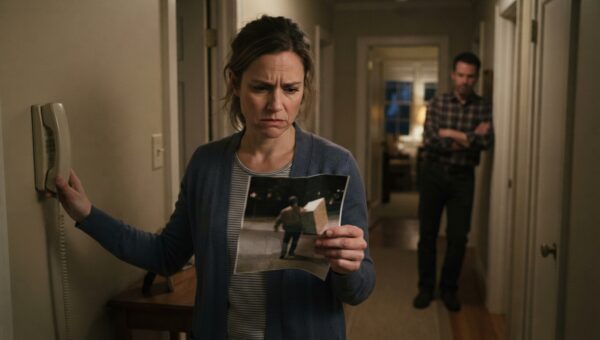
“I’m giving it to the sheriff’s investigator in the morning,” I told him, picking up the phone from the wall mount. “And then I’m calling a divorce lawyer.”
“You can’t do that,” he said, and for the first time, there was a real edge of panic in his voice. “We’ve been married twenty years.”
“Get out,” I said.
He packed his duffel bag that night, slamming doors and muttering curses into the dark hallway, convinced until the very end that he was the victim of a conspiracy. When he finally slammed the front door behind him and drove off into the gravel road, the silence that settled over the house wasn’t peaceful. It was just heavy.
The next morning, I took photocopies of every page to the county prosecutor’s office, and by afternoon, my attorney had filed the papers for an immediate divorce based on fault and documented misconduct. There was no negotiation left to do. The evidence spoke in a dead girl’s handwriting from a fifteen-year-old mind that had tried to leave a trail through the dark so her mother wouldn’t lose her way forever.
Two weeks later, I packed a small bag, locked the front door of the house, and drove west across the country toward Oregon.
I didn’t call ahead. I didn’t send an email asking for a meeting or a chance to explain. I knew better than to demand anything from Maya after what I had taken from her. When I finally found the small, unassuming neighborhood in Portland where she lived, a quiet street lined with maples and modest houses, I sat in my sedan across from her workplace for two hours just watching her walk back and forth behind the counter of the local bakery where she managed the front office.
She was twenty-nine now. Her hair was longer, pulled back in a loose clip, and she moved with an easy, settled grace that told me she had built a life far away from the shadow of our kitchen.
When she came out on her break with a paper cup of coffee, I stepped out of the car and walked across the asphalt. I didn’t run. I didn’t call out her name.
She saw me when she reached the edge of the sidewalk, and she stopped dead. The color drained from her face, and her hands tightened around the coffee cup until her knuckles went white. For a second, I saw the fifteen-year-old girl standing by the pantry again, waiting for someone to choose her.
“Mom,” she said. It wasn’t a welcome. It was just an acknowledgment of a ghost she thought she had buried.
“I found the journal, Maya,” I said, my voice barely carrying over the sound of the afternoon traffic behind us.
She didn’t move. Her eyes searched my face, looking for the old excuses, the old defensiveness, the familiar tilt of the head that meant I was about to defend Rick.
“I kicked him out,” I told her, keeping my hands empty at my sides. “The police have the copies. The divorce is moving. I didn’t come here to ask you to forgive me. I didn’t come here to tell you it’s going to be okay.”
I reached into my canvas bag and pulled out the purple notebook, holding it out between us like an offering.
“I just came to bring it back,” I said. “And to tell you that you were right. You told the truth, and I chose wrong.”
Maya stared at the book for a long time. The wind picked up slightly, rustling the leaves overhead, and neither of us said a word. Then, very slowly, she reached out and took the journal from my hands. Her fingers brushed mine, warm, steady, and real.
She didn’t hug me. She didn’t invite me into her car or offer me a cup of coffee. But she didn’t turn around and walk away either. She just held the purple notebook against her chest, looking down at the faded cover with a quiet, hard-won expression that didn’t need any words to finish the story.