The loan officer looked about twenty-five, and he told me I had insufficient credit history for a fourteen-thousand-dollar car loan. Sweetheart. I have banked in that building since before his mother was born. I was born right here in this county, and my signature is quite literally part of the foundation. I didn’t argue with him. I just asked him to walk me out to the lobby.
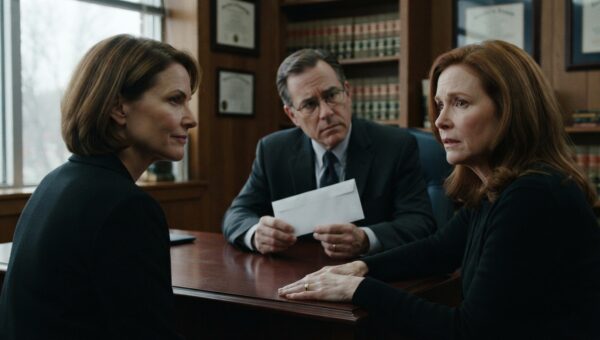
There is a brass plaque by the front door that nobody reads anymore, tucked right between the directory and the night drop slot. It was dedicated in 1974, the year eleven women founded the credit union this bank swallowed up in ninety-two, back when a woman couldn’t even secure a loan without her husband’s signature. I tapped the fourth name down with my knuckle. Then he read my driver’s license. Then he read the plaque again and asked me, real quiet, to please wait right there. When the branch manager came out and saw who was standing on that rug, she said…
Well, she didn’t just speak. Her face went completely rigid, and then she looked at Tyler like he had just tracked mud across a Persian carpet.
The morning had started out normal enough. My old sedan, a two-thousand-and-six Buick LeSabre with a dented bumper and eighty-thousand miles of faithful service, finally dropped its transmission right at the bottom of Miller Hill.
The mechanic, a nice boy named Dale whose father I used to teach fifth-grade arithmetic to, gave me the bad news before I even sat down in his office. He told me it would cost more to fix the transmission than the car was worth on any open market. So I did what any sensible person with a pension and a clean savings account does. I walked three blocks down to the local branch of First Mercantile, the institution that had absorbed our old community credit union thirty years ago, and asked about a straightforward car loan.
I sat across from Tyler in cubicle four. He had a brand-new suit that smelled faintly of dry cleaning chemicals and a haircut that looked like it had been trimmed with a level. He kept tapping his mouse with a little clicking sound that started to grate on my nerves after about four minutes.
“The system is just not giving me an approval flag here, Mrs. Higgins,” he said, not bothering to look up from his monitor. He had a little habit of biting the inside of his cheek whenever a screen didn’t do what he wanted it to do. “It says here you have zero active revolving credit lines. No credit cards, no open mortgages, no car payments. From a risk perspective, the algorithm flags that as an unknown entity.”
I leaned back in the plastic visitor chair and folded my hands over my pocketbook. “An unknown entity. Is that what I am? I have had an account in this exact room since Lyndon Johnson was in the White House, Tyler.”
“I understand that, ma’am, truly I do,” he said, using that tone people use when they are talking to someone they think is mildly confused. “But the computer requires recent data. Within the last twenty-four months.
Without a credit score to back up the application, I can’t write a fourteen-thousand-dollar note for a pre-owned vehicle. My hands are tied.”
That was when I called him sweetheart. It slipped out before I could check myself, but honestly, he had earned it.
I told him to stand up. I didn’t ask; I told him. He blinked, surprised by the sudden shift in tone, but he got up because my voice had that old schoolteacher drop to it that usually made twelve-year-olds put their comic books away. We walked out of the carpeted maze of desks and into the high-ceilinged marble lobby where the tall arched windows let in the noon sun.
The plaque was right there by the heavy oak entrance doors. It was polished brass, though the bank janitors usually missed the corners where the dark tarnish gathered like old tea. Eleven names, etched in block letters during an era when women had to pool their grocery money into a cigar box just to keep a ledger going.
I tapped the fourth name. Clara Mae Higgins.
“Read my driver’s license, Tyler,” I said, holding the little plastic card right under his nose.
He looked down at the card. Then he looked up at the brass wall. Then he looked back down at the card. I watched the blood drain right out of his ears, leaving them pink and translucent against his short hair. His mouth opened just a fraction, but nothing came out.
“You see that date up top?” I asked him, keeping my voice low so the teller at window two wouldn’t turn around. “Nineteen seventy-four. We bought this building with cashiers checks and pure stubbornness after the local commercial banks told every woman in town she needed her husband’s permission to open a checking account. When your bank bought us out in ninety-two, the merger agreement had one strict condition. You kept our history on the wall. And you never, ever turned away a local depositor with a clean ledger.”
Tyler swallowed hard. His fingers twitched against the edge of his tablet. “I… I didn’t know, ma’am. The training module just said…”
“Your training module didn’t teach you how to look outside a glowing box,” I told him. “Now go get Evelyn. And tell her Clara Higgins is standing on her favorite rug.”
Tyler didn’t walk back to the offices; he practically jogged. I stood there with my hand resting on the cool metal frame of the plaque, feeling the tiny raised edges of the letters under my palm. It was funny how quickly forty years of loyalty could vanish into a spreadsheet error just because some programmer in a glass tower two states away decided that not owing money was a suspicious lifestyle.
Evelyn Vance came around the corner two minutes later. Evelyn had been the branch manager for six years now, and she was one of the few people in this zip code who actually read the local historical society gazettes. She was wearing her usual emerald-green blazer, and her heels clicked sharply against the marble floor as she hurried over. When she saw me standing by the plaque with Tyler hovering behind her like a whipped puppy, she stopped dead in her tracks.
“Clara,” she said, her voice dropping an octave as she crossed the remaining distance. “What on earth is going on out here?”
“Your boy here thinks I’m a credit risk, Evelyn,” I said, not moving my hand from the brass. “He tells me my credit history is insufficient for a fourteen-thousand-dollar note on a commuter sedan because I haven’t carried a mortgage since nineteen-ninety-four and I pay my grocery bill with a debit card.”
Evelyn turned her head slowly and looked at Tyler. It wasn’t an angry look, which was worse. It was the look of a very competent professional realizing she had a massive liability on her hands.
“Tyler,” Evelyn said, her voice dropping so low it barely carried over the hum of the air conditioner. “Did you run Mrs. Higgins’s primary routing number through the legacy database before you kicked her to the automated retail tier?”
Tyler swallowed again. I could see the pulse jumping in his neck. “I… the prompt said, “
“The prompt is designed for people who just moved to town from Ohio last week,” Evelyn interrupted, her tone sharp as a dry twig. “It is not designed for the people whose signatures are cast in the metal beside your front door. Go back to your desk, log out of your terminal, and pull up manual override code zero-one. Right now.”
Tyler vanished back into the cubicle area without another word.
Evelyn turned back to me, and the tight, managerial expression on her face softened into something much older and warmer. She reached out and touched my shoulder. “I am so sorry, Clara. We brought in a batch of new trainees from the regional hub last week, and they’ve been running them on the software simulators instead of having them walk the floor. They don’t know anything about the roots of this place.”
“They don’t teach history in business school anymore, I suppose,” I said, letting out a short breath through my nose. “They just teach how to look at numbers without asking where the numbers came from.”
“Come on back to my office,” Evelyn said, gesturing toward the glass-walled room in the corner. “We’re going to write this loan right now. Prime rate, zero administrative fees, and I’m going to personally deliver the cashier’s check to Dale down at the garage so you don’t have to walk back up the hill.”
“I can walk just fine, Evelyn,” I said, though I let her guide me toward her office anyway.
The rest of the process took twenty minutes. Evelyn didn’t use the computer for most of it; she pulled out a physical green ledger book from her bottom drawer just to be traditional, or maybe just to make a point. She filled out the forms by hand using a heavy fountain pen that left dark, wet lines on the heavy paper. Every few minutes, she would glance up and apologize again, but I waved her off. The damage to my morning was done, but the system had been corrected, and that was what mattered.
“Here you go, Clara,” she said finally, sliding the final authorization sheet across the mahogany surface. “Sign right here where the X is. Fourteen thousand, thirty-six months, zero percent interest on the promotional tier for legacy founders. I’ll take the hit on the branch ledger if audit asks.”
“Audit won’t ask,” I said, picking up the pen. “The auditors are all younger than my kitchen table. They don’t know what a legacy founder is anyway.”
I signed my name the way I had been signing it since the Nixon administration, looping the C and crossing the H with a firm, steady hand that hasn’t shaken much despite the years. Evelyn watched the nib of the pen move across the paper with a look of quiet respect that felt a lot more real than any computer algorithm ever could.
When I left the bank twenty minutes later, the afternoon sun had moved around to hit the front windows directly, warming the cold stone of the stoop. I stopped for just a second before pushing open the heavy glass door. My thumb found that fourth name on the brass plaque one last time, tracing the raised metal edge where the tarnish still lived in the corners.
A fourteen-thousand-dollar car loan isn’t much in the grand scheme of things. It won’t make the news, and it won’t change the banking laws in Washington. But as I stepped out onto the sidewalk and started the long walk back down to Dale’s garage to tell him the Buick was getting a new lease on life, I knew one thing for certain. Tyler was sitting at his desk right now, staring at a screen that had just been forced to learn a little bit of history it didn’t ask for. And the next time an old woman walked into cubicle four with a zero credit score and fifty years of local deposits behind her, that boy was going to look up at the lobby wall before he opened his mouth.