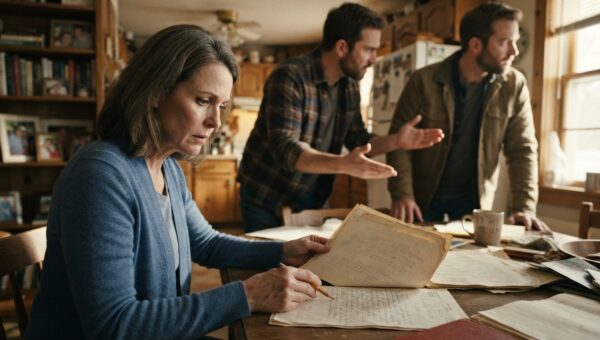
Three hundred and forty-two days. That was the exact number of mornings I had woken up and looked at the wall calendar, checking off another square in blue ink, wondering if my only son even remembered what my voice sounded like. I kept a ledger of my own stubbornness, and every line felt like a small, quiet failure.
It started in my kitchen over a pot of weak coffee and a box of saltines that had gone soft in the humidity.
My son Nathan had stood by the refrigerator, holding a glass of tap water, telling me he was going to marry Clara. She was a quiet woman with three kids from a previous marriage, little ones who still smelled like baby shampoo and cheap laundry detergent. I looked him in the eyes and said what I thought was the hard, honest truth.
“She’s using you,” I told him, scrubbing my fingernails against the formica counter. “Why are you raising another man’s kids?”
Nathan had gone entirely still. The glass in his hand didn’t shake, but his knuckles turned white, the skin stretching tight over bone. He didn’t yell right away, which was worse. He just set the glass down so hard the ice rattled against the rim.
“You’re cruel,” he said. His voice was lower than I had ever heard it, stripped of all warmth. “Stay out of my life.”
He walked out the back door and let the screen slam behind him, and that was the last time I set foot in his house for twenty-four months. I didn’t go to the wedding. I didn’t send a card. I let pride sit between us like a heavy iron stove that nobody could move. I told myself I was protecting him from a woman who wanted a provider for her ready-made family, while ignoring the fact that Nathan was twenty-eight years old and perfectly capable of choosing his own burdens.
The months dragged on with a heavy, ticking silence. The local grocery store cashier, a woman named Martha who had known Nathan since he was in Cub Scouts, stopped asking how he was doing after the first six months. She saw the tight set of my mouth and learned to just hand me my change in silence. I kept busy with my garden, planting tomatoes I didn’t even like to eat, pulling weeds until my palms blistered.
But every time a car turned down our gravel lane too fast, my chest would tighten for a second before I remembered he didn’t visit anymore.
Then came the night that broke the clock.
My alarm hadn’t gone off yet, and the house was pitch black except for the green numbers glowing on the microwave downstairs: 3:00 AM. The phone on the nightstand didn’t just ring; it shrieked. My hand fumbled for the receiver, knocking over a glass of water that spilled across the wooden table, soaking the fringe of my bedside rug.
“Mom,” Nathan said.
He wasn’t talking. He was gasping, the sound raw and tearing, like someone trying to breathe underwater. There was background noise, a child wailing in the high, thin pitch of absolute terror, and the muffled thump of heavy objects being dragged across a floor.
“Nathan? What is it? Where are you?” I sat straight up, the cold water soaking through my flannel nightgown, but I didn’t care.
“I was wrong about everything,” he choked out, his voice cracking right down the middle. “Please, Mom. Please come now. I need you.”
The line went dead with a sharp click.
I didn’t turn on the overhead lights. I didn’t change out of my nightgown. I pulled a heavy wool cardigan over my shoulders, shoved my bare feet into my garden clogs, and ran out to the Buick. My hands shook so badly against the steering wheel that I stalled the engine twice before I finally caught the gears and backed down the drive, kicking up gravel that pelted the side of the shed.
The drive to Nathan’s neighborhood took twelve minutes, but every red light on Main Street felt like a wall. The town was dead asleep, streetlights casting long, yellow pools of light over empty sidewalks. My mind raced through a dozen terrible versions of what I might find. An accident. A break-in. Something worse.
When I turned onto his street, I saw the headlights first. A silver sedan was idling in the middle of the road with both passenger doors standing wide open, but it wasn’t Nathan’s car. As I pulled into his driveway, I saw him.
Nathan was sitting slumped on the bottom step of his front porch, his elbows resting on his knees, his face buried in his hands. Three small figures were huddled around him like ducklings in a storm. Maya, the oldest, was seven, clutching a frayed pink blanket to her chest. Toby, the middle one, was still in his dinosaur pajamas, staring blankly at the front lawn. And Leo, the little three-year-old, was clinging to the back of Nathan’s shirt so tight his knuckles were blue.
I killed the engine and stepped out into the damp night air. The front door of the house stood wide open, a rectangle of pale light spilling out onto the welcome mat.
Nathan looked up as my footsteps crunched on the gravel. His eyes were red-rimmed and swollen, the skin around his nose raw from crying. He looked ten years older than the boy who had walked out of my kitchen two years ago.
“She’s gone,” he whispered. The words barely carried over the hum of my car engine.
“Who’s gone, honey?” I asked, walking up the steps and kneeling right in front of him on the cold concrete.
“Clara,” he said, and his voice broke entirely on the name. “She took the truck. She cleaned out the joint checking account at five o’clock this afternoon. When I got home from the warehouse, the closets were empty. Everything. Even the kids’ winter coats.”
I stood up slowly and walked past him into the hallway. The house didn’t feel like a home anymore; it felt hollowed out, like an old bird’s nest abandoned after a storm. The living room rug was rolled up in the corner, and a single plastic hairbrush lay abandoned on the baseboard. I walked back to the kitchen and saw the screen of Nathan’s phone sitting face-up on the counter. A banking app notification glowed in the dark room, showing an outgoing wire transfer of thirty-eight thousand dollars to an account in another state, leaving behind an available balance of eighty-seven dollars.
Thirty-eight thousand dollars. That was every penny Nathan had saved from five years of double shifts at the machine shop, money he had set aside for the kids’ schooling, for braces, for a rainy day that had just arrived all at once.
I walked back out to the porch. The night wind was picking up, rattling the dry leaves in the maple tree by the driveway. Nathan was staring down at his hands, his shoulders shaking with dry, silent sobs that were harder to watch than the screaming.
“The kids keep asking if I’m leaving too,” he whispered into the dark. He looked up at me then, and all the anger from the last two years, all the stubborn pride and the bitter words, simply dissolved into the space between us. He wasn’t the stubborn young man who had slammed my door; he was just a terrified father who had lost everything except the three children clinging to his jacket.
Before I could answer, little Leo pulled away from Nathan’s back. He walked over to me, his heavy pajama pants dragging on the concrete step, and looked up with big, wet eyes.
“Can you help us?” the little boy asked, his voice small and trembling in the quiet night. “We don’t want to lose him.”
That was the moment the wall I had built around myself for twenty-four months cracked and fell apart. I looked down at those three children, shivering in the cool air, and I realized how blind I had been. I had spent two years telling myself they were a burden, a trap, a pair of grasping hands taking advantage of my boy’s good heart. But they weren’t holding on to him for his money or his car or his name. They were holding on to him because he was the only father who had ever stayed.
I knelt down on the cold concrete, right beside my son, and pulled Leo into my arms. He smelled like baby soap and cold air, just like he had when Nathan first brought him home.
“Nobody’s leaving,” I told him, my voice cracking as I hugged him tight against my shoulder. “I promise you, nobody is going anywhere.”
Nathan reached out, his hand trembling, and caught my sleeve. He didn’t say anything, but his fingers gripped the fabric of my cardigan with a desperate strength that told me everything words couldn’t reach. We stayed out there on those cold steps for a long time, the five of us, while the sky slowly turned the color of wet slate above the rooftops.
Around 4:30 AM, I got the kids inside. I found an old electric space heater in the hall closet and plugged it into the living room wall, setting it up in front of the sofa where Maya and Toby could wrap themselves in blankets. I made three mugs of warm milk with a little vanilla and sugar, the same thing I used to make for Nathan when he had bad dreams as a boy. They drank it in the quiet kitchen, the only sound being the soft clink of spoons against ceramic.
Nathan sat at the kitchen table with his head in his hands while I sorted through the mess of paperwork left on the counter. There were overdue utility notices I didn’t know about, credit card statements in Clara’s name that we would have to untangle, and a half-empty box of cereal sitting by the sink. It was a mess, a genuine, complicated mess that would take months to sort out.
“I have some money in the credit union,” I told him quietly, setting a fresh cup of tea in front of him. “From your father’s pension. It’s enough to cover the mortgage for a while until we figure out the bank accounts.”
Nathan looked up, his eyes shining in the dim light of the kitchen bulb. “Mom, I can’t take your savings.”
“You aren’t taking anything,” I said, pulling out the chair opposite him and sitting down for the first time in two years. “I’m investing in my family. There’s a difference.”
He let out a long, shuddering breath, the kind of exhale that came from carrying a weight he wasn’t strong enough to bear alone. “I was so mad at you,” he whispered. “For two years, I was so mad.”
“You had every right to be,” I said, reaching across the table to cover his hand with mine. His skin was rough with grease and calluses from the shop, real working hands, just like his father’s. “I was wrong. About everything.”
We didn’t talk about Clara anymore that night. There was nothing left to say about a woman who could walk out the door and leave three sleeping children behind in the dark. The silence that followed wasn’t the heavy, bitter silence of the last two years; it was the quiet of a house that was starting over from the foundation up.
By 6:00 AM, the first pale streak of morning light was cutting across the linoleum floor. In the living room, Maya and Toby had finally fallen asleep, curled up together under the heavy wool blankets I had brought from my car. Little Leo was resting his head on Nathan’s knee where my son sat on the edge of the sofa, watching the front window with steady, tired eyes.
We walked out onto the front porch just as the orange sun crested the line of oak trees down the road. Four mugs of untouched tea sat cooling on the small wooden table beside the door.
Down at the corner, the yellow school bus appeared, its red flashers cutting through the morning mist with a steady, mechanical rhythm. Maya stirred on the couch inside, sitting up and rubbing her eyes, calling out softly for her brother.
Nathan stood up, straightening his shoulders, and reached down to take Leo’s small hand in his. I put my arm around my son’s back, feeling the solid strength of him under my palm, right there on the steps we shared. The bus slowed down, its heavy brakes hissing against the asphalt, and the door swung open with a sharp, familiar metal click.