I always get things wrong when I try to rush. That is what my dad used to tell me out on the porch when I was twelve, scraping my knees on the gravel because I wanted to run inside before the rain started. I was running again seven years ago, sprinting down the aisle toward a man who knew how to smile in all the right places, while my father stood beside me with a face like dry timber.
Dad never raised his voice. He did not have to. On my wedding day, just minutes before the organ started playing, he pulled me aside near the vestry door and asked quietly, “Are you absolutely sure he’s the right one?” I laughed, squeezed his rough hand, and told him, “One day, you’ll see his good side too.” Dad forced a smile and nodded, but the worry never left his eyes, lingering there like smoke trapped under a low ceiling.
Now Dad was in a room down at St. Jude’s with a tube in his arm, and I was standing in his quiet, empty house with dust motes dancing in the kitchen sunlight. The stroke had hit him on a Tuesday morning while he was out checking the mailboxes at the end of the gravel lane. By the time the ambulance got him to the county hospital, the left side of his body had stopped cooperating, and his voice had turned into a low, frustrated rumble that nobody could quite translate except me.
“I need you to go get his winter coat and some clean shirts,” the nurse had told me earlier that morning, handing over a clear plastic bag with his belt and silver wristwatch.
So I drove out to the house on County Road K. The place still smelled like pine soap and old paper, exactly the way it had when Mom was alive. I walked down the narrow hallway toward his bedroom, my boots clicking softly on the worn hardwood floors. The bed was made with the blue plaid quilt Mom had stitched back in ninety-four. Everything was in its place, right down to the Sears catalog on the nightstand and the tin of peppermints by the lamp.
The trouble started when I opened his closet to grab the heavy wool coat he wore to church.
The closet always smelled of cedar blocks and stale pipe tobacco, even though he had quit smoking the year I graduated high school.
I pushed aside his everyday jackets, the brown leather one with the frayed cuffs, the gray windbreaker, the heavy winter parka, and reached for the back corner where he kept his good Sunday suit. My hand brushed against something square and heavy tucked away behind a stack of old flannel shirts that nobody had worn since the winter of 2012.
It was a metal lockbox, painted battleship gray, the kind you buy at the hardware store for twenty dollars to keep birth certificates in.
I pulled it out into the pale light coming through the small window above his dresser. The latch was old brass, tarnished dark around the hinges, but it was not locked. Dad never was very good at remembering combinations, so he had just left the little lever clicked to the side. I sat down on the edge of the mattress, my knees suddenly feeling weak, and lifted the lid.
The smell of old paper and dried rubber bands rose up out of the box. Inside lay a neat stack of manila folders, secured with thick rubber bands that had rotted and cracked into brittle yellow crumbs.
On top rested a photograph of Julian, my husband, walking out of a brick building in Milwaukee that I had never seen before. The date stamp in the corner read October 14, 2014, three months before we even met at the community center fundraiser where he had charmed half the committee with his stories about working in architectural design.
My breath caught in my throat. I didn’t want to look, but my fingers were already sliding the rubber band off the first folder.
“He’s a ghost, honey,” Dad had said once over Sunday pot roast, staring out the window while Julian was out in the driveway washing the sedan. “Nobody just appears out of thin air at thirty-two years old with zero paper trail behind them.”
I had laughed it off back then, telling Dad he watched too many cable television mysteries. Julian had explained it all so easily. He told me his family had drifted apart after college, that his mother had passed away in Ohio and his father had moved overseas, leaving him to carve out a new life here in our quiet dairy county. He was charming, he was attentive, and he always remembered to bring Dad a bag of those peppermint drops he liked, even when Dad didn’t offer him a seat on the porch.
I opened the folder labeled with Julian’s full name, written in Dad’s steady, looping cursive.
Inside were bank statements, property deeds from three different counties four hours south, and a typed summary from a private investigator named Arthur Vance, whose office was located down in Madison. The invoice attached to the front was dated six years ago, detailing $4,850 in investigative fees paid out in three separate installments from Dad’s savings account.
I turned the page, my hands shaking so badly I dropped the top photograph onto the quilt.
The notes were meticulous. Arthur Vance had dug up Julian’s actual birth certificate from a small town near Peoria, along with marriage records that listed a completely different wife, a woman named Claire who had filed for bankruptcy in 2011 before disappearing from public records entirely. There were employment verifications from firms where Julian had supposedly worked as a senior draftsman, stamped with bold red letters reading UNVERIFIED / FABRICATED CREDENTIALS.
“He’s not who he says he is,” I whispered to the empty bedroom, the words sounding hollow and strange in the quiet house.
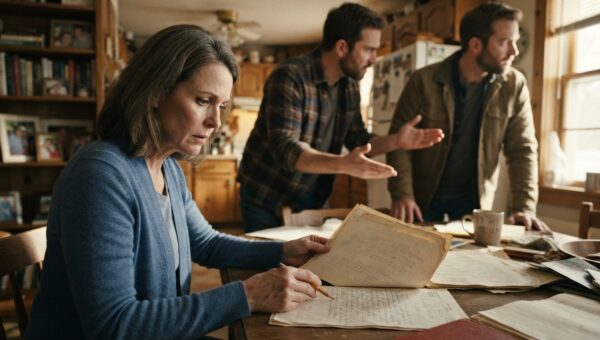
I kept reading because I could not stop. Every page turned revealed another layer of a life constructed out of thin air. There were records of small claims judgments, unpaid supply bills from a defunct contracting business in Janesville, and a police report from 2009 involving a dispute over a commercial lease that ended abruptly when the tenant skipped town under an alias.
The man who slept beside me every night, who helped me fold our laundry on Sunday evenings and kissed my forehead before leaving for his morning commute, had spent a decade erasing his tracks and building a new skin right here where nobody knew to ask questions.
And Dad had known. Or at least, he had suspected enough to spend thousands of dollars of his retirement money to find out the truth, all while keeping his mouth shut so he wouldn’t drive me away with unproven accusations.
“Why didn’t you just tell me?” I said aloud to the empty hallway, tears finally spilling over my lashes and soaking into the collar of my shirt.
If Dad had shouted at me on my wedding day, if he had slammed his foot down and forbidden me to walk down that aisle, I would have fought him. I would have called him stubborn and suspicious and stuck in his ways. I would have packed my bags and moved into town with Julian, convinced that my father simply couldn’t bear the thought of sharing me with another man.
Dad understood that better than I did. He knew that an angry daughter cannot be argued into wisdom; she has to hit the wall herself before she can see the brick.
I packed the box back into its gray metal casing, tucked it deep inside my canvas tote bag under Dad’s spare flannel shirts, and drove back home with my foot heavy on the accelerator. The world outside the windshield looked the same, the rolling cornfields, the red barns with faded feed advertisements on their sides, the cows standing knee-deep in the creek, but everything felt tilted on its axis, as if gravity had suddenly decided to pull sideways.
When I walked through our front door at 5:15 in the evening, Julian was standing by the kitchen island chopping celery for dinner. He looked up with that easy, practiced smile that used to make me feel safe.
“Hey, beautiful,” he said, wiping his hands on a dish towel. “How is your dad doing? Did you find his heavy coat?”
He looked so normal. That was the terrifying part. There was no shadow over his face, no twitch in his eye, no sign of the man described in Arthur Vance’s investigative files. He was just Julian, wearing his favorite blue sweater, asking about my father with just the right amount of professional concern in his voice.
“He’s resting,” I said, setting my bag down by the front door with a heavy thud that made the hall table rattle.
Julian kept chopping, the knife tapping rhythmically against the wooden board. “They said anything about when he might come home? It’s quiet around here without him coming over on Sundays.”
I walked into the kitchen, pulled the gray metal box out of my tote, and set it right in the middle of the island, right on top of the celery he was slicing.
The metallic clatter made him stop. He looked down at the box, then up at me, his smile slipping just a fraction of an inch before he pasted it back on.
“What’s this?” he asked, his voice dropping into that smooth, slightly amused register he used whenever he wanted to make me feel like I was overreacting. “Are we going through your dad’s old keepsakes now?”
“Open it,” I said.
“Honey, come on, I’m trying to get dinner started before, “
“Open the box, Julian.”
He stared at me for three seconds, his jaw tightening slightly. Then he reached out, flipped the brass latch, and lifted the lid. He didn’t even flinch when he saw the top photograph, but I saw the color drain out from under his tan skin, leaving him looking gray and sharp-edged under the kitchen pendant lights.
“Where did you find this?” he asked, and for the first time in seven years, the charm was completely gone from his voice. It sounded flat, metallic, and small.
“In Dad’s closet,” I said, my voice not shaking anymore. The fear had burned itself out during the drive home, leaving behind something cold and clear. “Behind the old flannels. Arthur Vance delivered it six years ago, right around our first anniversary. How much did you take from that lumber yard in Beloit before you changed your last name, Julian?”
He slammed the lid down so hard the metal rattled against the wood. “Your father was a paranoid old man who spent his retirement chasing shadows. He hired some hack to dig up garbage and make things fit his narrative because he couldn’t stand the idea of you being happy with someone he didn’t pick out himself.”
“He didn’t show it to me,” I said, taking a step closer to him until I could smell the lemon dish soap on his hands. “He kept it in a box in his bedroom so I wouldn’t have to choose between my husband and my father. He carried that secret around for years by himself because he was afraid I’d hate him for trying to save me.”
Julian opened his mouth to say something else, another excuse, another half-truth, another neatly packaged defense designed to make me feel guilty for doubting him, but I held up my hand.
“Don’t,” I said. “Just don’t finish that sentence.”
He looked at me then, really looked at me, as if he were seeing me for the first time, realizing that the soft, agreeable woman he had married was gone. He stood there in the quiet kitchen for a long minute while the refrigerator hummed in the background.
“You’re making a mistake,” he said quietly, grabbing his car keys off the counter by the fruit bowl.
“I made a mistake seven years ago,” I told him, not moving an inch from my spot by the sink. “I’m just fixing it now.”
He didn’t pack a bag that night. He didn’t need to; most of what he owned was tied up in accounts I was already planning to freeze in the morning with the help of Dad’s lawyer down in town. He walked out the front door without looking back, the latch clicking shut behind him with a dry, final sound that echoed off the hallway walls.
I stood in the center of the kitchen for a long time after he left, listening to the silence settle over the house. It wasn’t an empty silence. It felt clean, the way the air smells right after a heavy summer thunderstorm has scrubbed the dust out of the sky.
The next afternoon, I sat in the sunlit visitor’s chair by Dad’s hospital bed at St. Jude’s. His eyes were open, bright and clear, tracking me as I walked across the linoleum floor. He couldn’t say much yet, just a low murmur that caught in his throat, but he reached out his good right hand, his fingers trembling slightly as they brushed against mine.
I took his hand, squeezed it tight just like I used to do when I was a little girl scared of the dark, and laid the gray metal box on the bedside table.
“I found it, Dad,” I whispered, leaning down so my forehead rested near his shoulder. “You were right. You were right about all of it.”
Dad didn’t smile, and he didn’t gloat. He just closed his fingers around mine with a strength I hadn’t felt in weeks, gave my hand one slow, deliberate squeeze, and let out a long breath that sounded like peace.
That evening, after I drove back out to the house on County Road K, I carried the box into the living room and sat down in his favorite worn leather armchair by the front window. The sun was dipping low behind the western woodlot, painting the horizon in streaks of gold and bruised purple. I emptied the photographs and papers out onto the coffee table, sorting them into neat little piles, and then I picked up his old armchair, shoved it back an inch into its rightful spot where it had always belonged, and knew that for the first time in seven years, I was finally safe.