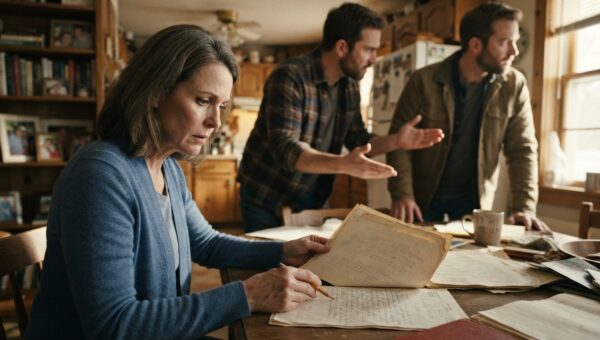
The kettle was whistling on the old iron burner, a thin, sharp shriek that usually made Dad yell from the front room to cut the heat before the bottom burned out. But the house didn’t have Dad in it anymore, and the only sound was that whistle bouncing off walls that had grown too quiet since spring. I pulled the kettle off the flame with a gray rag, the burner clicking twice before the blue fire died down to nothing.
Outside, the gravel in the lane crunched under tires, but I didn’t look up. I knew it wasn’t anybody coming to help me clear the place out.
For thirty-four years, my hands have looked like my father’s hands. Thick across the knuckles, skin stained with pine resin and linseed oil that never quite scrubs out no matter how much pumice soap you use at the sink. Arthur and Claire never had that. They went off to college on partial scholarships and full loans, traded their work shirts for ties and blazers, and figured out how to talk around things instead of through them. When Dad’s stroke hit three years back, and his legs started giving out like dry timber, they were always tied up. Claire had a conference in Chicago. Arthur had a quarterly review in Hartford. They sent fruit baskets with little cards written by someone else’s secretary.
I was the one who drove out every morning at six to lift him out of that narrow bed, my shoulder wedged under his armpit while his heels dragged against the braided rug.
I was the one who mashed his peas and spoon-fed him soup when his right hand started shaking too hard to hold the tin spoon. I didn’t mind it. Dad had taught me how to true an edge on a chisel before I knew my multiplication tables, and when a man builds you a life out of sawdust and quiet patience, you don’t drop him just because his knees go soft.
Three weeks after the funeral, the lawyers called us into an office with slate-gray carpeting that smelled like wet wool. Arthur sat in the leather armchair with his legs crossed, shaking his signet ring against his knee, while Claire checked her phone under the mahogany table every thirty seconds. The reading didn’t take long because there wasn’t all that much to divide besides the house on Elm Street and a few thousand dollars in a credit union account. Arthur got the house, lock, stock, and barrel, because he claimed he needed a place to stay when he visited from the city.
Claire got the cash to help pay off her daughter’s private school tuition.
And me? Dad left me the workbench in the garage.
Arthur actually laughed right there in the lawyer’s office, a short, dry bark that made the young attorney look up from his notepad. He leaned back and told me the grunt gets Dad’s old bench and to saw my way to nowhere. Claire gave me that thin, tight-lipped smile she reserves for waiters who bring the wrong side dish, patted my forearm once like I was a stray dog that had wandered onto the porch, and told me it was probably for the best since I liked puttering around anyway. They didn’t even wait for the ink on the probate forms to dry before they put the house on the market with a local realtor who slapped a neon-orange sign right in the petunias Dad had planted the year before he took sick.
I didn’t take the workbench that day. I couldn’t. I drove my truck back home with the cab smelling like stale tobacco and grief, and I left that heavy old piece of furniture sitting right where it had always been against the back wall of the garage. For almost a year, I stayed away from that property. Arthur called twice to tell me I needed to haul my junk out of his new yard before the closing went through, but I just hung up on him. I couldn’t bring myself to look at it.
The coffee ring was still on the top left corner of the bench, right where Dad used to set his mug every morning while he waited for the oatmeal to cool. I remember the exact morning he made that ring. It was a Tuesday in November, cold enough that the frost on the window looked like ferns. He had set his heavy ceramic mug down while his hand was still wet with boiled linseed oil, and the stain had soaked right into the red oak grain, dark and round like an eye watching the room.
The garage door was half-open when I finally went back there last Thursday, letting in a pale, thin strip of afternoon light that cut across the oil-stained concrete. The air smelled like dust and dry cedar, the kind of smell that gets deep down in your chest and stays there. The realtor’s sign was gone from the front lawn, replaced by a small wooden sold stake near the mailbox. Arthur had already cleared out the house, hauling away Dad’s books and clothes in a rented trailer, but they had left the garage alone because nobody wanted to deal with thirty years of scrap iron and dried-up paint cans.
I walked over to the bench and laid my palm flat on the scarred surface, feeling the grain that Dad had planed down by hand back when Eisenhower was in the White House. It didn’t feel like scrap lumber. It felt like something heavy that had been anchored to the floor by years of steady work. I needed to clear the drawers out so the new owners could tear the garage down for a two-car carport, just like Arthur planned to do with the whole lot.
I started with the top drawer, tossing handfuls of rusted carriage bolts and old brass hinges into a plastic bucket. Then I moved to the middle one, clearing out drill bits and grease-stained pencils that still had Dad’s tooth marks chewed into the cedar wood near the eraser. But the deep bottom drawer gave me trouble right away. It didn’t want to slide on its runners. It caught about four inches out, biting against something heavy wedged hard at the back of the carcass.
I wiggled it, but the wood just groaned. I reached my arm all the way into the dark space above the drawer, my fingers brushing past old jars of wood putty and a tin of rusted finishing nails. My knuckles scraped against something rough and dry at the very back wall of the bench, right where the four-by-four leg joined the frame. I hooked my middle finger into a small recessed lip I hadn’t noticed before, and with a sharp, dry pop, a hidden wooden panel dropped down inside the lower framing.
The breath left me all at once, whistling out of my lungs like I’d taken an elbow to the ribs.
I pulled my hand back, reaching into the narrow void behind the drawer cavity, and my fingers closed around the edges of a flat wooden box. It wasn’t store-bought. It was made of walnut with dovetail joints so tight you couldn’t slip a razor blade between the pins. I lifted it out into the pale strip of garage light and set it down right over Dad’s old coffee ring.
The brass latch was stiff, but it gave way with a small metallic click that sounded entirely too loud in the empty garage. Inside, resting on a bed of yellowed flannel, was a heavy parchment envelope addressed to me in Dad’s steady, unhurried hand, along with a set of vintage brass-handled chisels wrapped in oiled leather. Those chisels were his grandfather’s tools, the ones he told me years ago had been lost during the move from Bangor.
I didn’t open the envelope right away. I just sat down on an overturned five-gallon paint bucket because my knees had suddenly decided they weren’t going to hold me up anymore. The silence in that garage felt different now. It didn’t feel empty. It felt like the kind of quiet you get right before a thunderstorm breaks over the ridge.
I broke the wax seal with my thumb, unfolding three sheets of heavy cream paper covered in that familiar blue ink that always smelled faintly of old fountain pens.
“If you’re reading this,” Dad wrote, “it means Arthur and Claire finally managed to sell the roof over my head, and you’re the one left cleaning up the mess they couldn’t be bothered to make. I gave them what they wanted, the house and the easy money, because a man who spends his whole life chasing paper will never understand what it means to build something that lasts. They think they got the lion’s share, but they only got what was light enough to carry away. The real work of my life wasn’t the drywall or the mortgage. It was this bench, and the land down by the river where I kept my timber.”
My hands were shaking so bad I had to hold the paper flat against my knee to keep the lines from dancing in the dim light.
“Attached to this letter,” Dad wrote on the second page, “you’ll find the deed to the four-acre woodlot off County Road nine, registered in your name alone back when my ticker first started acting up. I bought it clear forty years ago with money your mother and I saved from the mill work before the kids came along. There’s a proper timber-frame shed on it, fully dried and stocked with every tool I ever laid hands on. Arthur thinks he’s getting a tear-down property and a quick fifty grand. Let him have his illusion. You’ve got the shop, the timber, and the only part of me that mattered.”
I stared at the heavy blue signature at the bottom of the page, the ink slightly smeared where his thumb had rested before the paper dried. The legal description on the deed was clear as church bells, stamped with the county seal and dated two days before he went into the hospital for the last time.
Two days later, a silver SUV crunched down the gravel drive, kicking up a cloud of white dust that settled over the wild onions by the fence. Arthur stepped out wearing a charcoal suit jacket that looked entirely too expensive for an old mill town, his sunglasses tucked into his shirt pocket. He walked with that quick, jerky stride he’d picked up somewhere down in Boston, checking his watch before he even shut the car door.
“You still hauling this junk out, or do I need to hire a crew to clear the pad?” Arthur asked, stopping ten feet short of the open garage door like he was afraid the dust might ruin his leather shoes. “The closing is in five days, and the new buyers want this eyesore gone so they can drop their modular garage on the slab.”
I didn’t stand up off the paint bucket right away. I folded the letter slowly, deliberately, and tucked it into the breast pocket of my flannel shirt, feeling the weight of the brass chisels inside the wooden box.
“You can’t tear this slab out, Artie,” I said, my voice sounding rough and flat against the rafters. “The foundation goes six feet deep, and it’s anchored to land that isn’t on your title work.”
Arthur let out a short, sharp laugh, stepping closer and shaking his head with that familiar look of mild pity he’d worn ever since we were kids. “I have the deed right here in my briefcase, little brother. The lawyer signed off on every square inch of the parcel, including this lean-to and the dirt beneath it. Everything within the fence line belongs to me and Claire now.”
“Not the timber lot off County Road nine,” I said, looking right up at him through the narrow strip of sunlight. “And not this workbench.”
Arthur’s smile didn’t drop, but his eyes narrowed just a fraction, the way they used to when one of his college buddies caught him in a bad bluff during a card game. “What are you talking about? Dad left you the scrap wood. You stood right there in Vance’s office and took it without a peep.”
I stood up then, my boots hitting the concrete with a solid, heavy thud, and slid the wooden box across the scarred top of the workbench until it hit Dad’s old coffee ring with a dry clack.
“He didn’t leave me scrap, Artie,” I said, and for the first time in my life, my voice didn’t shake when I looked at him. “He left me the shop. You can keep the house. You can keep the paper. I’ve got work to do.”
Arthur didn’t say anything for a long, heavy second. He just stared down at the walnut box and the open drawer, his mouth half-open like he was trying to figure out an equation that didn’t have any numbers in it. Then he turned around without another word, got back into his silver SUV, and backed out down the lane so fast he tore up three yards of roadside chicory before he hit the paved county road.
The garage is gone now, hauled away by the new buyers two weeks later with a couple of yellow bulldozers that flattened the old petunia bed into gray mud. But the workbench isn’t gone. I loaded it onto the flatbed of my Ford with the help of two neighbors who know how to keep their mouths shut, and we brought it out to the timber shed by the river where the sun hits the pine needles just right every morning at seven.
The coffee ring is still there on the top left corner, dark and round against the red oak grain, but I sanded the edges down smooth last night so it won’t catch on my shirts anymore. The vintage chisels are laid out in a row beside the oil stone, gleaming in the bright noon light that pours through the high south window. Every time I set my own mug down on that wood, the grain holds it steady, and the house down the road stays quiet enough to hear the water moving through the reeds.