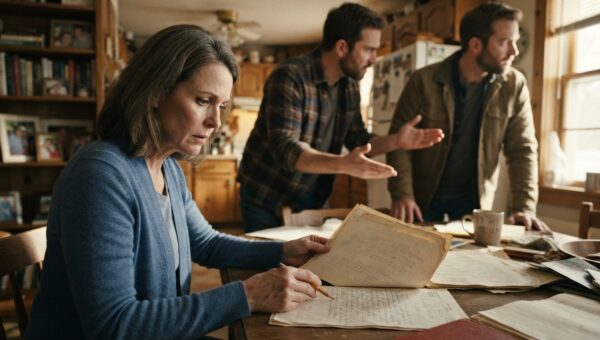
Seventy-six years is a terribly long time to wonder who you belong to. I reckon most folks take for granted that when they look in the glass, they are seeing something handed down by a mother or a father, some little slant of the cheekbone or stubborn set of the jaw that connects them to a line. I never had that luxury.
For as long as I could draw breath, my own face was a stranger’s face to me. I was adopted out of the county home back in the winter of 1949, handed over in a stiff woolen blanket to a childless couple who loved me fiercely enough, but who could not give me what was never theirs to give. My history started on a piece of brittle white paper stamped with county ink, and for six decades, that single paper lived tucked safely inside the back cover of my family Bible right next to the dried palm frond from Easter Sunday 1974.
I figured that was all I would ever get of my beginnings. You reach a certain age in a small town outside Tucson, and you learn to make peace with the blank spaces in your story. My husband, Lyle, passed on five winters ago, and the quiet in the house had settled deep into the floorboards like dust.
Tuesdays were my anchor. Every week, Martha and Clara and I would drag our sewing baskets into the community center fellowship hall, set up our folding chairs under the harsh fluorescent lights, and spend three hours stitching scraps of leftover calico into something useful. We talked about grandchildren, aching joints, and the high price of tomatoes at the Piggly Wiggly. It was predictable. It was safe. And then Helen walked through the double doors on the first Tuesday of last month, carrying a canvas tote bag and a wicker basket, and the ground simply gave way beneath my sewing stool.
I didn’t hear her come in over Martha complaining about her arthritis. My needle was halfway through a patch of deep blue cotton when a shadow fell across my lap, and I looked up. Helen had those same wide-set eyes I spent my whole life washing my face around. Not just similar, but exact, right down to the tiny freckle just beneath the left tear duct.
I dropped my brass thimble. It rolled across the linoleum with a tinny clatter that made Clara jump. Helen bent down with a surprising quickness for a woman our age, scooped up the thimble, and handed it back to me with a little crooked tilt of her pinky finger that made my breath catch in my throat. My own right pinky finger has been crooked since I jammed it in a screen door at age seven. I sat there staring at her hand, completely forgetting my manners, until Helen gave me a soft, questioning smile and pulled out her folding chair right across from mine.
We spent the first hour making small talk the way old ladies do when they are sizing each other up. Her name was Helen Vance, she had moved down from Flagstaff to live near her granddaughter, and she loved a sharp quilting needle just as much as I did.
But every time she leaned forward to thread her needle, I caught myself staring at the way her hair grew at the temples, that exact same silver widow’s peak I saw in my bathroom mirror every single morning. The air in that fellowship hall suddenly felt too thin. Martha was busy telling a long story about her neighbor’s dog, so Helen leaned across the table toward me, her voice dropping down to a low, confidential murmur that only I could hear. “You keep looking at me like you’ve seen a ghost, honey,” she said. I shook my head, feeling foolish, and told her she just favored an old friend of mine. It was a lie, of course, but saying the truth out loud felt like shouting in an empty church.
The real break came right around three in the afternoon, right when Martha stepped out to check on the coffee pot in the kitchenette. Helen was rummaging through her canvas tote, looking for a spool of yellow thread, when a manila envelope slipped out and landed corner-first on my knee. It wasn’t sealed. A corner of old, yellowed parchment poked out from the opening, smelling faintly of old cedar and damp basements. I recognized that smell instantly. It was the exact smell of the paper I kept tucked in my Bible back home. Helen snatched it back quickly, her cheeks flushing a pale pink, and gave a nervous little laugh that sounded remarkably like the one I made whenever I dropped a dish. “Oh, goodness,” she muttered, tucking the paper back inside. “Just some old paperwork from when I was little. The adoption agency back in the county home gave it to my folks in forty-nine. I carry it around out of pure habit, I reckon.”
My needle stopped dead in the cloth. The silence in the room suddenly grew so heavy I could hear the faint hum of the ancient refrigerator in the corner. “What county home?” I asked, and my voice came out much sharper than I intended, raspy like dry leaves scraping across concrete. Helen blinked, her hands pausing over her basket. “The old county receiving home up north,” she said softly. “March third, 1949. My folks always told me I was dropped on the steps wrapped in a flannel quilt.” I didn’t think. I didn’t plan it out. I just stood up so fast my folding chair screeched against the floorboards, startling Clara right out of her stitching. “Wait right here,” I told Helen, my heart hammering against my ribs like a trapped bird. I grabbed my canvas tote bag, zipped it open, and hauled out my heavy leather-bound Bible with the worn spine. I didn’t care that Martha was walking back in with a tray of Styrofoam cups, staring at me like I had lost my last good sense.
I flipped the heavy cover open with shaking fingers, and my sixty-year-old adoption paper fluttered down onto the quilting table, landing right beside Helen’s wicker basket. Helen stared down at my paper, her mouth parting slightly. Then she reached into her bag, pulled out her own brittle sheet, and laid it right beside mine. We didn’t even have to read the top paragraphs. The stamps were identical, stamped in faded purple ink by the same county clerk who had long since turned to dust. Helen looked up at me, her eyes shining with sudden, bright tears, and pulled a corner of her paper toward the light. “Mine says Twin B,” she whispered, her voice trembling so badly she could hardly get the words out. “I always wondered what happened to A.” I looked down at my own paper, at the faded typing near the bottom edge that I had memorized in the dark forty years ago, and my vision blurred. The line on mine has always said Twin A.
Nobody said a single word for a long minute. Martha stopped dead in her tracks with the coffee tray, her eyes darting from Helen’s face to mine and back again, taking in the matching eye shape, the same nose, the identical way we both stood hunched slightly over the table. “Lord have mercy,” Martha breathed out, setting the tray down with a loud thud that sloshed coffee over the rims of the cups. Clara didn’t say anything at all; she just reached out and covered her mouth with her hand, her eyes wide behind her thick glasses. Helen reached across the table, her fingers brushing against mine, and we just sat there holding hands over a pair of seventy-six-year-old documents while the fluorescent lights hummed above us. All those years, we had lived less than a hundred miles apart. She had raised three boys in a brick house in Flagstaff while I raised two girls down here in the desert. We had shopped at the same grocery store chains on our visits, driven past the same highway markers, and breathed the same dry Arizona air, both of us carrying half of a whole without ever knowing the other side existed.
That evening, Helen didn’t go straight back to her granddaughter’s place. She rode home in the passenger seat of my old Buick, her canvas bag clutched tightly in her lap like she was afraid someone might snatch it away. We didn’t talk much on the drive; the silence between us wasn’t the lonely kind I was used to, but a thick, comfortable quiet that felt like sinking into a warm bath after a long winter day. When we got to my little house on Elm Street, I brewed a pot of chamomile tea and we sat at my kitchen table until the sun went down behind the mountains, spreading long streaks of orange and violet across the sky. We spent hours laying our lives out on the table like pieces of a puzzle we were finally allowed to finish. She showed me pictures of her grandchildren, boys with my father’s chin, and I showed her faded photographs of Lyle standing by our first rusted pickup truck. We laughed until our sides ached over how different our lives had been, and then we cried over the birthdays, the Christmases, and the ordinary Tuesday afternoons we had spent missing each other without even knowing who we were missing.
Two days later, we drove up to the county library and asked to look through the historical archives to see what else we could find about the winter of forty-nine. The librarian, a young man who looked like he had never heard of a typewriter, pulled up the old ledger scans on a glowing computer monitor. There it was in black and white: our mother’s name, written in a shaky cursive hand, and the notation of two healthy baby girls born twenty minutes apart during a howling March blizzard that had shut down the county roads for three days. The intake clerk had marked us down as separate placements because two different families had come through the doors within forty-eight hours, each looking for a baby to take home out of the storm. It wasn’t malice that separated us. It was just bad timing, a hurried pen stroke on a ledger page, and a world that moved too fast for its own good. Reading those words didn’t make me angry. It just made me realize how fragile our lives are, how easily a single sheet of paper can alter seventy-six years of history.
By the end of the month, Helen had moved her quilting basket over to my house permanently. We didn’t bother going back to the Tuesday circle for a while; we had too much catching up to do right here in my front room. My daughters came over that weekend, and when they opened the front door and saw Helen sitting in the armchair by the window, my oldest daughter dropped her car keys on the entry rug and just stared, her jaw dropping open in pure astonishment. “Mom,” she whispered, looking between the two of us. “If you’re sitting right there, then who in the world is that?” We laughed until we cried, explaining the whole impossible story from the beginning, and by Sunday evening Helen was sitting at the head of my dining table surrounded by grandchildren who suddenly had a whole new set of cousins they never knew existed.
It is a strange thing to find your own face across a dinner table when you are well past seventy. Some days I catch myself looking at Helen across the kitchen island while she slices tomatoes or pours the morning coffee, and my chest gets tight with a strange, sweet ache for all the decades we missed out on. We could have grown up together. We could have shared secrets behind the barn, held hands at our first school dances, and comforted each other through the grief of losing our parents. We missed all of that. But sitting here now, in the golden light of late afternoon, with the radio playing softly in the corner and the smell of fresh coffee filling the room, I don’t spend much time looking backward anymore. We have right now. And that is more than I ever thought I would get.
We sat together at the kitchen table yesterday afternoon, working on a new quilt using scraps of deep blue and gold calico. Helen threaded her needle first, her hands moving with that same familiar, steady grace, and then I threaded mine. Two pairs of hands, both bearing the exact same crooked little finger, guided a single quilting needle down through the layers of fabric, finishing a neat, tight seam that felt like it had been waiting seventy-six years to be sewn.