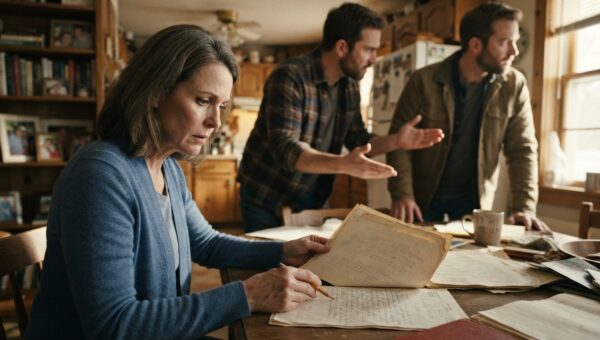
“Did you dig that out of a trash bag?”
The words didn’t just drop into the dining room; they landed like a heavy iron skillet hitting a plank floor. Evelyn sat at the head of the mahogany table, her silver napkin resting neatly against her lap, a thin, cruel smile curved at the edge of her mouth. Around the table, seven other family members froze with their forks halfway to their mouths.
My cousin-in-law cleared his throat and stared hard at his water glass.
I stood right there by the sideboard, the rough wool of the heavy winter jacket scratching slightly against my wrists. It wasn’t a fancy coat. It was an old, dark brown tweed affair with worn leather buttons, smelling faintly of cedar and cold iron because it had hung in the back of my mother’s closet for fifteen years before she passed away. It was the last tangible thing she had left me. When I slipped it on that Sunday afternoon because the wind off the dairy flats had turned sharp and bitter, I thought I looked respectable enough for a family Sunday supper.
Instead, I stood in the center of Evelyn’s dining room feeling like a stray dog tracked mud onto her imported wool rug.
I looked straight across the table at Richard, my husband of four years.
I didn’t say a word. I just waited for him to catch my eye, to shift in his chair, to say something, anything, to remind his mother that my mother had been a human being who deserved a shred of basic decency.
Richard didn’t look up from his plate. In fact, a slow, ugly little smirk crept across his mouth, the kind he always wore when he wanted to pretend he was above the nonsense while secretly siding with the people holding the checkbook. He took a slow sip of his iced tea and stared down at the tablecloth.
Nobody said a word for three seconds, and honestly, that felt worse than the insult itself.
“I think I’ll head home,” I said, my voice shaking so badly I could barely form the vowels.
I didn’t wait for an answer. I turned on my heel, grabbed my canvas purse off the chair by the front door, and walked out into the gravel drive.
The drive home was a blur of gray asphalt and hot, stinging tears that leaked down my cheeks until my throat ached. I kept the heater blasting, but I couldn’t shake the chill deep inside my bones.
For the next three days, the house was a tomb. Richard stayed late at his father’s office downtown, and when he finally did come home, he acted like I had committed some terrible social crime by losing my temper over a harmless joke.
“You’re making a mountain out of a molehill,” he told me on Tuesday night, tossing his leather briefcase onto the kitchen island with a loud clatter. “Mom was just teasing. You’ve always been way too sensitive about your family background, Clara. You can’t expect everyone to treat you like glass.”
“She asked if I got my dead mother’s coat out of a trash, Richard,” I said, my voice flat and dead. “And you sat there grinning like a fool.”
“Oh, stop being dramatic,” he muttered, walking down the hall toward the bedroom without looking back.
I spent Wednesday moving through the rooms like a ghost, cleaning counters that were already spotless, folding towels that didn’t need folding.
The hurt had settled deep into my chest, hardening into something cold and heavy. I didn’t care about their country club friends or their trust funds anymore. I just wanted my mother’s quiet dignity back.
Then came Thursday afternoon at 2:14.
I was sitting at the kitchen table with a cup of lukewarm coffee when the front door didn’t just open, it practically blew off its hinges. The crash echoed through the hallway.
Before I could even stand up, Evelyn came charging down the corridor. Her usually immaculate coiffure was half-unraveled, her expensive silk blouse was wrinkled at the collar, and her face was the color of skim milk. Her hands were shaking so violently she could barely keep her fingers straight.
“Where is it?” she gasped, her breath coming in ragged, shallow hitches.
“Evelyn, what on earth, “
She didn’t even look at me. She marched straight past the kitchen table, her heels clicking frantically against the hardwood, and shoved open the door to our bedroom. I dropped my coffee mug, it didn’t break, just rolled across the linoleum spilling dark drops, and hurried after her.
She was already standing in front of my cedar wardrobe. She wrenched the wooden doors open so hard one of the hinges groaned in protest. She ignored the dresses, ignored the slacks, and lunged straight for the back corner where my late mother’s old brown tweed jacket hung like an out-of-place relic among our modern clothes.
She yanked it off the hanger, nearly tearing the sleeve. Without pausing to catch her breath, she jammed her trembling fingers into the right-side pocket. When she found nothing, she clawed at the left pocket, turning the lining completely inside out like a desperate woman searching for a lost vial of medicine in a burning house.
I stood in the doorway, completely frozen, watching her panic with a strange, numb detachment. Her face was slick with sweat, her eyes darting around the room like a trapped animal’s.
Then, her fingers stopped dead.
Her breath hitched in her throat. She slowly, almost religiously, slid two fingers into the hidden seam near the inside hem of the jacket lining, a secret pocket my mother had sewn in herself decades ago to keep spare keys safe while she worked late hours at the county records office.
She withdrew her hand. Between her thumb and forefinger was a tiny, unremarkable object.
The second Evelyn’s eyes locked onto it, every drop of color drained entirely from her face. She staggered backward a half step, her knees buckling slightly against the edge of the dresser, and let out a small, strangled sound that wasn’t quite a gasp.
“No,” she whispered, her voice barely a breath. “No, that’s impossible. That’s been gone for thirty years.”
I didn’t move an inch. “What is that, Evelyn?”
She didn’t answer. She just stared down at the small object in her hand as if it were a live coal.
It was a rare, custom-engraved platinum winding key, small enough to fit on a charm bracelet, but heavy with solid metal. Stamped into the tiny circular head was the distinct, old-fashioned crest of the historic Hawthorne Estate trust, the very land holdings and legal properties that Evelyn’s family had claimed sole, unblemished ownership of back when my mother was just a young archivist working the night shift in the basement of the county courthouse.
My mother never talked much about her archival days, but she kept a few old leather-bound work journals locked in her cedar chest. I remembered reading through them after the funeral. They detailed how Evelyn’s grandfather had quietly altered the original land grants and property ledgers to squeeze out the legitimate heirs, securing the family’s entire social fortune overnight. Everyone thought the master provenance key had vanished in the courthouse fire of 1974.
Except my mother hadn’t let it burn. She hadn’t blackmailed anyone either; she wasn’t that kind of person. She had simply tucked the physical proof into the lining of her work coat, the very coat she wore every single day down in those cold, damp archives, and kept it safe until the day she died.
And now, Evelyn was holding it in her palm, looking at the instrument of her family’s impending ruin.
“Give that here,” Evelyn hissed, her voice dropping into a desperate, frantic whisper as she lunged toward me with her hand outstretched. “Clara, listen to me. You don’t know what this means. Give it to me right now, and I swear to you, we can, we can work something out. Money, a car, whatever you want.”
I stepped back, keeping my hands firmly at my sides. The fear in her eyes was intoxicating, but it wasn’t satisfying in the way I would have guessed. It was just pathetic.
“You laughed at my mother’s jacket, Evelyn,” I said, my voice steady and cold in a way that scared even me. “You called it trash.”
Just then, the front door clicked open, and heavy footsteps sounded in the hall. Richard appeared in the bedroom doorway, his briefcase still in his hand, looking confused and entirely out of breath.
“Mom? What’s going on? I got your text, ” He stopped dead, looking from Evelyn’s pale, tear-streaked face to the platinum key in her hand, and finally to me standing by the door. “Clara, what did you do?”
“Ask your mother,” I said, pointing a finger straight at Evelyn. “Ask her what she spent thirty years pretending she never lost.”
Richard looked at Evelyn, panic flashing across his face. “Mom? What is she talking about?”
All of Evelyn’s haughty veneer vanished in an instant. She grabbed Richard by the lapel of his expensive suit jacket, her voice breaking into a frantic, pleading whine. “Richard, do something! She has the key. If this gets out to the board, the trust, the estate auditors, we’ll lose everything. The house, the accounts, our entire name, it’ll all be gone!”
Richard’s eyes widened in sheer horror. The arrogant, dismissive attitude he wore like armor around his family evaporated completely. He turned to me, his face twisting into an ugly, desperate mask of accommodation.
“Clara,” he stammered, taking a step toward me with his hands raised in a placating gesture. “Clara, honey, let’s just be reasonable. Whatever Mom did in the past, that’s ancient history. Just give her the key. We’re a family, right? We can’t have this out in the open. Just hand it over, and we’ll… we’ll take a trip, buy that car you were looking at last month. Just give it to her.”
I looked at my husband. Really looked at him.
I saw the exact same cowardice I had seen at the dining room table, magnified a hundred times over. He didn’t care about the truth, he didn’t care about my dignity, and he certainly didn’t care about me. He only cared about his mother’s approval and his own comfortable, unearned lifestyle.
“You’re right, Richard,” I said softly. “We are a family. But I’m not part of it anymore.”
I reached down, plucked the platinum key right out of Evelyn’s limp, unresisting fingers, and slipped it safely into my own jacket pocket.
“Clara, wait, ” Richard started, reaching out to grab my arm.
I stepped back, slipping my arms through the worn sleeves of my mother’s tweed jacket. I zipped it all the way up to the collar, feeling the heavy, comforting weight of the wool against the chill in the air.
I walked past both of them without another word, stepping out of the bedroom and down the quiet hallway. On the little wooden table by the front door, I slipped my gold wedding band off my finger and set it down neatly in the center of the tray.
I pulled the front door open, stepped out onto the porch into the crisp afternoon air, and pulled the heavy oak door shut behind me with a solid, final click. I didn’t look back once.