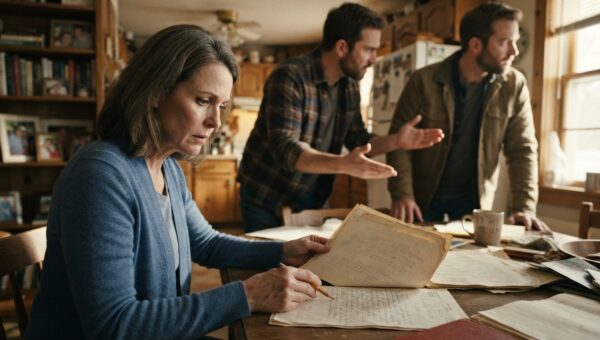
The smell of cedar mulch and damp November dirt always stays in the back of my throat whenever I think about the day we lowered Mama into the ground. Four solid years had passed since that cold afternoon behind St. Jude’s parish house. Four years of memorial candles lit on her birthday, four years of quiet Sundays where I still found myself reaching for the phone to tell her about a new hydrangea variety that finally took root by the side of the porch.
I honestly didn’t even think about the checks. Why would I? When someone dies, you hand over the death certificate to the funeral home director, you sign the county registry, and you assume the massive, lumbering machinery of the federal government simply notes the ledger and moves on. You figure the system works. You figure there are safeguards built into the very architecture of bureaucracy to catch the ones who fall.
The white envelope didn’t look like an instrument of destruction when it dropped through the mail slot on a Tuesday morning. It was just standard government stock, dull windowed paper with the return address of the Social Security Administration printed in flat blue ink.
I was standing by the kitchen island wiping down the granite counter with a damp sponge when I slid my finger under the flap. I figured it was some sort of year-end informational notice or perhaps a stray adjustment form concerning Mama’s final burial stipend.
Instead, I found myself staring at a row of numbers that made my temples throb with a sudden, dull ache.
Nineteen hundred and seven dollars. Month after month, stretching backward across an unbroken chain of forty-eight months. A total of ninety-one thousand five hundred and thirty-six dollars.
The money hadn’t stopped when Mama’s heart stopped. It had kept flowing, silently, digitally, into an active checking account held at the regional credit union downtown. An account belonging exclusively to my younger brother, Lucas.
My brain simply refused to process the arithmetic for a good thirty seconds. I read the deposit routing numbers three separate times, tracing the ink with my thumb as if the touch might change the digits. Ninety-one thousand. For four years, while Lucas drove around in a brand-new Ford F-150 and posted pictures of weekend fishing trips up in the Ozarks, he had been collecting Mama’s monthly stipend as if she were still sitting in her recliner taking her blood pressure pills.
I set the paper down on the counter and my hands were shaking so badly I knocked over the ceramic spoon rest. It shattered into three clean pieces against the linoleum.
The mechanism behind the theft was almost terrifyingly simple once the federal fraud investigator explained it to me a week later. Lucas hadn’t just pocketed the checks; he had systematically bypassed the mandatory annual redetermination audits by forging medical incapacity affidavits. Every twelve years, or in Mama’s case, every twelve months, the agency required a licensed physician’s physical signature and stamp certifying that the beneficiary was alive, incapacitated, and unable to manage their own affairs.
Lucas had found an old pad of prescription forms from Mama’s former primary care doctor who had retired back in 2018. He had traced the signature, forged the medical license number, and mailed the packets back like clockwork every November.
By the time Thanksgiving rolled around ten days later, I was walking around in a state of icy detachment.
I didn’t say a word to Wayne, my husband of twenty-two years. Not yet. I kept the Social Security audit notice folded inside my checkbook register in the bottom drawer of the cherry secretary desk in the den. Every time Wayne walked past me in the hallway, whistling some cheerful tune from the morning radio show, my stomach gave a sharp, sickening twist.
We drove out to Lucas’s house outside of town for Thanksgiving dinner. The drive out there was heavy with a low, sullen gray cloud cover that hung just above the tree line.
Lucas lived in a split-level brick ranch with an oversized three-car garage he had built with contractor loans he never quite seemed to pay off. When we pulled our sedan into his gravel drive, his shiny white truck was parked right out front, catching the dull afternoon glare.
Dinner was a grotesque parody of family normalcy. Lucas had bought a massive fifteen-pound Butterball turkey and roasted it until the skin was blistered golden-brown. He stood at the head of his dining table holding a heavy carving knife with a black plastic handle, grinning as he sawed through the breast meat with long, rhythmic strokes.
Nobody said anything for a second and honestly that felt worse. The only sound in the room was the scrape of steel against bone and the muffled chatter of a football game playing on the wall-mounted television in the den.
Lucas dropped a thick slice of turkey onto my plate and gave me a lazy, lopsided smile. “Eat up, sis. You look like you’ve seen a ghost this week. Too much paperwork at the bank?”
I stared down at the gray steam rising from the gravy on my plate. “Mama would have hated this house, Lucas,” I said quietly. My voice didn’t shake. I was surprised by how flat and hollow it sounded. “She would have hated how it was paid for.”
Lucas didn’t even miss a beat with the carving knife. He made another slice, sliding the meat onto Wayne’s plate before answering. “She would have wanted me to have it. I took care of her.”
The sheer, staggering audacity of the statement hung in the air like woodsmoke. I looked up at him, my eyes burning. “You didn’t visit her the last two years she was alive, Lucas. You didn’t even call on her birthdays because you were too busy chasing down some new truck part or boat trailer.”
Lucas just shrugged, his shoulders rolling beneath his flannel shirt. He dropped a fork onto the table with a sharp clatter. “Details. She was gone anyway. The money was just sitting there doing nothing in some federal holding bin. Somebody had to put it to good use.”
Wayne cleared his throat from across the table, shifting uncomfortably in his chair and reaching for his water glass. “Now, let’s keep the peace today, honey,” Wayne said, his voice dropping into that soothing, placating tone he always used when he wanted me to swallow my own tongue for the sake of polite company. “It’s a holiday. We don’t need to air family laundry over turkey.”
I looked at Wayne. Really looked at him. I noticed how his fingers gripped the crystal glass a little too tightly, how his eyes wouldn’t meet mine, sliding instead toward the living room doorway. I figured he was just being his usual coward self, terrified of a shouting match that might ruin his appetite for pumpkin pie.
I didn’t argue any further at the table. I sat through the rest of the meal in total silence, chewing food that tasted like wet cardboard, watching Lucas laugh at a stupid commercial on the television.
The very next morning, I drove straight to the federal building downtown.
I didn’t call ahead. I walked through the heavy glass doors past the security scanner, clutching my leather purse like a shield, and asked the woman at the front reception desk where the inspector general’s office was located. It took three hours of waiting on a hard plastic chair under buzzing fluorescent lights before a man in a rumpled gray suit named Agent Miller called my name.
Agent Miller listened to me with a look of profound, exhausted boredom until I pulled the Social Security audit notice out of my bag and laid it on his scarred oak desk.
Within ten minutes, his entire demeanor shifted. He pulled a thick manila folder from a filing cabinet behind him, flipped open the cover, and began running his index finger down a series of scanned federal benefit renewal forms.
“You’re right about your brother,” Agent Miller said, looking up over the rim of his wire-rimmed glasses. “Our field office flagged the IP routing on the online portal submissions three weeks ago. We’ve already subpoenaed his credit union records. The ninety-one thousand is gone, mostly tied up in vehicle equity and equipment loans, but we’ll freeze whatever is left.”
I felt a cold wave of vindication wash over me, mixed with a deep, heavy exhaustion. “He forged the doctor’s signature,” I said. “He used Dr. Harrison’s old stamp from five years ago.”
Agent Miller tapped the corner of the paper against the desk, his expression turning strangely careful. He didn’t answer right away. He adjusted his glasses, leaned back in his squeaking leather chair, and studied me as if trying to figure out how much more bad news a person could absorb before breaking completely.
“Well, that’s just it, Mrs. Evans,” Agent Miller said softly, resting his elbows on the desk. “Your brother isn’t the only name on the forged documents. The agency requires a secondary verification signature for remote disability and incapacity filings when the primary applicant cannot appear in person. Someone had to witness and co-sign the physical paperwork every single year.”
My breath hitched in my throat. I shook my head slowly, the room suddenly feeling too small, the air too thick to draw into my lungs. “What are you talking about? Lucas did it all on his own printer.”
“No,” Agent Miller said, turning a single sheet of paper around so it faced me across the desk. “Someone who had access to your mother’s private medical records. Someone who knew her social security number by heart. Someone who attended your mother’s funeral and signed the registry right beside the immediate family.”
My hands started shaking so violently I had to grab the edge of the desk to keep from sliding off the chair.
I looked down at the signature block at the bottom of the 2021 annual incapacity renewal form.
There was Lucas’s jagged handwriting in the primary box. And right beneath it, clear as day, written in the neat, practiced cursive of a man who balanced a family checkbook every Sunday morning, was Wayne’s name.
The world didn’t shatter or collapse into dramatic ruin. It just went terribly, deafeningly quiet.
Agent Miller was still talking, his voice sounding like it was coming from the bottom of a deep well, but the only words echoing in my head were the ones Wayne had spoken across the Thanksgiving table just forty-eight hours earlier: *Let’s keep the peace today, honey.*
He wasn’t trying to avoid a family fight. He was protecting his own signature.
The drive home from the federal building took twice as long as it should have. Every red light felt like a personal insult, every brake light ahead of me a glowing red stop sign telling me I had nowhere left to run.
When I pulled our car into the driveway of our small suburban house on Elm Street, Wayne’s sedan was parked right in the middle of the double-wide concrete. The kitchen light was on, casting a warm, yellow rectangle across the manicured front lawn. It looked like the home of a normal, hardworking, respectable couple.
I unlocked the front door and pushed it open. The smell of roasted chicken and rosemary floated down the hallway from the kitchen. Wayne was standing by the stove stirring a pot of rice, whistling under his breath just like he did every Tuesday evening.
He looked up as I dropped my keys into the wicker bowl by the front door. The keys made a sharp, clattering sound against the ceramic bottom.
“Hey, babe,” Wayne called out, turning around with a wooden spoon in his hand. “How was your day? You were gone for hours. I was starting to wonder if you got stuck in traffic downtown.”
I didn’t take off my coat. I stood right there in the entryway, my purse still slung over my shoulder, staring at him with a coldness in my chest that I didn’t recognize as my own.
Wayne stopped stirring. The smile slid off his face bit by bit, replaced by a twitch in his left jaw that always appeared whenever he knew he was caught dead to rights.
“What’s wrong?” he asked, his voice dropping an octave as he set the wooden spoon down on the counter. “Why are you looking at me like that?”
I reached into my bag, pulled out the certified copy of the federal document Agent Miller had given me, and laid it flat on the kitchen island right next to the cutting board.
Wayne didn’t look down at the paper immediately. He looked at my face, and in that split second, all the twenty-two years of shared breakfasts, Sunday morning crossword puzzles, and quiet evenings on the back patio simply evaporated into thin air.
“I went to see Agent Miller today, Wayne,” I said. My voice was barely a whisper, but it filled the kitchen like a gunshot.
Wayne took half a step backward, his hip bumping against the edge of the stove. “I don’t know what you’re talking about.”
“You signed it,” I said, pointing a finger straight down at the signature block beneath Lucas’s name. “Four years of stealing Mama’s money to pay off your gambling debts at the riverboat, and you had the absolute stomach to stand at her grave while you were actively plotting to rob her corpse.”
“It wasn’t like that,” Wayne stammered, his face flushing a dark, ugly red as he raised his hands defensively. “Lucas was drowning. He came to me with the forms. He said it was just temporary until his contracting business picked up. He needed a witness who knew her medical history. I just… I just signed my name, honey. I didn’t touch the money. Most of it went to his truck anyway.”
“You signed your name,” I repeated, the words tasting like ash on my tongue. “You sat at my mother’s Thanksgiving table and told me to keep the peace while you were knee-deep in a federal felony with my brother.”
“We can fix this,” Wayne said, taking a desperate step forward, his hands reaching out toward me as if he could somehow push the clock back ten minutes. “I’ll call an attorney. We can pay the restitution back in installments. The feds don’t have to ruin us over this. We’ve been together twenty-two years, please, “
“Don’t touch me,” I said, stepping back so sharply my shoulder hit the wall.
The silence that followed was absolute. No birds outside, no hum from the refrigerator, no traffic on the street. Just the sound of Wayne breathing heavily through his nose, realizing for the first time that the safety net he had woven out of lies and forgery had finally snapped clean through.
I didn’t scream. I didn’t throw plates or cry tears of rage. I walked past him into the master bedroom, pulled a heavy nylon duffel bag out from the top shelf of the closet, and dropped it hard onto the mattress.
By midnight, Wayne was gone, sitting in a cheap motel off the interstate waiting for federal marshals to serve his arraignment papers alongside Lucas.
I sat alone at the kitchen island in the dark, listening to the hum of the refrigerator finally kick back on. The federal audit notice lay right where I had left it on the granite counter.
Outside, the first heavy rain of winter began to tap against the windowpane, steady and relentless, washing away the last remaining traces of a family that never really existed at all. I reached out, picked up the heavy brass house key from the wicker bowl, walked over to the front door, and turned the deadbolt twice until the mechanism clicked firmly into place.