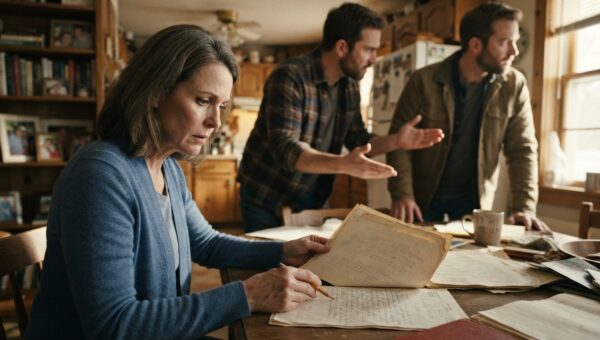
I thought I was walking into a routine meeting with a lawyer. Instead, the moment I sat down, he looked at me and quietly said, “Ma’am, as you know, your neighbor, Mr. Sloan, passed away. My condolences.” I thanked him, completely confused. Mr. Sloan and I weren’t friends. We spent years arguing over fences, parking spaces, and property lines. Then the lawyer opened a thick folder and calmly said, “Mr. Sloan left his entire estate to you.” I stared at him in disbelief. “That’s impossible.” He slid the will across the desk and continued, “His home alone is worth nearly $400 million, and everything he owned now legally belongs to you.” My hands began to shake.
None of it made any sense. Why would the man who could barely stand the sight of me leave me everything? Then his lawyer pointed to one final paragraph and quietly said, “There is one condition. You’ll inherit every dollar, but only if you agree to fulfill the final request Mr. Sloan wrote in his own handwriting.” As I read the first line, I realized my difficult neighbor had been hiding a secret that turned my entire understanding of our decade-long feud upside down.
Attorney Vance folded his hands on the polished walnut desk and watched me closely, waiting for the shock to wear off. His office smelled of old paper, leather, and peppermint. I sat there in my faded corduroy jacket, holding a paper coffee cup I had brought from home, feeling entirely out of place in the high-rise suite overlooking downtown Milwaukee.
“I don’t even know who Arthur Sloan really was,” I said, my voice sounding thin to my own ears. “We spent eight years screaming at each other over a three-foot strip of gravel.”
“He knew that,” Vance replied evenly. “He knew it very well.”
That was the starting point of a puzzle I never asked to solve.
For eight years, Arthur Sloan had been the grey cloud hanging over my small property on the edge of town. He was seventy-two when he died, thin as a rail, with sharp eyes that missed nothing and a temper that flared up whenever my truck tires drifted two inches over the asphalt boundary we shared. We had called the town zoning board out twice. We had shouted over lawnmowers. I used to keep a notebook just to log his complaints about my oak tree dropping leaves on his immaculate driveway.
Now, I was sitting in a law office listening to a man talk about hundreds of millions of dollars.
“You need to look at the paperwork, Sylvia,” Vance said, sliding a manila folder across the blotter. “Take your time. Read the terms.”
I opened the folder. Inside was a thick stack of legal briefs, property valuations, and bank statements with numbers so large they looked like typos.
But right on top was a single sheet of heavy cream paper covered in shaky, cramped handwriting. Arthur’s handwriting. I recognized the fierce, jagged slashes of his ink from the angry notes he used to wedge under my windshield wiper.
“Read the first line out loud,” Vance instructed quietly.
I cleared my throat. My eyes tracked across the page, picking out the words. “To the only person in this county who never once apologized for standing her ground.”
My stomach gave a hard twist. I looked up at Vance. “What does that even mean?”
“It means he watched you, Sylvia,” Vance said. “Through every fight, every zoning dispute, every hard winter when your roof leaked and you stayed out there on the ladder fixing the shingles yourself while refusing to ask him for help. He watched you. And he decided you were the only one he could trust with the finish line.”
The next few days were a blur of quiet panic and disbelief. I didn’t tell my sister Clara right away. How do you tell someone over the phone that the grumpy old man who yelled at your cat left you enough money to buy half the county? Instead, I went back to my kitchen, sat at my Formica table with a cold cup of coffee, and stared at the certified copies of the will.
Three days later, I met Vance again. This time, he handed me a heavy brass key on a frayed green lanyard.
“He wanted you to go through his house yourself,” Vance told me. “Not his executors. Not the state. Just you. There’s a metal box in his study. The key opens it. Inside is the rest of the history.”
Arthur Sloan’s house sat fifty yards from mine, separated by the very gravel strip we had fought over for nearly a decade. I had never set foot inside it. From the outside, it looked like a fortress of dark brick and drawn velvet curtains.
When I slid the brass key into the front deadbolt, it turned with a heavy, dry click. The door swung open, and I stepped inside.
The air was stagnant, smelling of old cedar, burnt coffee, and floor wax. It was entirely silent except for the hum of an old refrigerator in the back. Dust motes drifted through shafts of afternoon light cutting across the formal parlor. Everything was meticulously tidy, almost aggressively so, as if no one had touched a throw pillow in twenty years.
I walked past the dark hallway, guided by instinct, straight to the back room Arthur used as a study. A massive mahogany desk dominated the space, piled high with old ledgers, tax returns, and surveyor maps yellowed at the edges.
I found the metal box sitting right on top of the desk blotter. It wasn’t even hidden. I slid the small key into the latch, popped the lid, and pulled out a bundle of tightly bound papers wrapped in twine.
On top was a personal letter written in that same jagged handwriting, dated just six months before he died.
I sat down in Arthur’s leather desk chair, it creaked loudly under my weight, and unfolded the paper.
“Sylvia,” it began.
“If you’re reading this, Vance finally did his job. You probably think I lost my mind leaving you everything. Maybe I did. Or maybe you’re the only person around here with enough backbone to clean up the mess I made forty years ago.”
I read on, my breath catching in my throat.
Arthur hadn’t always been a lonely old man fighting over fence lines. Back in the late seventies, he was a ruthless land speculator working for a development corporation that carved up the county. One of his early acquisitions involved a small family farm owned by a man named Thomas Vance, the father of the lawyer handling my case now. Through aggressive legal pressure, forged boundary signatures, and manipulated debt, Arthur had systematically forced the family off their eighty acres, driving the old man to financial ruin and an early grave.
Arthur made a fortune off that stolen land. He built his entire empire on the foundation of that single, merciless eviction. But as the decades passed, and his wife died, and his children drifted away to live their own lives across the country, the money stopped feeling like an achievement. It felt like a monument to his own greed.
“I spent my whole life building walls and arguing over property lines because I was terrified of looking at the boundary I crossed back in seventy-eight,” Arthur had written. “I watched you fight me tooth and nail over three feet of gravel. You didn’t back down. You didn’t cry to the county. You just stood your ground because it was yours. That’s when I knew. You’re stubborn enough, and honest enough, to do what I never had the courage to do.”
The final request wasn’t just about inheriting the money. It was a mandate.
The handwritten condition stated that before a single dollar of the estate could be transferred to my personal name, I had to use the primary trust fund to locate the surviving descendants of Thomas Vance’s family, deed back the original eighty acres currently held in a shell corporation, and fund a permanent community trust in their name.
I sat in that dark study for a long time, holding Arthur’s letter. The silence in the room felt heavy, but it wasn’t hostile anymore. It felt like a confession waiting for an answer.
“You really left me with quite a chore, didn’t you, Arthur?” I whispered to the empty room.
The work took four months. It wasn’t glamorous, and it certainly wasn’t easy. Local reporters caught wind of the estate transfer within weeks, camping out by my mailbox and knocking on my door at all hours. Rumors flew through the county like wildfire. People whispered that I must have blackmailed the old man, or that there was some secret family connection nobody knew about.
I didn’t talk to the reporters. I worked with Attorney Vance, going through dusty title archives, tracking down distant grandchildren living in three different states, and drawing up the legal instruments necessary to dissolve the corporate holding companies Arthur had set up decades ago.
There were moments when I wanted to walk away. The sheer volume of paperwork, the legal challenges from distant Sloan relatives trying to contest the will, and the weight of the public scrutiny nearly broke my patience. I remember sitting at my kitchen table late one Tuesday night, staring at a stack of deeds, ready to call Vance and tell him to give the whole mess to the state.
Then I thought of Arthur’s note. I thought of the way he stood his ground in his isolation, trapped by his own guilt, waiting for someone who wouldn’t blink.
“Not my style,” I muttered to myself, closing the folder and reaching for my pen.
By late autumn, the legal transfers were complete. The eighty acres of original farmland were legally deeded back to the surviving great-grandchildren of Thomas Vance, completely free and clear, backed by a multi-million-dollar endowment for the community trust Arthur had specified. The local paper ran a quiet retraction and summary of the settlement on page four. The reporters packed up their vans and left.
The neighborhood settled back into its usual autumn rhythm. The leaves fell from the oak tree, landing on the gravel boundary between Arthur’s property and mine.
On a crisp November morning, I walked out to the old property line where Arthur and I used to shout at each other over misplaced fence posts and parking spaces. The rusted iron gate that led from his driveway to mine had been bolted shut for as long as I could remember.
I reached down, pulled the heavy metal pin, and unbolted the latch. It groaned loudly in the cold air, protesting the movement after decades of neglect. I pushed the gate open, letting it swing wide against the brick pillar, leaving it permanently open to the quiet morning light.
I stood there for a moment, watching the wind sweep through the shared gravel path, feeling the strange, steady peace of a boundary finally laid to rest.