I spent twelve years treating Arthur Sloan like he was a cactus I had to walk past every single morning. He was the neighbor who measured my lawn with a yardstick, the one who left notes on my windshield about parking three inches over the line, and the man who once called the city because he thought my sunflowers were a zoning violation. I kept my head down, said nothing, and lived my life.
I thought I was walking into a routine meeting with a routine lawyer. Instead, the moment I sat down, he looked at me and quietly said, “Ma’am, as you know, your neighbor, Mr. Sloan, passed away. My condolences.”
I thanked him, feeling that standard bit of polite grief you offer for someone you barely knew. I was already planning what errands I had to run on the way home. Then Mr. Vance opened a thick manila folder and calmly said, “Mr. Sloan left his entire estate to you.”
I stared at him, my coffee cup halfway to my mouth. “That is impossible. You have the wrong house number.”
He slid the will across the polished mahogany desk. “His home alone is worth nearly $400 million, and everything he owned now legally belongs to you.”
My hands began to shake. I felt the air leave the room.
It was not a joke. I knew enough about law to recognize the seal on the paper. Why would the man who spent a decade making my life difficult leave me everything? I looked at the lawyer, waiting for the catch, the punchline, or the mistake. Mr. Vance just pointed to one final paragraph. “There is one condition. You will inherit every dollar, but only if you agree to fulfill the final request Mr. Sloan wrote in his own handwriting.”
I took a breath and read the script. As I scanned the first line, I realized my difficult neighbor had been hiding a secret that changed the entire history of our street.
The drive home felt like a hallucination. I looked at my neighborhood, these modest brick houses and trimmed hedges, and then I looked at the looming, overgrown estate at the end of the block. For twelve years, those black iron gates had been a fortress.
I had always imagined Arthur sitting inside, stewing in his own bitterness, watching the world through blinds he never lifted. I was wrong.
Mr. Vance had given me a key. Not a physical one, but a legal permission to walk across the boundary I had respected out of spite for over a decade. I walked up to the iron gate. The chain was heavy and cold in my palm. It swung open with a shriek of rusted metal that echoed down the quiet street.
The garden inside was a disaster of neglected beauty. Rose bushes had grown into thorny walls, and the pathways were choked with weeds. I walked toward the front door, my heart hammering against my ribs. I felt like an intruder, even though I was the owner. I opened the door to the smell of old paper and stale, dry air.
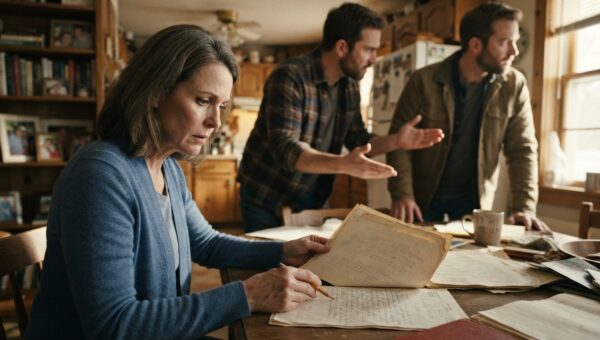
The study was exactly where he spent his life. I found the journals stacked neatly on a mahogany desk.
I sat down in his leather chair, the leather creaking under my weight, and opened the first one.
It wasn’t a diary of hate. It was a record of me.
He had recorded every time I helped the elderly woman across the street with her groceries. He noted the time I stood up to the homeowners association to protect the family who couldn’t afford their dues. He wrote about the way I stayed calm when he screamed at me, and how I always cleaned up the trash that blew onto my lawn from the street, even when it wasn’t mine. He wrote about my resilience. He wrote about the integrity he saw in me, the kind he claimed he had lost decades ago when he pushed his own family away to chase a fortune that left him hollow.
I was reading about my own life through the eyes of a man who had hated me, or so I thought. He didn’t hate me. He was studying me. He was searching for proof that people like me still existed.
I flipped to the back of the ledger. There it was, the handwritten condition. It wasn’t a demand for a statue or a monument to his ego. It was a plea.
“I have spent forty years building walls,” he had scrawled in shaky, tired handwriting. “I have enough money to buy anything, but I have nothing that matters. I watched you for a decade. You are the only person who never broke. I need you to break these walls for me. Use this money to create a sanctuary for those who have nowhere left to go. Do not let this house be a tomb. Make it a home for others. If you refuse, the money goes to the state, and this place will be torn down. I am trusting you with the only thing I have left to give.”
I sat there for hours. The sun moved across the desk, illuminating the dust motes dancing in the air. I looked at the photos tucked into the journal. They were of a daughter and a granddaughter he had lost, not to death, but to his own pride. He had spent his final years watching me because I was the mirror image of the life he had abandoned.
The shock began to fade into a heavy, grounding realization. I wasn’t just a neighbor anymore. I was the steward of his redemption.
The next day, I didn’t go to work. I went to the hardware store and bought a pair of bolt cutters and a heavy-duty saw. I walked back to the estate, but I didn’t go through the gate this time. I walked to the edge of my own property, to the fence that had been the subject of three lawsuits and endless shouting matches.
I started the saw. The sound was deafening in the quiet morning, a violent, screeching protest against the metal. But as the blade bit into the first post, I felt a weight lifting off my shoulders. I wasn’t just cutting a fence. I was cutting the ties to a decade of petty resentment.
Neighbors started coming out of their houses. They stood on their porches, whispering and pointing. I didn’t care. I kept cutting. By noon, the entire stretch of chain-link that separated my yard from the estate was lying in the grass.
I walked into the street. I looked at the gathered crowd, my face covered in dust, my clothes stained with grease. I told them that the gates were open. I told them that the house was going to be a community resource center, a place for families in crisis, a library, a kitchen, a place to heal. I told them Arthur Sloan had left his fortune to the neighborhood, not to me.
There was a long silence. Then, Mrs. Gable, the woman I had been helping for years, stepped forward. She didn’t say a word. She just walked over to the pile of fence metal and helped me drag the first piece to the curb.
Within an hour, there were a dozen people in the yard. We were pulling weeds, clearing paths, and opening windows that hadn’t seen the light of day in years. The house was finally breathing.
The media scrutiny was intense for a few weeks. They called it the miracle on Elm Street. They wanted to know why a billionaire would leave everything to a neighbor. They wanted to know if I was a secret relative or a long-lost friend. I didn’t give them the sensational headlines they wanted. I just handed them copies of Arthur’s journal entries that pertained to community service. I told them it was a trust of conscience, not a lottery win.
Mr. Vance helped me navigate the legal maze of the foundation. We set up the charter to ensure the money would be used exactly as Arthur wanted, for the people who needed it most. We didn’t keep a dime for personal luxury. The estate was turned into a nonprofit, and I became the director.
It has been six months since I sat in that office. The estate is no longer a fortress of bitterness. The roses are blooming again, and the backyard is filled with the sound of children playing in a park that was once a disputed parking space. We have a food pantry in the basement and a tutoring center in the former study where I read his secrets.
Sometimes, when the house is quiet and the evening light hits the garden, I walk to the edge of the property where the fence used to be. I look out over the unbroken stretch of green grass that now connects our yards.
Arthur died a lonely man, but he didn’t die without a legacy. He spent his life building walls, but he spent his last breath ensuring they would be torn down. I look at the iron gate of the estate, propped wide open against the spring wind, and I know that some things have to be broken before they can truly be made whole.
I still have the bolt cutters in the shed. I don’t think I’ll ever need them again, but I keep them there as a reminder. It’s funny how a yardstick and a few feet of fence can define a life, and how a simple choice to do the right thing can change the entire course of a neighborhood. I am not the same person I was twelve years ago, and I don’t think I would have ever discovered who I really was if Arthur hadn’t spent those years watching me from the dark.
The house is full of life now. Every morning, I unlock the front door and wait for the first person to arrive. They come for help, or for comfort, or just to sit in a space that feels like it has finally been forgiven. Arthur’s secret wasn’t his money. It was his desperate, hidden hope that someone would be better than he was.
I hope I am. I think, in his own way, he knew I would be.