Twenty-two years. That is how long a bank account can bleed out in the dark before someone finally turns on the kitchen light.
My grandfather, a man who measured his life by how straight his fence posts were and how early he got to the hardware store, set up the trust back in the fall of 1985. Twelve grandchildren. Ten thousand dollars apiece, locked away in an ironclad fund meant to pay for textbooks or a first apartment when each of us turned eighteen.
He picked his oldest son, Warren, to be the executor because Warren was the one who stayed close to home, took over the bookkeeping, and always wore a clean white shirt to Sunday dinner.
I was fourteen when Grandfather passed away in the winter of 2001. Everyone cried into their coffee cups at the kitchen table, and Warren gave a speech about keeping the family together. Nobody questioned him. You do not question the man who handles the probate papers and drives the widow to the doctor’s office.
The trouble did not start until last month. My oldest boy, Lucas, turned eighteen on a Tuesday. By Friday, I had the paperwork from the bank ready to sign over his college money. I called Warren from my kitchen while Lucas sat at the island eating a bowl of cereal.
Warren didn’t sound surprised. He sounded tired. “You’re calling about the trust,” he said, and I heard the faint click of a lighter on the other end of the line.
“Lucas is eighteen,” I told him, leaning my hip against the counter. “We’re ready for the transfer whenever you want to sign off.”
“It’s gone,” Warren said, and his voice was flat, like he was reading off a shipping manifest.
I actually laughed. I thought it was some kind of grim uncle joke. “Very funny, Warren. What do you mean, it’s gone?”
“The account is empty,” he said, and then he let out a long breath of smoke. “Markets went south years ago. Administration fees ate the rest. There’s nothing left to transfer.”
That was the moment the floor felt like it dropped about four inches. I looked at Lucas across the kitchen island, his spoon halfway to his mouth, waiting to hear which bank we were driving to. I didn’t tell him right then. I just told Warren I would look into it, hung up the phone, and spent the next three days sitting on the sticky vinyl chair at the county probate court basement while a clerk named Brenda pulled up twenty-two years of microfilm and wire transfers.
The records didn’t show market crashes. They didn’t show lawyer fees or administrative costs. They showed a steady, metronomic outflow of sixteen hundred dollars every single month, starting six months after Grandfather was buried, straight out of the grandchildren’s trust and into a mortgage routing number in Naples, Florida.
Warren had bought himself a sprawling four-bedroom house with a screened-in pool three blocks from the gulf. A house the whole family visited every Thanksgiving. A house where we swam in the pool, ate grilled shrimp, and thanked Warren for being such a generous brother and uncle.
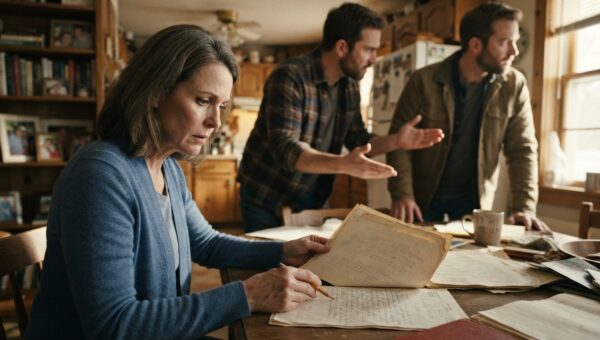
I didn’t call a lawyer right away. I didn’t call the police. I took every single printed bank statement, every canceled check, and every deed transfer, and I slid them into thirty-five identical manila folders. One for every relative coming to Christmas Eve dinner at the old family homestead.
By the time Christmas Eve rolled around, the snow was coming down hard enough to pile against the windowpanes, blurring the lights of the porch.
Thirty-five people filled the old dining room, smelling of wet wool, pine needles, and baked ham. Grandmother sat at the head of the long walnut table in her motorized wheelchair, wrapped in a heavy wool shawl. She hadn’t spoken more than three words in six months, not since her stroke in June. She mostly just watched the room with dull, heavy eyes, her hands resting like dry leaves on her lap.
Warren sat near the foot of the table, carving the ham with a silver-handled knife Grandfather had bought in Germany back in the fifties. He was holding court, telling some loud story about his boat down in Florida and how the fishing had been exceptional that fall.
Nobody noticed when I stood up and set the thick manila folders down right on top of the lace tablecloth, right beside the gravy boat.
The room got quiet in chunks. First the cousins stopped talking, then the aunts, and finally Warren stopped sawing at the ham.
“What’s all this then?” Warren asked, looking up with a greasy smile. “Tax forms?”
“Open it,” I said. My voice didn’t shake, which surprised me. “Page four.”
Warren didn’t move. He just stared at the thick brown paper sitting next to his elbow. “You’ve lost your mind, haven’t you?”
“Open page four, Warren,” I said again, louder this time. “Look at the routing number from March 2003. Look at where the money went every month for twenty-two years. Every penny Grandfather left for the kids. All four hundred thousand of it.”
My sister reached out first. She pulled the flap open, slid out the top statement with the bank letterhead, and stared at the columns of numbers. The color drained right out of her face so fast she looked like she had seen a ghost. She looked down the table at her own teenage daughters, then back at Warren.
“Warren,” she whispered. “What is this?”
Warren finally dropped the carving knife. It hit the wooden table with a sharp, heavy clatter that made several people jump. He didn’t look at the papers. He just looked at me, his jaw working like he was chewing on a dry piece of leather.
“Your grandfather would have wanted me to enjoy life,” Warren said, and his voice had a sharp, nasty edge to it that sounded nothing like the uncle who used to take us fishing. “He worked hard so this family could have things. I had a vision for that property down south. We all benefited from it. You stayed down there for two weeks last Thanksgiving.”
The silence in that room was heavier than the snow piling up outside the window. Nobody breathed. Thirty-5 family members sat frozen in their holiday sweaters, staring at the man who had stolen from his own brother’s children to buy himself a retirement palace in the sun.
That was when Grandmother moved.
At first, we just thought she was shifting her weight in the chair. But then the metal creaked. She pushed her dry, spotted hands against the armrests, her knuckles turning white as bone. Her breathing came in short, ragged gasps, the kind of sound you only hear when someone is hauling themselves up from a very deep dark place.
My cousin made a move to help her, but Grandmother held up one trembling hand.
She stood up.
She hadn’t stood on her own two feet since the summer before. She swayed there for a second, her frame frail under the heavy wool shawl, and then she planted her heels firmly into the Persian rug. She turned her head slowly, looking past the ham, past the manila folders, right at her oldest son.
Grandmother looked at Warren for a long, quiet minute, and then she spoke in a voice that was thin and sharp like dry winter wind.
“Your father didn’t build that trust for you to buy a palm tree, Warren,” she said.
Warren tried to smile, but his mouth just twitched. “Ma, sit down. You shouldn’t be standing up like this, it’s, “
“Quiet,” she said. It wasn’t a shout. It was just an old woman’s voice with forty years of iron behind it.
She took one slow step toward him, her slippers shuffling against the carpet. “There was a second paper signed in ninety-nine. A codicil you never filed because you thought I wouldn’t remember. Any executor who touched the principal for personal gain forfeits their share of the homestead, and the court takes the title before the ink is dry.”
Warren’s face went completely slack. “Ma, that’s not, that was just talk, “
“It’s registered in the county archive,” Grandmother said, her voice never wavering an inch. “I filed it myself the day we buried him, just in case you ever forgot who the money belonged to.”
She turned around, looked right at me, and then slowly lowered herself back down into her wheelchair. Her breathing was steady, and she rested her weathered hand right over Lucas’s newly minted eighteenth-year birthday card that was sitting on the table. Outside the dining room window, the snow kept falling against the glass, heavy and white, burying everything underneath.