The rain on graduation morning had that gray, flat persistence that smells of wet asphalt and old cedar mulch. I stood on the front porch with my briefcase gripped in my right hand, feeling the damp chill soak right through the wool of my jacket while the screen door banged once against the white siding behind me.
My father stood in the doorway with his arms crossed over his chest, his jaw set in that hard, square line that always meant a lecture was coming.
Behind him, my stepmother, Cheryl, was fussing over Chloe’s collar, smoothing down the royal blue gown that was supposed to be mine. Chloe stood right beside them, clutching her phone and looking entirely bored by the whole production, as if sitting through a three-hour university commencement was just some chore she was doing us all a favor to attend.
“I am not going to argue with you about this, Valerie,” my father said, his voice dropping into that low, flat register he used whenever he wanted to make sure everyone in the house felt small. “Chloe needs the floor seating. Her friends are meeting her down front for pictures, and you know how important her social circles are. You’re nothing more than a nurse’s assistant anyway, give your sister this moment.”
He reached out and plucked the heavy cream-colored cardstock ticket right out of my fingers. He didn’t even look me in the eye when he did it.
He just slid it across the wooden hallway table and pushed me gently toward the top of the porch steps.
“Go on around to the lawn if you want to catch a glimpse from the back,” Cheryl added, peering over his shoulder with that tight, practiced smile she always wore when she was getting exactly what she wanted. “Nobody’s stopping you from standing outside with the other onlookers, dear. We just need the actual credential for the family rows.”
The rain started coming down a little harder, splashing against the concrete steps and darkening the hem of my trousers. I looked down at my briefcase. Inside that black leather case, tucked right beneath a stack of printed diagnostic abstracts, sat my faculty VIP lanyard and the embossed program bearing my name in gold foil. I had spent four years balancing fifty-hour weeks scrubbing instruments and monitoring telemetry in the telemetry ward with eighty-hour weeks analyzing biomedical samples in the basement lab.
They thought I was just carrying a clipboard for the doctors. They had never once asked what my actual job title was, and I had never bothered to correct them because explaining it always felt like talking to a brick wall.
“Okay,” I said quietly.
“Don’t use that tone with your father,” Cheryl snapped, already turning back toward the kitchen to check on the corsages.
My father didn’t say another word. He just pulled the heavy front door shut, the latch clicking into place with a dry, final sound that cut off the warmth of the hallway. I stood there on the porch for three seconds, listening to the drip of the gutter overhead, before I turned around and walked down the steps into the gray downpour.
The walk from the house to the faculty parking lot behind the science complex took about twelve minutes. By the time I reached the secure gate, my hair was plastered to my forehead and my boots were soaked through.
The campus security guard, old Miller who had worked the gate since I was an undergraduate, looked up from his crossword puzzle and blinked through the fogged glass of his booth.
“Rough morning for a stroll, Dr. Vance,” Miller said, reaching out to push the buzzer without even checking my ID. “Dean’s been asking if you made it through the back way yet. They’re lining up in the green room in ten minutes.”
“Traffic was slow, Miller,” I said, offering a small, tired smile as I stepped past the arm into the dry warmth of the service corridor.
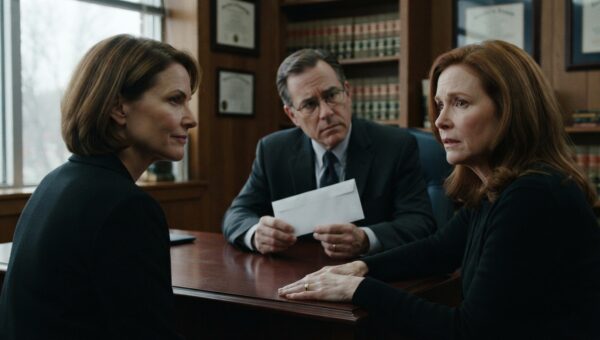
The green room smelled of fresh coffee and old paper. Dr. Harrison, the head of the biomedical department, was standing by the mirror trying to knot a silk tie that looked like it had survived three decades of faculty meetings. When the door clicked open and I stepped inside, he dropped his hands and let out a long breath.
“There she is,” Harrison said, walking over to hand me a thick linen towel from the catering cart. “We were starting to wonder if the diagnostic board had sent you to Zurich a week early. Did you get your robes sorted?”
“In my case,” I said, taking the towel and wiping the rain from my cheeks. “And the speech is right here. Every word checked twice.”
“Good. Because the crowd out there is massive this year. Trustees, donors, half the state legislature.” He lowered his voice, leaning in a little closer. “Your father’s section is right down front center, by the way. Row four. Seat twelve through fifteen.”
I stopped drying my hands. A strange, cold calm settled right behind my ribs. “Row four?”
“Cheryl called the alumni office three times last month to upgrade their seats,” Harrison said with a dry, knowing smirk. “Apparently, they wanted to make sure they had an unobstructed view of Chloe receiving her general studies certificate. They told the registrar you were just tagging along to help with the family luggage.”
“They’re thorough,” I said, and the silence in the small room felt heavier than the rain outside.
Ten minutes later, the line started moving. We filed out of the green room two by two, stepping into the dim, cathedral quiet of the backstage wings. The low murmur of four thousand people filled the auditorium, a steady, rushing hum like wind through a pine forest. Through the gap in the heavy red velvet curtains, I could see the sea of black caps stretching all the way back to the balcony.
Down in the fourth row, right where Harrison said they would be, sat my family. My father was leaning over to whisper something to Cheryl, his tie straight, his shoulders squared with that familiar look of civic pride he always wore whenever he thought he was the most important person in any room. Chloe was scrolling through her phone, her blue gown hanging off her shoulders, her legs crossed at the ankle. They looked comfortable. They looked like people who owned the room.
The processional music swelled, a heavy brass arrangement that vibrated right through the floorboards. We took our places on the stage chairs arranged in a semicircle behind the podium. The university president took his seat in the center, and the Dean stepped up to the massive wooden lectern to begin the opening remarks.
The first twenty minutes went by in a blur of standard academic protocol. The president gave his welcome, the chancellor said a few words about endowment growth, and then the Dean stepped back up to the microphone, tapping the metal neck to clear the room’s attention.
“And now,” the Dean said, his voice echoing off the high oak rafters, “it is time to recognize the pinnacle of this year’s graduating class. An individual whose work in automated diagnostic protocols has not only rewritten our third-year clinical guidelines but has already been adopted by three major regional hospital networks.”
Down in the fourth row, my father straightened his posture. I saw him lean forward, nudging Cheryl and pointing a finger toward the stage as if to say *watch this part, this is where they honor the standard degrees*. Chloe didn’t look up from her screen, but she shifted her weight like someone waiting for an intermission to end.
“This year’s recipient of the University Research Medal,” the Dean continued, his eyes scanning slowly across the rows of seated faculty before locking onto the center stage, “and our keynote speaker for the Class of this year, is Dr. Valerie Vance.”
The auditorium went completely dead silent for half a second. It wasn’t the polite quiet of a listening crowd; it was the abrupt, physical vacuum of four thousand people processing something entirely unexpected.
And then the applause started from the faculty row behind me, rolling forward like a wave.
I stood up from my chair. The stage lights were blindingly bright, catching the gold medallion hanging around my neck and the heavy dark fabric of my doctoral gown. As I stepped toward the podium, the camera crane swung around, projecting my face onto the two giant jumbo screens hanging on either side of the proscenium arch. Ten feet tall, right there in high definition, looking down over the entire hall.
I didn’t look at the fourth row right away. I let my eyes sweep across the balcony, then down the center aisle, before I finally let my gaze drift down to row four.
My father’s mouth was slightly open. His hand was still raised halfway from where he had been nudging Cheryl, frozen in mid-air like he’d been hit with a physical blow. Cheryl had gone entirely bloodless, her fingers clamped so hard around her program that the white cardstock was tearing down the middle. Chloe had dropped her phone; it was sitting face down on the carpet between her feet, ignored.
The Dean stepped back, offering me a warm, steady nod as I reached the wooden lectern and adjusted the microphone.
“Thank you, Dean Miller,” I said, my voice carrying clear and steady through the massive sound system. “Four hours ago, I was standing on a front porch six miles from here, being told that my place in this room was worth less than a spectator’s seat because I was, in my father’s exact words, *nothing more than a nurse’s assistant*.”
A sharp, collective intake of breath swept through the front rows. Several members of the board of trustees turned their heads sharply toward the fourth row, their expressions hardening.
I didn’t name names. I didn’t have to. The jumbo screens were projecting my face, and every single person who knew my family history, from the local church members sitting in the balcony to the department heads who had signed my research grants, already knew the address.
“For four years,” I continued, leaning slightly into the microphone, “I worked the midnight shift in the telemetry ward. I learned how to read a failing heart monitor by the rhythm of the static before the alarms even started. I learned that healthcare isn’t built on the people who sit in the gallery with borrowed tickets. It’s built on the invisible labor of the people who do the work when nobody is watching.”
Down in the fourth row, my father tried to stand up. He actually half-rose from his seat, his face dark red, his mouth moving as if he wanted to shout something across the rows of graduating seniors. But a university security officer standing by the side aisle stepped forward one pace, his arms crossed, his gaze fixed dead on my father’s chest. My father sat back down, sinking heavily into the red upholstery, and stared straight ahead at his own shoes.
I delivered the rest of the twenty-minute address without looking down at my notes once. I talked about the diagnostic protocol we had built in the basement lab, the late nights, the discarded trials, the real cost of medical progress. I spoke about dignity, and about the difference between a title given by family decree and a title earned through four thousand hours of standing on a concrete hospital floor.
When I finished, the standing ovation started before the last word even left my lips. The entire faculty stood as one, followed by the rows of medical students, until the whole auditorium was a wall of clapping hands and cheering voices.
I walked back to my seat, shaking hands with the university president, who slipped the heavy gold research medal over my head. As I sat down, I looked out one last time toward the fourth row.
My family wasn’t looking at the screen anymore. They were gathering their coats, my father’s face stiff and averted, Cheryl pulling her cardigan tight around her shoulders as the people around them slowly turned their heads to watch them try to shrink into their seats.
When the ceremony finally let out thirty minutes later, the lobby was a crush of flashing cameras, floral bouquets, and tearful hugs. I stood near the base of the grand marble staircase, my briefcase in one hand and my research medal resting against the heavy dark wool of my gown, waiting for my department head to hand me the final fellowship documents.
“Valerie.”
I turned around. My father was pushing his way through the crowd, his face flushed, his hand half-raised in that familiar, authoritative gesture he used whenever he wanted to reset the rules of a conversation.
“Valerie, we need to talk about what just happened out there,” he said, his voice tight, trying to force a thin, awkward smile that didn’t reach his eyes. “You should have told us. You can’t expect us to know you were carrying all this faculty credentials stuff. It was just a misunderstanding with the seating, you know how excited your stepmother gets, “
“You told me I wasn’t enough to walk through the front door,” I said. My voice wasn’t angry. It was just flat, the way it sounds when you’re reading a patient’s chart after the code has already been called.
“Now listen here,” he started, stepping closer, his voice dropping into that familiar warning tone. “That’s no way to talk to your father in public, especially with all these people, “
“My ride is here,” I said, cutting him off completely.
Across the marble foyer, Dr. Harrison was holding open the heavy mahogany side doors that led out to the faculty parking lot. Beyond the glass, the rain had finally stopped, and the afternoon sun was breaking through the gray clouds, catching the wet asphalt in a bright, clean glare.
I didn’t wait for him to finish whatever excuse he was about to manufacture. I turned my back, walked past him without breaking stride, and stepped out into the light.