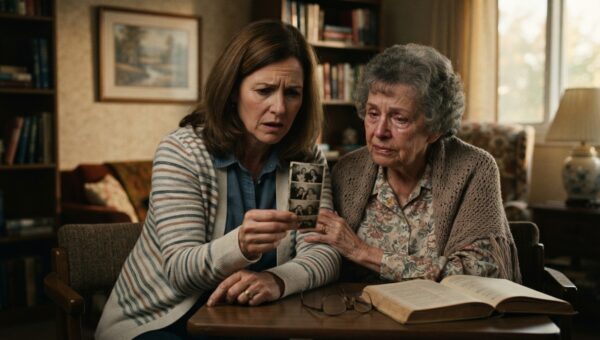
The driveway gravel settled back into place with a dry, familiar scuffle every time Odell pulled away. For nine years, that sound marked the beginning of my Sunday afternoon. He would slide the aluminum thermos into the cup holder, tap the steering wheel twice with his calloused thumb, and look at me through the open truck window. “Just clearing my head, Martha,” he would say.
He always said the exact same words. He spoke them with a flat, careful cadence that brooked no argument, a tone he had perfected sometime back in the gray autumn of 2014 after our boy Jesse didn’t come home from the diner.
I used to stand on the porch with a dish towel in my hand, watching the blue tailgate disappear past the mailbox. I figured an old man deserved his quiet. We had spent forty years building a life out on the edge of town, working the tractor until our backs ached and keeping mostly to ourselves after the county road got paved over and the neighbors started putting up brick mailboxes. When Jesse died at nineteen, hit head-on by a kid who couldn’t even manage to blow clean into a roadside breathalyzer, something inside Odell simply shut down like an old barn door dropped into its iron latch.
He never yelled. He never broke a plate. He just went out to the machine shed and fixed things that weren’t broken until his knuckles were black with grease.
When the stroke took him down in the hallway back in February, it didn’t give us any warnings. One minute he was carrying a basket of damp sheets toward the back porch, and the next he was on the linoleum, his breathing sounding like dry leaves dragged across a concrete floor. The ambulance came with its lights cutting red circles through our kitchen curtains, but by the time they got him onto the stretcher, his skin already had that cold, bluish tint of a winter creek. The funeral was a blur of black wool coats and casseroles that tasted like nothing. People said the usual kind things about a good man going to his rest, and I nodded along because that was what you did when your life was being boxed up and labeled for the attic.
It was three days after the church ladies stopped coming by with foil-wrapped hams that I finally went out to the driveway to clear out his truck. The cab still smelled like his Chesterfields and old peppermint drops, a stale, comforting odor that made my throat tighten up. I started with the door pockets, pulling out a handful of expired gas station receipts and a pocket knife with a broken tip. Then I reached for the glovebox. It always stuck a little on the left side, needing a sharp rap with the heel of my palm to pop the latch.
The plastic tongue gave way with a dull snap, and the door dropped down into my lap. Inside sat a stack of papers held together by a thick rubber band that had rotted and cracked right down the middle. I didn’t think much of it at first. Odell kept all kinds of truck manuals and old insurance cards in there, things he never threw away because he figured they might come in handy for the next owner.
I pulled the bundle out, and the top paper slid sideways, showing a row of stamped dates and a small, passport-sized box with a monochrome photograph.
My thumb stopped moving against the coarse cardstock. State Penitentiary. Visitor Division. The words were printed in blue ink right across the top edge. I turned the card over, and my eyes caught the name line, typed in that old, heavy font they use at the county seat. Inmate number 418-902. Julian Vance.
The garage seemed to tilt on its axis for a second, the light coming through the corrugated fiberglass roof panels blurring into long, white streaks. Julian Vance. That was the nineteen-year-old boy from three counties over who had crossed the center line on Route 4 by the grain elevator with a half-empty bottle of bourbon rolling around on his floorboards. That was the boy who had taken Jesse away before he even had time to shave his first gray chin hairs.
I sat right down on the running board of the truck, the cold iron biting through the back of my housedress, and began to untangle the rubber band. It snapped into three dry pieces that fell into the gravel between my sensible walking shoes. There were dozens of them. Fifty-two passes a year, stacked neatly by month, going all the way back to the winter of 2014. Every single Sunday that Odell had told me he was driving out to the ridge to clear his head, he had actually been driving two hours south down the interstate, turning off at the exit for the industrial park, and walking through the heavy steel detectors of a maximum-security prison.
Folded at the bottom of the stack was a small piece of lined yellow legal paper. It was covered in Odell’s blocky, carpenter’s handwriting, the kind of writing he used when he was drawing up rafter measurements on a piece of scrap pine. He hadn’t written it to me. It looked like an old note to himself, or perhaps something he meant to leave behind if the ticker ever gave out while he was on the road.
I unfolded the paper with fingers that felt like dry twigs. He wrote: “I go so the boy who killed our son won’t sit in there alone.”
The silence in that garage was so heavy I could hear the pilot light of the water heater humming through the kitchen wall behind me. I didn’t scream, and I didn’t drop the paper. I just stared at those fourteen words until the ink started to wobble behind my eyes. Nine years. Four hundred and sixty-eight Sundays. While I sat at home staring out at the bird feeder and wondering why my husband had turned into a block of ice that wouldn’t let me touch him, Odell had been getting into his truck every single week, driving down to sit across a scarred laminate table from the creature who had ruined our family.
My sister Clara came by on Tuesday with a tin of oatmeal cookies, and she found me sitting at the kitchen table with the passes spread out like a game of solitaire across the oilcloth. She took one look at the yellow paper and dropped her car keys right on top of the salt shaker.
“Martha, are you out of your mind?” she asked, her voice jumping an octave the way it always did when she got scared. “Why on earth would he do that? After what that little monster did to our boy? You need to burn those right now. Every last one of them.”
“He didn’t tell me, Clara,” I said, my voice sounding like it belonged to someone else standing across the room. “Not once in nine years. He ate breakfast with me every Sunday morning, and then he put on his clean shirt and went to see him.”
“It’s unnatural,” she said, reaching out to scoop the passes into a pile. “It’s like a sickness. Odell must have lost his senses after the accident. You shouldn’t have to carry this now that he’s gone.”
“Leave them,” I told her, and my hand came down flat on the table with enough force to make the sugar bowl rattle. She stopped, her fingers hovering over the corner of a 2017 visitor slip. She looked at me for a long time, her mouth pinched up like she had swallowed a lemon peel, before she grabbed her purse and let the screen door slam behind her without another word.
I didn’t sleep that night. I sat by the window watching the headlights of the logging trucks sweep across the ceiling as they took the sharp curve down by the creek. Every time I closed my eyes, I saw Odell’s face across the kitchen table, chewing his toast and looking right through me as if he were already sitting in that visiting room four counties away. I hated him for it, just for a little while during the small hours when the wind was rattling the tin on the roof. I hated that he had shared his deepest self with a stranger while leaving me out here in the cold to rattle around in an empty house like a dry pea in a pod.
By Thursday morning, the anger had burned itself down to a hard, gray ash, leaving behind a hollow sort of curiosity that wouldn’t let me breathe right. I needed to know what happened across that table. I needed to know if Odell had spent those hours screaming curses into the face of his boy’s killer, or if they had just sat there in the gloom staring at their own hands.
The drive down south took two hours and fourteen minutes. I followed the route Odell must have taken thousands of times, past the interstate exit with the rusty sign for the tractor supply, down the long stretch of two-lane blacktop where the pine trees grow so thick they keep the sun off the asphalt until noon. The prison didn’t look like much from the road, just a series of long, low brick buildings surrounded by gray chain-link fences topped with coils of shiny wire that looked like silver ribbon in the midday glare.
The woman behind the bulletproof glass at the front desk had hair dyed the color of a dried peach and a little plastic name tag that said Brenda. She didn’t look up when I pushed my driver’s license through the slot in the metal tray.
“State ID or visitor pass?” she asked, her fingers already tapping away on a keyboard that sounded like a woodpecker on a dead oak.
“I’m not here to visit,” I said, laying Odell’s old leather wallet on the counter. “My husband passed away last month. Odell Higgins. He came here every Sunday for nine years. I need to know who he was seeing.”
Brenda stopped typing. She looked up through the thick glass, her eyes narrowing as she took in my black cardigan and the sensible purse I had carried to three funerals and four county fairs. She didn’t ask me how I knew. In a place like that, people usually knew more than the records let on.
“Inmate Vance is in solitary housing clearance, ma’am,” she said, her voice dropping down to a flat, professional drone. “He’s got six years left on his sentence. You looking to claim personal effects or something?”
“No,” I said, and my hand went flat against the cold steel of the counter. “I just want to sit where he sat. For ten minutes. Just to see the room.”
She looked at me for a long beat, her chewing gum moving slow in the side of her cheek. Then she reached down beneath the desk and pulled out a yellow logbook with water-stained corners, flipping back through the onion-skin pages until her red-tipped finger stopped near the bottom of a page dated three weeks ago.
“Odell never missed a month, did he?” she murmured, more to herself than to me. “Even when the snow was coming down so hard they closed the county road, that old man sat right over there in booth four. Most folks stop coming after the first year. Families get tired. People move on. But he just came in every week, sat down, and put his hands flat on the table.”
“What did they talk about?” I asked, and my voice cracked just enough to let her know I wasn’t just a curious stranger.
Brenda gave a small, dry snort that sounded like a dry valve clicking in a tractor engine. “Talk? Most of the time, they didn’t say a blessed word for the first half-hour. The boy would come in looking like he was about to throw up his boots, and your husband would just pull out a little pocket knife and start whittling on a scrap of cedar wood he brought in his shirt pocket. Little animals. Birds mostly. Cardinals and blue jays. Odell would set them down on the edge of the laminate table one by one, and Vance would line them up by size like he was counting fence posts.”
She reached out and tapped the glass with her fingernail. “You want to go back? The warden’s got an open-door policy for family members of long-term regulars if they clear the metal detector. But I got to tell you, Vance isn’t much to look at these days. He looks older than his twenty-eight years. Looks like a man who forgot how the sky looks.”
Ten minutes later, I was sitting in booth four. The air in the visiting room smelled like strong pine cleaner and old wool carpets that had been shampooed too many times with hard water. The table was scratched gray laminate with gum stuck underneath the edge, just like every school cafeteria in the state of Georgia.
The heavy metal door at the back clicked open, and a guardsman brought in a young man in a faded orange jumpsuit that hung off his shoulders like it belonged to someone else. His hair was cropped close to his skull, and he had a thin, pale scar running from the corner of his left eyebrow down into the roots of his beard. He didn’t look like a monster. He looked like a boy who had been worked over by a threshing machine and left out in the rain to dry.
He sat down across from me, his hands cuffed loosely to a leather belt around his waist, and he blinked against the harsh fluorescent light above us. He didn’t look at my face at first. His eyes dropped straight to my hands resting on the edge of the table.
“You’re not Odell,” he said. His voice was cracked and thin, like dry corn husks rubbing together in a November draft.
“I’m his wife,” I said. “Martha.”
Julian Vance flinched slightly, his shoulders hunching up toward his ears as if he expected me to reach across the table and take him by the throat. I didn’t move. I just looked at the way his knuckles were scarred over, the skin white and puckered where he must have gone through the windshield himself back when the world ended for both of us.
“He died,” I said.
The boy closed his eyes. He didn’t cry. There weren’t any tears left in him, I could tell that just by looking at the dry skin around his sockets. He just nodded once, slow and heavy, like a man agreeing to take down a barn that had rotted through at the sills.
“I know,” he whispered. “He didn’t show up last Sunday. That was the first time in nine years he didn’t come through that door. I figured something happened. He was getting on in years, Mrs. Higgins. But he stayed until the very end, didn’t he?”
“Why did he come here, Julian?” I asked. The words came out sharper than I meant them to, but I couldn’t help it. The weight of those nine years was sitting right there between us on the grey laminate. “Why didn’t he go to the police and ask for more time? Why didn’t he scream at you? You killed our boy. You took everything we had.”
Julian looked down at his cuffed hands, his fingers twitching against the metal link between them. He didn’t pull away or try to make excuses. He just stared at the table the way Odell used to stare at the floorboards after Jesse’s room was cleared out.
“The first time he came here, back in November of fourteen,” Julian said, his voice dropping so low I had to lean across the table to catch the words over the hum of the vending machine by the door, “I was ready to hang myself with my bedsheet. I didn’t have nobody. My mama died when I was twelve, and my uncle who raised me wouldn’t even accept my collect calls from the county jail. I was all alone in that tank, and every time I closed my eyes, I saw your boy’s headlights coming at me through the rain.”
He stopped, swallowing hard as his throat worked against the dry air.
“Your husband walked in here looking like he wanted to kill me with his bare hands,” Julian continued, his eyes finally coming up to meet mine. “He sat right where you’re sitting now. He didn’t say a word for twenty minutes. He just stared at me until I started shaking so hard I fell right out of my chair. And then he reached into his shirt pocket, pulled out a little wooden duck he’d whittled out of scrap cedar, and set it on the table between us.”
Julian leaned forward, his voice dropping to a harsh, ragged whisper.
“He looked at me, Mrs. Higgins, and he didn’t call me a murderer. He didn’t spit on me. He just said, ‘You’re nineteen years old, and you’ve got no one left to tell you when you’re acting like a fool. I’m going to come back next week, and you’re going to sit here and tell me you’re still breathing.'”
He reached into the deep pocket of his orange jumpsuit with his cuffed hands, fumbling for a second before he pulled out a small, smooth piece of cedar wood no larger than a matchbox. It was shaped like a tiny, rough-hewn sparrow, its wings folded tight against its body, polished bright from years of being turned over and over in nervous palms.
“He brought me one of these every single month,” Julian said, his voice breaking at last as a single drop of water finally leaked out and tracked down his scarred cheek. “He never talked about Jesse much. We just sat here. Sometimes we played checkers with little bits of cardboard. He kept me alive, ma’am. If he hadn’t walked through that door every Sunday, I wouldn’t have made it through the first two years. I’m sorry. God help me, I’m sorry about your boy.”
I sat there in that harsh, white-walled room for a long time, looking at the tiny wooden bird in his cuffed hands. The anger that had been sitting in my chest like a lump of cold lead ever since I found the glovebox notes didn’t vanish all at once. It didn’t turn into some movie-style forgiveness where you hug the person who ruined your life. But something else shifted, quiet and heavy like an old door finally clicking shut in the wind.
Odell hadn’t gone down there to betray our boy’s memory. He had gone down there because he looked into the dark and realized that if he let hatred consume the last remaining pieces of his soul, there wouldn’t be anything left of him either. He had carried that cross in absolute silence for nine years just so I wouldn’t have to share the room with the ghost of the boy who took our son. He had protected me the only way he knew how, by taking the ugliness of it all and burying it deep in the pocket of his old canvas coat every Sunday afternoon.
“Keep it,” I said, nodding toward the little wooden sparrow in his hand.
Julian looked down at the carving, his fingers closing over it so tight his knuckles turned the color of chalk. “He told me he’d bring me a bigger one once I got out,” he whispered. “He said we’d go fishing down by the creek.”
“The creek’s mostly dried up now,” I told him, standing up and smoothing the front of my black cardigan. “The beaver dam broke three winters ago. But the water still runs deep enough if you know where to drop the line.”
I walked out of that visiting room without looking back, my boots clicking hard against the linoleum floor. The two-hour drive home was quiet, the radio turned off so I could listen to the hum of the tires against the asphalt and the steady clicking of the turn signal as I took the exit toward the farm.
When I got back, the sun was sitting right on the top of the ridge, turning the old barn roof the color of dried blood. I didn’t go straight inside. I walked around to the back porch where Odell’s old metal thermos was still sitting on the wooden bench where he had left it the morning he fell.
I took the thermos over to the kitchen sink, unscrewed the black plastic cap, and dumped out the stale water from the morning he died. I filled it up with fresh well water from the tap, scrubbing the inside with the old gray sponge until the stainless steel shone bright enough to catch the light coming through the window. Then I turned it upside down on the wire drying rack right beside the windowpane.
I reached out and plucked a single wild purple aster that had managed to push its way up through the gravel near the porch steps, its petals rough and wind-beaten from the October snap. I tucked it right beneath the wire of the drying rack, beside the clean, open mouth of the thermos, where it could catch the last bit of the afternoon sun before the dark came down over the ridge.