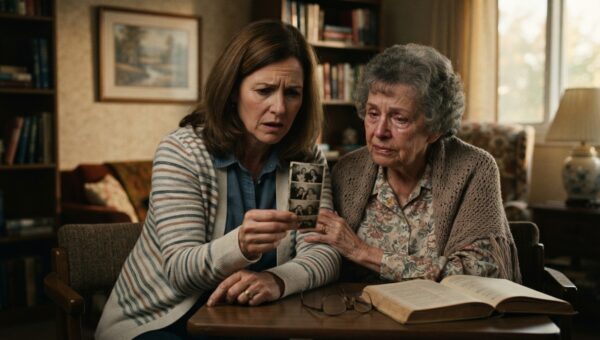
The delivery truck had been gone for maybe ten minutes when the kitchen went quiet, that thick, heavy kind of quiet where you can hear the refrigerator motor clicking off. My aunt Beatrice was standing right by the sink with a roll of bubble wrap in her hand, her rings clinking against each other every time she moved. She didn’t even wait for the smell of the funeral flowers to fade out of the hallway before she started dividing up the silver teaspoons.
Marcus, my brother, leaned his hip against the counter with a cup of lukewarm black coffee and tapped his phone screen against his palm. He looked at Beatrice and nodded toward the dining room sideboard. “We should probably check the lower drawer for the bonds before Chloe gets back with the boxes,” he said. His voice was too loud, too casual, like he was talking about inventory at a hardware store instead of the house where we used to shell peas on the back steps.
Grandma Clara had only been gone since Tuesday morning. Her bedroom still smelled faintly of lavender soap and the Vick’s Vaporub she rubbed into her chest when the autumn damp got into her joints. But the house didn’t feel like hers anymore. It felt like a crime scene where the police had already left and the scavengers had climbed through the windows.
I was sitting at the edge of the floral armchair, the one with the worn armrests where her little gray cat used to sleep before it died back in nineteen-ninety-something, holding a cardboard box of photographs that nobody else wanted.
Every time I reached for something that actually mattered to me, a small picture of her garden or the brass bell she used to ring for dinner, somebody would make a sharp noise or wave a hand.
“Leave the brass one, Clara wants that for the porch,” Beatrice had snapped, even though Beatrice lived three states away and hadn’t visited twice in five years.
And then Cousin Julian walked in from the hallway holding two gold-framed portraits of our great-grandparents, his teeth showing in a wide, greasy grin. “Look what I found behind the cedar chest,” he said, holding them up like he’d just discovered sunken treasure. “These might fetch fifty bucks apiece down at the antique mall on Route 9.”
I didn’t say anything. I just looked down at the photograph in my lap, an old polaroid of Grandma standing by her tomato plants in an apron with grease stains on the pocket.
That was when Beatrice walked over, holding a folded bundle of heavy cotton that smelled faintly of cedar and old dust. She dropped it right into my lap like she was tossing a wet towel to a dog.
“This should go to you,” Beatrice said, her mouth twisting into that tight, patronizing smile she always wore when she thought she was being generous.
Julian coughed into his hand and smirked. “Perfect. No resale value.”
Then Marcus leaned back in his chair, crossed his arms, and laughed a dry, rattling sound. “Honestly, giving her the quilt saves us from hearing speeches later about memories and family history.”
They all laughed then. A light, easy little chuckle that bounced off the floral wallpaper and died somewhere near the ceiling. They thought they were so clever. They had spent the last six hours ransacking the drawers, stripping the jewelry boxes, and arguing over who got the title to the old Buick, and they felt good about themselves.
They had left me the heavy patchwork quilt because it was faded in spots and had three cigarette burn holes near the bottom corner where Uncle Ray used to sit back in the seventies.
I didn’t argue. Didn’t ask for a different share of the silver. Didn’t even unfold it there at the table. I just carried it out to my sedan, tossed it into the passenger seat, and drove the twenty miles back to my apartment with the windows rolled down because the air in that house felt like it was sticking to my skin.
I left the quilt sitting over the back of my couch for three days. Every time I walked past it in the dim light of the evening, it looked lumpy and tired, just another piece of junk left behind by someone who had taken up too much space in the world. I told myself I would wash it eventually, maybe take it to the laundromat on Maple Street where the industrial machines could handle the weight of it.
Then last night, while I was sitting there with a cup of tea and a rerun of some old game show playing on the small television in the corner, my elbow caught the edge of the fabric. I heard a small ripping sound. A loose thread, right near the dark green binding where the backing met the top.
I set my mug down on the coffee table and reached out to pull the little thread loose so it wouldn’t snag on my sweater. It didn’t snap the way cheap cotton thread usually does. It held firm, pulling tight against the lining with a strange, stubborn resistance.
I grabbed the small pair of sewing scissors from the basket under the end table and leaned in closer to the light of the floor lamp. The silence in the room was absolute, just the hum of the refrigerator and the ticking of the clock on the wall. I snipped one tiny stitch, then another, easing the green cotton binding away from the heavy backing.
Inside the seam, the fabric wasn’t filled with the usual lumpy cotton batting or old flannel scraps you’d expect from a homemade utility quilt. My fingers brushed against something stiff, flat, and remarkably uniform. It didn’t feel like stuffing. It felt like paper. Or woven cloth treated with something heavy to keep it rigid.
I don’t even know why my heart started beating a little faster right then, but my hands got clumsy. I didn’t want to cut the fabric, so I used the tip of the scissors to carefully pick at the old, yellowed stitches, one by one, until a two-inch gap opened up near the corner.
I slid two fingers inside the dark opening. The material felt like fine linen, tightly woven and crisp. When I pulled the edge toward the light, I didn’t see batting. I saw rows and rows of tiny, painstaking embroidery.
Grandma Clara had spent forty years making quilts for every wedding, graduation, and baby shower in the county, but this one was different. The stitches weren’t flowers or stars. They were letters and numbers. Row after tiny, precise row of dark blue and crimson thread, stitched so neatly it looked like ink printed on cloth.
I sat there on the edge of the couch for a long time, just staring at the first line near the corner.
August 14, 1994. Beatrice. Down payment on Buick LeSabre. $12,450. (Loaned, never repaid).
I blinked and rubbed my eyes, thinking the tired dimness of the room was playing tricks on my vision. But the letters didn’t change. I moved the lamp closer, my hand shaking just a little as I held the heavy fabric open.
October 3, 2001. Marcus. First mortgage relief. $25,000. (Noted as ‘gift’ per family pressure, conditioned on future care).
The quilt wasn’t a blanket. It was a ledger. A complete, itemized, embroidered history of every time Grandma Clara had bailed out her greedy children, covered their debts, paid their tuitions, or handed over cash to keep them from losing their houses. Every single favor, loan, and financial rescue operation spanning three decades was stitched right into the core of the quilt, row by row, complete with dates, amounts, and initials.
I stayed up until four in the morning with those sewing scissors, carefully unpicking the lower seam three inches at a time, turning the heavy fabric over in my lap like a scroll. By the time the sky outside my apartment window started turning that pale, bruised gray before dawn, I had uncovered half the bottom panel.
There was Beatrice’s college tuition split across four winters. There was Marcus’s failed landscaping business bailout from the spring of two-thousand-and-eight, listed down to the exact dollar amount of $38,470. And right at the bottom corner, hidden inside a double-lined pocket near the hem, I found a sealed heavy plastic envelope that hadn’t seen the light of day in years.
Inside the envelope was a formal legal codicil, signed by Grandma Clara and witnessed by two people from her church back in May, just two weeks before her stroke. It wasn’t the rambling, emotional letter my family expected. It was a legally binding amendment to her primary will, explicitly stating that all previous financial disbursements made to Beatrice and Marcus were to be deducted dollar-for-dollar from their shares of the estate. And as for the house, the land, and the primary savings accounts remaining in her credit union?
They were left entirely to me.
I didn’t sleep for the rest of the night. I just sat at the kitchen table with a legal pad and a pen, checking the numbers against the embroidered columns, translating my grandmother’s quiet, methodical wrath into plain English. She had watched them circle her house like vultures for years, and instead of screaming at them, she had simply sat in her rocking chair every evening after dark, threading her needle, and writing it all down in red and blue cotton.
By Friday afternoon, my phone started buzzing on the kitchen counter while I was boiling water for pasta. It was Marcus. I let it ring out to voicemail. A minute later, a text popped up on the screen.
Marcus: Beatrice is meeting me at Grandma’s house in an hour with the title agency forms. You need to come sign the release for the residual accounts so we can close the probate filing today. Don’t be difficult.
I stared at the screen for three seconds. Then I picked up the phone, tapped out a short reply, and hit send.
Me: Meet me at Grandma’s house instead. Bring Beatrice and Julian. We need to go over the final accounting together.
Marcus didn’t reply, but twenty minutes later, my car was pointed down the familiar gravel driveway of the small brick house on Elm Street.
When I walked through the front door, the place already looked hollowed out. The walls were bare where the landscape paintings used to hang, and a stack of empty cardboard boxes sat by the front coat rack like building blocks for a fort. Beatrice was sitting at the kitchen table with a thick manila folder, and Marcus was pacing near the sink, checking his watch with an impatient scowl on his face. Julian was leaning against the refrigerator, scrolling through his phone.
“Finally,” Beatrice said, not even looking up as I walked in. “We’ve got forty-five minutes before the title office closes, Clara. Just sign the executor waiver on page three so we can divide the remaining bank balance and be done with this mess.”
I didn’t take off my jacket. I didn’t sit down at the chair they had left open for me near the door. Instead, I walked over to the wooden dining table, the same table where they had divided the silver three days ago, and laid a heavy, folded bundle of fabric right down in the middle of it.
The old patchwork quilt landed with a dull, heavy thud against the polished wood.
Marcus stopped pacing. He looked down at the quilt, then up at me, his eyebrows pulling together in a sharp, irritated V. “What is this? We told you to leave the junk at your apartment. We’re trying to do paperwork here.”
“You forgot to check the inventory,” I said. My voice didn’t shake. It sounded surprisingly calm, almost flat, like I was reading a weather report.
Beatrice set her pen down slowly, her eyes narrowing as she looked at the faded green binding. “Clara, don’t play games with us today. We don’t have time for your little sentimental items. The lawyer is waiting for these signatures.”
“The lawyer already has his copy,” I said.
I reached out and unfolded the top edge of the quilt, spreading the heavy fabric across the table so the embroidered red and blue rows caught the afternoon light coming through the kitchen window. The tiny, precise letters were right there in the open, plain as day, stretching across the backing from corner to corner.
Julian leaned forward, squinting down at the fabric. “What am I looking at? Is that… sewing?”
Marcus took two quick steps toward the table, his hand reaching out to touch the fabric before he snatched it back like the cotton was hot. He read the first line near his name. His face didn’t go pale the way people’s faces do in the movies; it just went tight, the skin around his nose pinching together while his eyes darted across the columns of dates and dollar amounts.
“August fourteenth, ninety-four,” Marcus muttered, his voice dropping an octave. “What is this?”
“That’s the Buick LeSabre Aunt Beatrice bought when her transmission blew,” I said quietly. “And right below it is your first mortgage relief from two-thousand-and-one. Twenty-five thousand dollars. Plus interest, according to Grandma’s notes in the margin.”
Beatrice stood up so fast her chair screeched against the linoleum floor. She leaned over the table, her hands flat on the wood, her fingers trembling slightly as she stared at the rows of embroidery. “This… this isn’t a legal document. This is sewing. You can’t bring a quilt to probate court, Clara. Are you out of your mind?”
“It’s not just a quilt, Aunt Bea,” I said, reaching into my coat pocket and pulling out the heavy plastic envelope with the legal seal. I laid the codicil right on top of the embroidered ledger. “Grandma had her attorney draft this amendment three weeks before she passed. She itemized every single advance, loan, and bailout you two took from her over the last thirty years, and she subtracted every penny from your share of the estate. According to this, and according to the credit union records currently locked under my name as sole executor, you don’t have a balance coming to you. You’re actually in the negative.”
The kitchen went so quiet you could hear the distant hum of a lawnmower three houses down.
Marcus looked from the paper to the quilt, then back to me, his jaw working like he wanted to say something heavy and violent, but the words wouldn’t come. His mouth opened once, twice, and then closed with a sharp click. “You’re lying,” he whispered. “You made this up. You printed this out or… or forged it.”
“I didn’t stitch forty years of your financial mistakes into a blanket, Marcus,” I said. “Grandma did. Every time you called her crying about a failed venture or a missed payment, she sat right in that armchair over there with her glasses on and embroidered your mistakes into the lining so you couldn’t lie about them later.”
Julian backed away from the refrigerator, his phone slipping an inch in his hand before he caught it. “I’m not part of this,” he muttered, shaking his head. “I didn’t take any money. I just wanted the portraits.”
“The portraits go with the house,” I said. “Which also belongs to me now.”
Beatrice didn’t yell. She didn’t throw a fit or slam the table. She just sank back down into her chair slowly, her hands dropping into her lap like all the starch had gone out of her clothes. She stared at the faded patchwork squares, her lips moving silently as she read her own name stitched in red thread right beside a figure of twelve thousand dollars she had long since pretended never happened.
“She knew,” Beatrice whispered, her voice sounding small and brittle in the empty room. “She knew the whole time.”
“She knew everything,” I said. “She just waited until she had enough fabric to finish the story.”
They didn’t stay another ten minutes. Marcus grabbed his car keys off the counter without looking at either of us, muttered something foul under his breath, and walked out the front door without holding it for Beatrice. She followed him a minute later, her purse clutched tight against her ribs, her head down as she hurried across the gravel driveway without looking back once. Julian had already slipped out the side door while we were talking, leaving the gold-framed portraits sitting face down on the sideboard where he’d dropped them.
I stood alone in the quiet kitchen for a long time after the sound of their car engines faded down the road.
The sun was dropping lower now, casting long, golden bars across the green linoleum floor right where Grandma Clara used to stand to stir her Sunday gravy. I reached out and gently ran my hand over the heavy cotton quilt, feeling the dense, bumpy texture of the stitches hidden beneath the surface. It wasn’t soft, and it certainly wasn’t pretty in the traditional sense, but it was the most honest thing left in this house.
I folded the quilt carefully, section by section, and tucked it under my arm.
When I got home to my apartment an hour later, I didn’t put the quilt back on the couch. I carried it into the spare room, laid it out flat across the wide wooden armchair by the window where the afternoon sun hits the wall just right, and smoothed out the edges. Then I went into the kitchen, filled my favorite mug with hot water and tea, and sat down in the quiet space that was finally, truly mine.