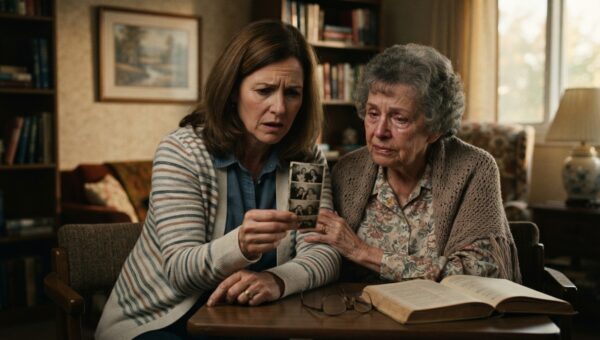
The smell of wet wool and cedar always stays in my chest whenever it rains too hard. It brings me straight back to the gravel of that driveway, twenty-four hours after we lowered Terrence into the cold ground, when Brenda decided my time in their family was officially over.
Terrence had been gone for one day. Just one. His shoes were still lined up by the back door exactly where he left them on Tuesday night, the left heel worn down a little more than the right because he walked with a slight hitch ever since his tractor accident back in ninety-eight.
I was sitting at the kitchen table with a cold cup of chicory coffee, trying to figure out how to breathe in a house that suddenly felt ten sizes too big, when the front door swung back hard enough to bang the drywall.
Brenda didn’t even knock. She marched straight through our mudroom like she owned the title to the place, her heels clicking a sharp, angry rhythm against the linoleum. Behind her came Howard, his hands shoved deep into his pockets with that heavy, superior slouch he always wore when he wanted you to feel small, and Chloe, holding her phone up with the front-facing camera already glowing.
“Pack your things, Helen,” Brenda said. She didn’t even look at me. Her eyes were darting around the room like she was taking inventory of the toaster and the copper pots Terrence’s uncle had hammered out by hand. “We’ve spoken to the lawyers.
Terrence didn’t leave a proper will that registered with the family trust, which means everything reverts to the bloodline. You’re just a guest who overstayed.”
I remember looking at the fringe of the braided rug under my chair. A stray thread was loose, and I had the sudden, absurd urge to reach down and trim it with the sewing scissors in the drawer.
“Terrence and I were married twenty-two years, Brenda,” I said. My voice sounded thin, like paper tearing.
“And twenty-two years of charity is quite enough,” Howard piped up from the doorway, jingling his car keys. “Mom’s right. The estate goes to the foundation. You don’t have a claim to a single shingle on this roof, and honestly, staying here makes everyone uncomfortable.”
They had already stacked my three cheap canvas suitcases by the front step before I even stood up. Brenda hauled the heavy one down the porch stairs herself, letting it drop hard against the wet gravel with a dull thud that sent muddy water splashing up against my porch shoes.
“Now that Terrence is gone, you get nothing,” Brenda sneered, dusting off her palms like she had just done a hard day’s work.
Chloe stepped closer, the light from her phone screen flashing right in my eyes. “Say bye to the house, Aunt Helen. Give us a little wave for the family group chat.”
The rain was starting to pick up again, turning the driveway dust into a thin, gray paste. My old wedding album was sitting on the foyer bench where I had left it after pulling it out of Terrence’s cedar chest. The cover was cloth-bound, dark green once, but the bottom corner had soaked up a puddle of dirty water from where Brenda dropped my bag across it.
I walked out the front door in my stocking feet, ignoring the cold bite of the gravel, and bent down to pick up that heavy, damp book. The pages inside were stuck together, warped by the rain, smelling of old glue and dust.
Howard crossed his arms, looking down his nose at me with a smirk that didn’t reach his eyes. “What are you dragging that old junk out for? Leave it. It’s ruined anyway.”
I stood up, holding the soggy book against my black cardigan, and looked right past Howard at the slate-gray sky over the valley.
“You’re right,” I said quietly. “I have nothing.”
Chloe laughed, a high, sharp sound that cut right through the drizzle, and hit stop on her recording.
I didn’t argue. I didn’t scream, and I didn’t pull out the leather folio sitting deep in my handbag that detailed the fifty million dollars in liquid municipal bonds I had inherited from my father’s timber business before Terrence and I even met. Terrence loved me because I didn’t care about his mother’s high-society posturing, and we agreed early on to keep my family’s money completely separate from his family’s greedy little hands. They genuinely believed I was a penniless schoolteacher’s daughter who had married up, and I let them keep believing it because peace was always worth more than pride.
Until that morning on the lawn.
The next six months were quieter than any season of my life. I bought a small, brick-faced cottage down near the county line, right where the maple trees turn bright orange every October. I spent my afternoons sitting at a white wooden table on my new back porch, using a pair of blunt tweezers and a little dish of warm water to slowly, carefully peel apart the pages of my ruined wedding album.
It took weeks. Some pictures of Terrence and me cutting the cake at the old VFW hall were half-destroyed, the emulsion lifting right off the paper, but I managed to save the one of him laughing with his shirt collar half-turned up.
While I was getting my house in order, my lawyer, Arthur, was busy getting his.
Arthur loved a puzzle, and he loved nothing more than digging through public filings for high-society families who spent more than they earned. It turned out that Howard and Brenda’s grand philanthropic empire, the Oakridge Heritage Foundation, was built on tissue paper and unpaid loans. They had been borrowing against future gala donations to maintain their estate, and when the bank called due on their primary development loan, they were staring down a fifty-million-dollar deficit that threatened to take their country club memberships, their imported cars, and their precious charity house.
They were desperate for an anchor donor. Someone with deep pockets, zero personal questions, and enough capital to bail them out before the local paper got wind of the foreclosure proceedings.
By March, the primary debt holding the entire Oakridge Foundation had been bought out by a private holding company named Pine Creek LLC.
And Pine Creek LLC was entirely owned by one person.
The charity gala was held at the grand ballroom of the St. Jude Hotel downtown. The invitation had arrived in my mailbox three days prior, addressed to *Occupant*, though Howard’s secretary had scrawled a mocking little note on the back suggesting I might want to come work the coat check since I needed the income.
I wore a dark emerald silk dress that had belonged to my mother, paired with a simple pearl pendant that Terrence had bought me at a roadside antique shop for our tenth anniversary. No flash, no diamonds, just clean lines and quiet money.
The ballroom smelled of expensive gin, damp wool from coats left in the foyer, and the stale vinegar of mass-produced potato salad. High-society women in heavy gold chains were laughing too loud by the ice sculpture, and Howard was standing near the stage holding a microphone, basking in the warm glow of his own supposed generosity.
He didn’t see me slip through the side doors behind the dessert tables. He was right in the middle of thanking the anonymous angel investors who had supposedly kept his foundation afloat at the eleventh hour.
“We are living proof,” Howard boomed into the PA system, his chest puffed out under his tailored tuxedo, “that true leadership and family legacy always find a way to weather any storm. Special thanks to our financial partners for recognizing the vital work we do here.”
The applause rolled across the room like dry thunder.
I walked right up the center aisle, my heels making a clean, measured click against the polished parquet floor. A few heads turned, eyebrows lifting at the sight of a woman who didn’t belong in the inner circle, but nobody tried to stop me until I reached the base of the short wooden steps leading up to the stage.
Howard’s smile faltered the second he saw my face. The color drained right out of his cheeks, leaving him looking pasty under the stage lights.
He lowered the microphone a fraction, his eyes darting to the side doors like he was looking for security. “Helen. This is a private ticketed event. I told you, “
I didn’t wait for him to finish. I stepped up onto the stage, stood two feet away from him in front of three hundred of the county’s wealthiest elites, and looked him straight in the eye.
“You evicted the wrong person from the lawn, Howard,” I said, my voice carrying clearly through the open microphone he was holding.
Howard’s mouth opened, but no sound came out.
“You thought I was leaving with nothing,” I continued, keeping my tone level and calm, the way you talk to a child who dropped his toy in the mud. “But I didn’t. I left with my wedding album. And last week, Pine Creek LLC bought the underlying mortgage on this entire hotel, every acre of your family estate, and every single cent of debt your foundation owes.”
A murmur rippled through the front tables. Brenda stood up so fast from the VIP row her napkin fell into her lap.
“You’re lying,” Howard choked out, his hands beginning to shake so badly the microphone rattled against his cuff links. “That’s, you don’t have that kind of money. You lived in that drafty farmhouse.”
“Terrence liked a quiet life,” I said, stepping back just enough to let the weight of the room settle on his shoulders. “He liked a wife who didn’t need to shout to feel important. But your mother made sure I took my suitcases, Howard. So I took them all the way to my bank.”
I reached into my handbag, pulled out a thick manila envelope bearing the embossed seal of the state banking commissioner, and laid it gently on the edge of the mahogany podium right beside his notes.
“Your foundation is in default as of four o’clock this afternoon,” I told him, loud enough for the reporters at the back table to hear every syllable. “And unless I sign the restructuring agreement by Monday morning, the sheriff is going to lock the front gates of your precious country club. Have a wonderful evening, Howard.”
I turned around, walked back down the steps without looking at Brenda or Chloe, and pushed through the heavy glass doors into the cool night air.
My car was waiting in the valet lane, the engine idling softly.
When I got back to the cottage, the house was dark and smelled faintly of pine and old paper. I walked into the front room, set my handbag on the cherrywood table, and reached for the fully restored wedding album sitting proudly in the center of the shelf.
I opened it to the page where Terrence was smiling back at me, his eyes crinkled at the corners against the bright June sun, and then I slid the glass case shut with a soft, clean click.
Outside, the moon was cutting a clear, bright line across the dark hills, and for the first time in six months, the quiet didn’t feel heavy at all.