The cardboard box sat on the kitchen counter for three days before I finally opened the plastic wrap. Mark bought it for my fiftieth birthday, laughing as he handed it over and saying something about tracing our ancestry back to some obscure corner of Ireland. It cost $199. I remember peeling back the tape with my thumb, thinking it was just a silly way to spend a rainy Tuesday afternoon while Mark was out at the hardware store.
Six weeks passed before the digital notification chimed on my phone while I was standing at the sink rinsing out coffee mugs. The screen didn’t show a list of distant cousins in County Cork or some vague percentage of Scandinavian heritage. It showed a direct blood match. A half-sibling. A woman named Patrice, born three months after me in the same county hospital.
My hand started shaking against the counter edge. Three months. That meant my father had been keeping two lives running parallel during the summer and autumn of seventy-four, juggling two pregnant women without either of them ever finding out.
I didn’t wait to think it through or pour another cup of coffee. I picked up the landline phone in the hallway because my cell was still sitting by the sink, and I dialed my father’s number with my thumb pressing hard against the plastic buttons. He picked up on the third ring, his breathing heavy the way it always got when he was tinkering in the garage with his small-engine parts.
“Dad, who is Patrice?” I asked.
The silence on the other end wasn’t a pause to think. It was a drop-off into a deep, frozen well. I heard the faint hum of his old radio in the background, a country station playing through the static, and then his voice came back, thin and sharp as a razor.
“Where did you hear that name?” he asked.
“A DNA test,” I said. “Mark bought me one for my birthday. She’s a half-sister, Dad. Born three months after me.”
He hung up without another word. The click of the receiver hitting the cradle sounded like a door slamming shut in an empty house.
Ten minutes later, before I could even set the phone back on its base, it rang again so loudly it made me jump. I picked it up, expecting my father to stammer out some kind of excuse or tell me I was imagining things.
Instead, my mother’s voice came screeching through the earpiece, shrill and shaking with a fury I had never heard from her in fifty years of life.
“How dare you dig into things that don’t concern you,” she screamed. “You have no idea what you’re stirring up. Leave it alone right now.”
“He had another family, Mom,” I said, my voice dropping into a flat, cold register that surprised even me. “Or at least another child. How long did you know?”
She didn’t answer. She just let out a ragged breath and hung up on me too.
I stood there in the hallway for a long time, listening to the dial tone drone on like a mechanical heartbeat. The sun was coming through the front window, cutting a bright, dusty stripe across the hardwood floor where the varnish was starting to wear thin near the coat rack. I looked down at my hands, at the short unpolished fingernails that looked so much like my father’s square fingers, and realized I couldn’t just walk back into the kitchen and pretend the phone hadn’t rung.
I grabbed my car keys off the hook, slipped my canvas jacket over my shoulders, and walked out to the Ford. Patrice’s address was on the profile page, just twenty-two miles north in the neighboring valley where the old brick mill houses sat under the shadow of the ridge.
The drive took twenty-seven minutes because a tractor was crawling along the two-lane state highway, its orange hazard beacon blinking lazily against the gray morning sky. I gripped the steering wheel so tight my knuckles turned white, my mind racing through every memory I had of my childhood, looking for the cracks in the foundation. My dad had always been a quiet man, working long hours at the lumber yard, coming home smelling of cedar dust and pipe tobacco, sitting in his armchair with the evening paper. I thought I knew every inch of him. I thought our family was the only one he had ever built.
When I pulled up to the curb at 228 Maple Street, the house looked small and neat, painted a pale yellow with white trim around the porch windows. A single white Honda Civic sat in the gravel driveway. The autumn wind was blowing dry maple leaves across the yard, rattling them against the fenders.
I sat in the car for three full minutes with the engine idling, watching the front curtains stay completely still. My stomach felt like it was full of cold stones. Every instinct I had told me to put the car in reverse, drive back home, and let my parents keep their fortress of silence intact. But the memory of my mother’s screaming voice pushed me forward. It wasn’t the voice of someone defending an innocent man. It was the voice of someone guarding a vault.
I got out, walked up the three wooden steps of the porch, and pressed the doorbell.
Inside, I heard a muffled chime, followed by the sound of footsteps crossing a bare floor. The door swung open before I could take a breath.
I didn’t faint, but my breath caught in my throat so hard I actually staggered backward half a step. The woman standing in the doorway had my eyes. She had the exact same narrow slope of the nose, the same slight dip in the chin, and that faint, pale birthmark sitting just above her left eyebrow like a smudge of ink. She was wearing a faded gray sweatshirt and holding a wooden mixing spoon in her right hand, her mouth slightly parted in surprise.
“Can I help you?” she asked. Her voice had the same low, resonant timbre as mine, though she spoke with a quicker, sharper clip.
“I think,” I managed to say, my throat feeling like sandpaper, “we have the same father.”
Patrice didn’t drop the spoon, but her fingers tightened around the handle until her knuckles went pale. She stared at my face, her eyes darting from my forehead down to my mouth, tracking every feature as if she were looking into an old, distorted mirror in a funhouse.
“You’re the DNA match,” she whispered. It wasn’t a question.
“I am,” I said. “My name is Clara. Well, Clara is my middle name, but, “
“My mother’s name was Clara,” she interrupted, her voice dropping an octave. She stared at me for another second, her chest rising and falling quickly under the gray cotton. Then she stepped back, pulling the door wide open. “You better come inside before the neighbors start staring.”
The living room smelled faintly of lemon oil and cinnamon tea. A small radio played classical music softly in the corner, and a stack of mail sat neatly on a round oak table near the window. There was none of the chaos I had half-expected, no sign of a dramatic storm, just the quiet, ordinary interior of a life built far away from mine.
Patrice led me into the small kitchen at the back of the house and gestured toward a chair at a square wooden table. She didn’t offer coffee right away. Instead, she walked over to the counter, picked up a thick, leather-bound photo album with a cracked spine, and brought it over like it was something heavy and dangerous.
She sat down across from me, her eyes still scanning my face with a kind of hungry disbelief.
“He never told you about us, did he?” she asked softly.
“He wouldn’t even say your name,” I told her. “I called him ten minutes after I saw the results. He hung up on me. And then my mother called and screamed at me for digging.”
Patrice let out a dry, humorless sound that wasn’t quite a laugh. “That sounds about right. They bought him out, didn’t they? Or he made his choice when the lawyers got involved back in seventy-four.”
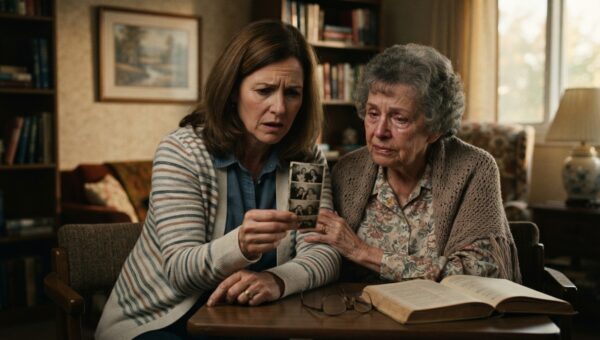
She opened the album to the middle pages, where the black paper was slotted with white corner tabs holding fading polaroids and square color prints from the mid-seventies. She slid one particular photograph across the laminate table toward me.
The man in the picture was younger, his hair dark and thick before the gray took over, wearing a plaid flannel shirt with the sleeves rolled up to his elbows. He was standing beside a young woman with long dark hair and a wide, bright smile, his arm wrapped firmly around her waist. They were standing in front of an old red barn that I recognized instantly from my grandfather’s property down near the river.
The woman in the photograph wasn’t my mother. She had soft, round features and kind eyes, looking straight into the camera lens with an expression of quiet, absolute trust.
“That’s Clara,” Patrice said quietly, tapping her fingernail against the corner of the picture. “My mother. She died when I was twelve. She never married, but she kept this album in her cedar chest until the day she passed. She always told me my father was a good man who got caught between two worlds and didn’t have the courage to fix it.”
I looked from the face of the young woman in the photograph up to Patrice, and then down at my own hands resting on the table. The whole puzzle clicked into place with a sickening, heavy thud. Fifty years ago, my father had been dividing his time between two women, getting one pregnant in the spring and another in the summer, until the pressure of small-town respectability and my mother’s family’s standing forced him to draw a hard line in the dirt. He chose my mother’s side, bought off the silence with whatever money he could scrape together from the lumber yard, and buried the other life so deep he probably convinced himself it never happened.
“She knew,” I said, thinking of my mother’s shrieking voice over the wire. “My mother knew every single day of her life.”
“Of course she knew,” Patrice said, her voice steady now, though her hands were trembling slightly as she closed the album. “Secrets like that don’t stay buried in a town this size without a lot of heavy lifting. They just built a wall around it and hoped we’d never find the gate.”
We sat there in the quiet kitchen for over an hour, piecing together the timeline of our parallel childhoods. We talked about the way our father walked with a slight hitch in his left knee after an old logging accident, the way he always smelled like pine pitch when he came home from work, and how he never liked talking about his own family history. We weren’t strangers, not really. Every gesture we made, every time we tucked a stray lock of hair behind our ears or laughed with a short, sharp intake of breath, we were looking at the same genetic blueprint.
When I finally stood up to leave, the afternoon sun was dipping low behind the ridge, casting long, bruised shadows across the valley.
“Are you going back there?” Patrice asked, standing by the screen door as the cool air drifted in from the porch.
“I have to,” I said. “I can’t just go home and pretend I didn’t see this.”
She reached out and touched my forearm, her skin warm and dry against mine. “Be careful. They’ve been protecting that lie for fifty years. They’re not going to hand over the rest of the truth just because we showed up.”
The drive back down the state highway felt different, the empty road stretching out ahead of my headlights like an unrolled ribbon. By the time I turned into the gravel driveway of my parents’ house, the kitchen light was burning yellow behind the sheer curtains.
I didn’t knock. I walked straight up the steps, turned the brass knob, and pushed the front door open.
My father was sitting at the kitchen table with a cup of cold tea in front of him, looking smaller and older than his seventy-nine years, his shoulders rounded under a faded cardigan. My mother was standing by the stove, her back rigid, her hands gripping the edge of the counter so hard her knuckles were stark white.
They both turned as the door clicked shut behind me.
“You shouldn’t have gone there,” my father said, his voice cracking slightly before he cleared his throat.
I walked into the kitchen, pulled out a chair directly across from him, and laid the vintage photograph of Clara and him right down in the center of the tea table, right beside his ceramic mug.
“She kept this until she died, Dad,” I said, my voice barely above a whisper, but the room went completely still around us. “And Patrice kept it after that. Fifty years of pretending she never existed doesn’t make her go away.”
My mother opened her mouth as if to start screaming again, but she looked down at the photograph, at the young woman smiling up from the cardboard table, and the breath seemed to leak right out of her. She sank down into the chair beside my father, her shoulders finally dropping as the fifty-year-old illusion splintered into pieces on the linoleum.
“I’m not here to yell at you,” I told them, looking from my father’s weathered face to my mother’s stunned eyes. “I’m just here to tell you that I’m done keeping the secret.”
I got up, walked back out through the front door, and left them sitting in the quiet kitchen with their ghosts.
The next afternoon, the sun was bright and warm enough to sit outside on Patrice’s back deck before the frost set in for good. Two identical ceramic mugs of black coffee sat side by side on the small wooden table between our chairs, sending up thin ribbons of steam into the crisp autumn air. We didn’t talk about our parents or the fifty years of silence that had kept us apart. We just sat there looking out over the dry grass of the backyard, laughing at the way our shoulders moved in exact time, and began the work of figuring out the next fifty years together.