The green plastic bin hit the asphalt with a hollow, echoing crack that sent three pigeons scattering from the curb. I was standing right there by my hydrangeas with my coffee still hot in my mug, watching ten-year-old Caleb trot back across the street like a soldier taking orders from a general. Arthur didn’t even look up from his porch swing.
He just rocked back and forth, his flannel shirt catching the morning glare while his youngest kid scrambled up the steps to earn another pat on the head. It was the third time that month my trash had ended up in the middle of Mulberry Street, and every single time it happened on a Tuesday, right after the garbage truck cleared the lane.
I didn’t go over there to yell. I was tired of yelling. Arthur had ten kids, a spotless white van, and a self-righteous attitude that could fill a cathedral, mostly because the rest of us in this little pocket of Utah weren’t part of his specific ward. He liked to make sure everyone on the block knew whose property values were doing the heavy lifting. “You’re a guest in this valley, Martin,” he had told me over our shared fence six months ago when I was just trying to trim my lilac bushes.
It wasn’t a threat, exactly, but it had that soft, church-supper condescension that makes your teeth grind together until your jaw aches. So I just turned around, picked up my scattered junk mail from the gutter, and decided I was done playing nice.
The conversation with my old buddy Marcus later that evening is what tipped the domino. Marcus and I used to swap comic books through the mail back when we were twelve before my folks moved out west, and we were laughing on the phone about how nobody writes physical letters anymore. “Everything’s an algorithm now, Marty,” Marcus said. “You can’t even get a decent pen pal without some app trying to set you up for a date or sell you a timeshare.” That casual line sat in the back of my skull while I sat in the dark kitchen after midnight, glow from the monitor lighting up the counters.
I started poking around online looking for old-school pen pal registries, the kind left over from the nineties that nobody really moderates anymore.
That was when I stumbled across the global archive index. It was an old international correspondence matching service, clunky and half-forgotten, where you could register any residential address to receive random cultural exchange mail from overseas directories. It didn’t ask for identity verification if you skipped the payment portal. It just wanted a street address, a name, and an open door for global dialogue. I didn’t even think twice. I typed in Arthur’s exact address, used his name, and selected the international historical archive tier just to see if a few dozen brochures for language schools in Brussels or pen pal inquiries from rural Scotland might start showing up in his oversized mailbox by the weekend. I figured it would rattle his cage a little bit. I figured he would have to explain to the mail carrier why he was suddenly getting letters from Munich.
For about two weeks, nothing happened, and I almost forgot about it while I was busy wrapping up my contracting books for the quarter. But then the delivery patterns across the street started getting weird. Arthur didn’t pick up his mail in the mornings anymore; he started sprinting down the driveway the second the postal truck turned the corner, grabbing the bundle before Sarah, his wife, could get the front door unlocked. I noticed it from my office window because Sarah was usually the one out there wrangling three toddlers in matching jumpers while the older boys loaded up the white van for school. Arthur would elbow past her, snatch the white and manila envelopes out of the metal box, and shove them straight into the back pocket of his khakis with his jaw locked tight.
The crack in the facade happened on a Thursday morning when the mail carrier dropped off something heavy. It wasn’t the usual lightweight circulars or local church flyers. It was a thick, cream-colored international packet bearing official-looking postal stamps from Germany and a secondary routing label from the pen pal archive database I had messed with two weeks prior. Sarah was actually holding the storm door open when the mail carrier handed it over, and Arthur wasn’t fast enough. He lunged for it from the bottom step, his voice cracking louder than I had ever heard it.
“Give me that, Sarah. It’s just business junk,” Arthur yelled, his face turning that tight, mottled red that usually meant he was about to lecture someone about Sabbath observance.
Sarah didn’t move. She just stood there in her faded floral apron, looking down at the return address stamped in bold black ink from an archive registry in Frankfurt. “Since when do you do business in Germany, Arthur?” she asked, her voice entirely flat, missing all the usual singsong cheer she used around the kids.
“It’s nothing. Put it in the trash,” he snapped, reaching for her wrist.
“Don’t touch me,” she said, and the whole front yard went dead silent except for the youngest boy banging a plastic truck against the driveway gravel.
I stayed behind my sheer curtains, my coffee cup halfway to my mouth, watching the slow-motion train wreck I had accidentally engineered. The platform I used hadn’t just sent him junk mail. Because of how the old international databases cross-referenced historical registry data using matching surnames and property records from the late nineties, the system had dug up an active, decades-old pen pal file Arthur had apparently maintained before he settled down into his current life of suburban piety. It had pulled up a physical verification letter from an address in Munich that matched his old college study-abroad stint, complete with correspondence logs that the database automatically forwarded to his current residence as part of its automated verification protocol.
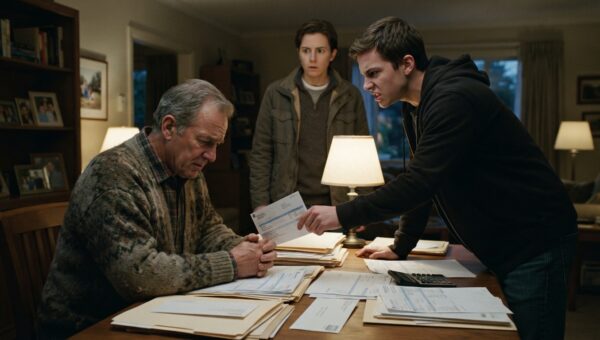
The next three days were a slow-motion eviction. Arthur didn’t go to work. The white van stayed parked in the driveway all Friday, its engine cold, while muffled shouting drifted across the street through closed double-pane windows. Every now and then, one of the older teenagers would step out onto the porch looking bewildered, carrying a basket of laundry or a stack of schoolbooks, only to turn right back around when they heard another crash from the front hall. Sarah didn’t come out to water her flower beds once. The hydrangeas by her porch started to droop in the afternoon heat, unheeded and dry.
Earlier today, the final act played out in broad daylight right on the grass. I was out on my porch sweeping up some stray leaves when the front door across the street banged open so hard it rattled the aluminum siding. Arthur came flying backward out the door, his hands up like he was warding off a blow, and tumbled down the two wooden steps onto the concrete path. Sarah stood at the threshold, her chest heaving, holding a thick stack of open envelopes and printed email logs in one hand while her other arm pointed straight down the driveway toward the curb.
“Get out, Arthur. You take your boxes and you go,” she shouted, her voice carrying clear across the asphalt into my yard. “You lied to the elders, you lied to the kids, and you’ve been lying to me since before we even bought this place.”
Arthur scrambled to his feet, trying to muster some of that old neighborhood authority, his tie hanging crooked over his shirt. “Sarah, honey, let’s talk about this inside, please, the neighbors are, “
“I don’t give a damn about the neighbors,” she screamed back, and she wasn’t crying, which was the worst part of it. She was just cold and done.
An empty suitcase came flying through the open doorway right behind him, hitting the turf with a dull thud before popping open to spill a pile of folded dress shirts across the lawn. The ten kids were lined up inside the hallway behind her like little statues, their eyes wide and round, watching their father scramble in the grass to grab his clothes before the rest of his things came raining down the steps. I watched from behind my screen door, the broom still heavy in my hand, realizing with a sudden, sinking weight that my little trick to teach a bully a lesson about a knocked-over trash can had just detonated an entire household.
An empty suitcase sat squarely on the manicured front lawn across the street, flanked by ten pairs of small shoes lined up on the porch steps as the front door firmly clicked shut.