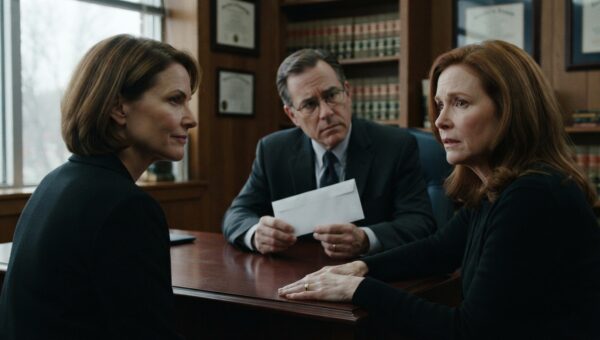
The cold on the sidewalk had that sharp, dry bite to it that usually meant snow was coming down off the ridges before nightfall. I had spent forty minutes at the mahogany desk of the probate attorney across town, signing my name to four different copies of Arthur’s death certificate and initialing boxes I never thought I would have to touch.
When the notary finally clicked his pen shut and slid the manila folder across the felt pad, I felt lighter and heavier all at once, like a suitcase packed with stones that you still have to carry down a long flight of stairs.
I didn’t want to go home to the silence. Arthur’s armchair still had the indentation of his left shoulder against the plaid cushion, and the blue mug he used for his peppermint tea was sitting right where he left it on the side table beside the radio. Instead, I walked three blocks down Main Street, past the window of the hardware store where the old belts hung in loops, and crossed the asphalt to the new glass-front bank branch.
The building used to be a dry goods store back when the valley still had two active timber mills and a working freight depot. Now it was all brushed aluminum, frosted glass panels, and the hum of an air-handling system that never seemed to turn off.
The air inside smelled of bleach, warm carpet glue, and expensive pine cleaner. It was too quiet, the kind of corporate quiet where everyone talks a little softer because they think someone important is listening from the regional office three states away.
I waited behind a young man who was arguing with a receipt printer about a four-dollar overdraft fee until the teller window cleared. When my turn came, I stepped up to the polished quartz counter and set my leather handbag down right where the laminate had a little scuff mark from someone’s wedding ring years ago.
“Morning,” I said. My voice sounded thin to my own ears, small against the high ceiling. “I need to open a standard checking account. Just a personal account. I closed the joint ledger this morning.”
The clerk behind the glass looked like he might have been twenty-four if he stood on his tiptoes.
He had that smooth, scrubbed look young men get when they spend all day under fluorescent tubes, his tie pulled into a knot so tight it looked painful against his collar. He had a gold name tag pinned to his lapel that said Kyle. He didn’t look up from his terminal for a solid five seconds, his fingers tapping a steady, rhythmic tattoo against the plastic keyboard.
“Checking account,” he said, his tone flat and practiced like he was reading off the side of a cereal box. “Do you have an existing relationship with this institution, ma’am?”
“My husband and I banked with the downtown branch for thirty-four years,” I told him, keeping my hands resting on the edge of the counter. “When he passed last month, I moved things over. I just want a local account here so I can pay the oil delivery and the municipal water bill without driving thirty miles down the valley.”
Kyle clicked the mouse twice. A small blue box popped up on his monitor, and his eyebrows drew together in that specific little frown people make when they are about to deliver bad news they don’t actually care about.
“We can certainly start an application,” Kyle said, finally looking up with a polite, empty smile that didn’t reach the corners of his eyes. “I’ll need two forms of government-issued photo ID, a utility bill showing your current residence matching the zip code, and proof of active income documentation for sole-account holders in your bracket.”
I blinked at him. “My bracket.”
“That’s right,” Kyle said, tapping the edge of the keyboard with a red ballpoint pen. “Federal compliance guidelines for our senior deposit products require either a co-signer under sixty-five or verifiable active employment income to offset unsecured liability risk on unlinked checking tiers. Without those documents, I can’t initiate the opening sequence.”
The word sequence made my jaw tighten. I looked down at my hands. The skin across my knuckles was dry, dotted with the faint brown spots that come with sixty-eight years of standing in the sun and washing dishes in hard well water. I thought about Arthur sitting in his truck outside the feed store, waiting while I ran in for salt blocks. I thought about the three thousand dollars sitting in my canvas purse in a cashier’s check that was currently worthless because a boy in a polyester suit wouldn’t let me put it in a hole in the wall.
“Active income,” I repeated. “At sixty-eight years old.”
“I don’t make the parameters, ma’am,” Kyle said, his voice dropping into that soothing, patronizing register people use when they think you’re about to make a scene in public. “The risk-assessment algorithm evaluates the demographic profile automatically. If you have a son or a daughter who can sign on as primary guarantor, we can run the credit pull again right now.”
I didn’t have children. Arthur and I raised two foster boys who went off to the coast in the nineties and stayed there, and after that, the house was just the two of us and the stove wood we stacked every October. I was entirely, completely on my own for the first time in half a century, and this bright young man with no lint on his jacket was telling me my signature wasn’t worth the paper it was written on unless someone else vouched for my pulse.
I didn’t yell. People who yell in banks usually end up talking to the police, and I had never liked uniforms in lobbies. Instead, I let my gaze wander past his shoulder, past the digital interest-rate board blinking in lime green, straight to the oak-paneled wall near the loan officer’s door where the original branch charter hung behind thick, glare-free glass.
It was framed in heavy walnut with a brass plate along the bottom edge that had tarnished slightly over the decades. I knew every nick in that wood. Arthur had helped me hang it on a rainy Tuesday afternoon in November 1991, back when the floorboards were still rough-sawn pine and the vault door came on a flatbed trailer all the way from Pittsburgh.
The charter had four signatures at the bottom, written in black fountain pen ink that had turned the color of dried tea over thirty-five years.
“Kyle,” I said softly.
He didn’t look up from his screen. He was already clicking through to the next window, eager to get rid of me before the noon rush from the diner started up. “If you don’t have the paperwork today, we do have some pamphlets on alternative third-party payee arrangements through local social services.”
“Would you ask your manager?” I asked. My voice didn’t shake. It had the steady, flat weight of an old timber beam settling into its footings. “And while you wait, read the third name on that charter over your left shoulder, because it’s…”
Kyle stopped clicking. He turned his head slowly, looking at the wall like he had never noticed the dark piece of paper hanging there in the twenty-two days he had probably worked in this branch. He squinted through his wire-rimmed glasses, his lips moving silently as he spelled out the cursive ink at the bottom of the yellowed parchment.
“M-a-r-i-l-y-n,” he read, his voice thinning out until it was almost a whisper. “Marilyn… H. Vance.”
“That’s me,” I said. “And if you look about three lines above my signature on the original risk-mitigation addendum, the one your regional office scanned into the system back when they bought us out in 2008, you’ll see that I wrote the exact clause you just used to tell me I couldn’t deposit my husband’s life insurance payout.”
Kyle’s mouth stayed open for a second. He looked from the charter back to my face, then down at my hands resting on the counter, taking in the plain gold band I’d worn since 1978 and the simple wool coat with the frayed hem. He swallowed hard enough that I could see the knot in his narrow throat jump.
“You’re…” He didn’t finish the sentence. He stood up so fast his ergonomic chair rolled backward six inches and bumped against the water cooler behind him. “I mean. One second, ma’am. Let me, let me get Marcus.”
He didn’t wait for me to answer. He ducked under the little swing-gate at the end of the counter and practically jogged toward the frosted glass office in the back, his heels clicking against the linoleum like dry twigs.
I stayed right where I was. I didn’t lean against the glass, and I didn’t check my watch. I just stood there and listened to the low hum of the ceiling vents, thinking about the winter of 1991 when Arthur and I drove three counties over in the rusted Ford just to buy three boxes of ledger paper and a gross of black ballpoint pens because the regional director said we had to look established before the state examiners arrived. We didn’t have algorithms back then. We had names, faces, and five acres of red clay that everyone in the township knew belonged to the family whose name was on the property tax rolls.
The door of the back office swung open with a muffled click, and a tall man with graying temples and a gray suit that cost more than my winter coal bill came out first, looking flustered. Kyle trailed a few steps behind him, carrying a heavy black binder that looked like it hadn’t seen the light of day since the Clinton administration.
“Mrs. Vance?” The manager, Marcus, according to the bronze wedge on his desk, stopped three feet from the counter. His face had gone that mottled, pale pink color men get when they realize they’ve nearly made a very expensive mistake in front of a witness. “I’m Marcus Holloway. I’m the branch manager here.”
“I know who you are, Marcus,” I said, looking right into his eyes. “You came out from the regional office in Roanoke about four years ago when they remodeled the teller line and put in those blue carpets that smell like wet dog when it rains.”
Marcus gave a tight, nervous little cough that sounded like a dry valve in an old tractor engine. He reached out and tapped the cover of the black binder Kyle was clutching against his chest like a prayer book.
“Kyle tells me there was some confusion regarding the documentation requirements for sole-party legacy deposits,” Marcus said, pitching his voice down into that smooth, practiced management register that was supposed to make me feel like I was talking to an equal. “Obviously, our automated system has certain parameters for non-wage-earning accounts that default to standard risk profiles…”
“Your automated system doesn’t know the difference between a widow with a cash-out check and an eighteen-year-old trying to bounce a car payment,” I said. I didn’t raise my voice. I didn’t need to. The entire lobby had gone so quiet I could hear the refrigerator compressor humming in the breakroom behind the wall. “When I drafted that original clause in the winter manual, Marcus, it was meant to protect eighty-year-old women from being conned out of their homesteads by traveling furnace salesmen. It wasn’t designed to keep a founding officer from depositing twenty thousand dollars of her own survivor’s benefit.”
Marcus looked over his shoulder at the charter on the wall, then back at Kyle. He reached down and took the binder out of the boy’s hands, flipping open the heavy plastic cover with a snap that made the teller jump. He turned a few pages, his finger tracking down a column of faded blue carbon copies until he hit a paragraph marked with a red marginal asterisk.
“Section twelve, subsection four,” Marcus muttered, reading the faded type. “‘Exceptions for founding personnel and primary equity holders upon verification of original signature card.'” He looked up, his expression clearing into something that looked suspiciously like respect mixed with sheer terror. “Mrs. Vance. I didn’t see your name on the daily intake manifest. We were told the legacy registry had been archived at the district warehouse.”
“Your district warehouse is full of boxes they haven’t dusted since the Bush administration,” I said. “And my name has been on that wall longer than you’ve been licensed to sell mutual funds in this state.”
Marcus didn’t argue. He closed the binder with a dull thump and handed it back to Kyle.
“Reset the terminal,” Marcus said, his voice dropping all the pretense of corporate polish. He looked at me, his shoulders dropping an inch as he let out a long breath. “And bring me the blue supervisor override card from my desk drawer. Right now.”
The transaction took seven minutes. Marcus didn’t make me fill out the new customer questionnaire, and he didn’t ask for a utility bill or a reference from my children. He walked around to the front of the counter himself, pulled out the sleek leather chair he usually reserved for commercial loan applicants, and asked me to sit down while Kyle ran the cashier’s check through the scanner with fingers that looked like they were working a live grenade.
“We’re updating the compliance software next month,” Marcus said quietly as we waited for the receipt printer to spit out the permanent account summary. “I can have the senior deposit exception flagged manually for your social security number so this doesn’t happen again when you come in.”
“You do that,” I told him. “And while you’re at it, tell whoever writes those prompts that old people aren’t a risk bracket. We’re the only reason this brick building is still standing on this corner instead of a used car lot.”
Marcus actually smiled at that, a real, crooked little grin that made him look less like a regional asset and more like a human being who had parents of his own somewhere out in the world. “Point taken, Mrs. Vance. I’ll make the call myself this afternoon.”
When the machine finally stopped clicking, Kyle handed me a crisp, dark blue passbook with my name printed in clean, black lettering across the top line, along with the routing numbers and my new account sequence. It felt heavier than the old one, the paper stiffer, the glue fresh.
I tucked it into the inside zipper pocket of my leather handbag, right beside Arthur’s silver pocket watch that still ticked twice as loud as it should have, and pulled my wool coat tighter around my throat against the draft from the front doors.
“Good afternoon, Marcus,” I said.
“Good afternoon, Mrs. Vance,” he said, holding the heavy glass door open for me himself as I stepped back out onto the sidewalk.
The sun was dropping behind the ridge now, casting long, slate-gray shadows across Main Street where the pickup trucks were starting to line up for the five o’clock shift change at the lumber mill down the road. The air smelled of woodsmoke and wet asphalt, cold enough to make my lungs ache when I took a deep breath, but my boots felt steady against the concrete.
When I got home, the house was dark and smelled faintly of the peppermint tea Arthur had left in his mug on the side table. I didn’t turn on the overhead light in the kitchen. I just set my handbag on the yellow oilcloth table, pulled the new passbook out of the zipper pocket, and laid it flat beside the white porcelain cup, right where the light from the streetlamp through the window caught the clean, dark ink of my name on the first page, exactly where it had always belonged.