The sawdust in my shop always smells like whatever wood I had on the lathe last, usually walnut or red oak, but on that particular Tuesday it smelled like nothing at all because my nose was completely blocked up from a head cold. My hands were stained dark with mahogany grain filler from three shifts of sanding down an Edwardian sideboard, and my knees ached in that dull, steady way they do when the damp air starts coming up off the river.
I had five different projects lined up against the plaster walls of the back room, including a battered Art Deco vanity that Martha had hauled in from a roadside flea market off Route 9. She dropped it on my loading dock for seventy-five dollars cash, laughing about the water damage on the veneer and telling me to make it look pretty enough for her guest bedroom.
I didn’t think much of it when I hoisted the piece onto my main trestle table. It was a standard 1930s setup, curved waterfall edges, cheap plywood core underneath a thin layer of walnut veneer that had bubbled up near the left drawer pull from some long-ago flower vase leaking water. The glass mirror was tarnished around the bottom corners, clouded with gray spots where the silver backing had given up after decades of attic heat. Martha wanted the glass replaced, or at least re-silvered if I could manage it without charging her an arm and a leg.
I reached for my heavy flathead screwdriver and a rubber mallet to tap out the wooden molding holding the oval mirror in place, figuring I would pop the glass out in ten minutes and get back to the sideboard.
The molding didn’t want to budge. The wood had swelled over the years, locked tight by humidity and old hide glue that had turned as hard as amber. I had to wedge my wood chisel right into the miter joint, working the blade millimeter by millimeter until the frame finally gave way with a sharp, dry crack that made the dust dance in the slant of sunlight coming through the window. The mirror glass slid forward into my hands, heavy and cold, and I set it carefully against a stack of pine boards on the floor. That was when I noticed the back panel. A standard vanity of that vintage uses thin three-ply luan for the mirror backing, tacked on with small wire brads that come out easy.
This panel was solid pine, nearly three-quarters of an inch thick, screwed down with flathead brass screws that looked like they had been driven by hand.
I reached for my hand drill, backing the screws out one by one while my shop radio hummed some old country station through the static. When the last screw came free, the panel didn’t just fall off; it was wedged so tight with old felt lining that it popped outward with a muffled suction sound. I pulled it away and looked into the dark recess where the mirror frame met the carcass. There was nothing in there except a little pile of gray dust and a single, stiff piece of heavy card stock that had slipped down into the narrow channel between the wood and the glass housing. I hooked it with the tip of my finger and dragged it out into the light.
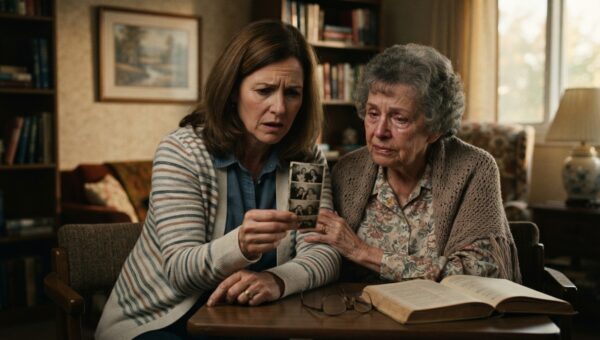
It was a black-and-white photograph, slightly curled at the edges from sitting in the dark for who knows how many decades. I wiped a layer of fine lint off the surface with the side of my thumb, and the image came into clear focus under the overhead lamp. It showed a family sitting on what looked like a stone bench in a public park, maybe Vienna or Prague given the wrought-iron work in the background. A father with a neat mustache and a wool suit, a mother holding a small cloth handbag in her lap, and three children standing between them in matching woolen coats. They weren’t smiling wide, but they looked settled, safe, and completely ordinary, like any family on any Sunday afternoon before the world went sideways. I turned it over, squinting past my bifocals. Someone had written four words on the back in dark fountain pen ink, the handwriting precise and sloped: Before. November 1938.
The ink didn’t look faded. It looked like it had been written yesterday by someone whose hand hadn’t shaken yet. I sat down on my old wooden stool because my legs felt suddenly hollow, turning the card over and over in my grease-stained fingers. I didn’t know anything about antiques from across the Atlantic, but I knew my history well enough to know what happened in Central Europe in November of 1938. Kristallnacht. The November pogroms. The moment the glass broke and the doors were kicked in and ordinary lives were erased in a matter of hours. Someone had tucked this photo deep inside the guts of a custom vanity frame, sliding it past the wooden stops so deep nobody would ever find it unless they dismantled the whole piece down to its skeleton.
I left the vanity sitting on the bench and spent the next three hours on my ancient desktop computer in the corner of the office, wiping sawdust off the keyboard before I typed in the four words from the back of the photo along with the date. The search results were a swamp of academic papers, museum archives, and digitized transport lists from the Holocaust Educational Trust. I found references to displaced families from the Leopoldstadt district in Vienna, names of people who vanished into the registry books of transit camps, and endless rows of scanned manifests from ports in Lisbon and New York. My eyes started burning from the glare, but I kept scrolling because I couldn’t shake the image of the little boy on the left side of the photograph holding his mother’s coat button.
By Thursday morning I had made up my mind. I didn’t call Martha. Instead, I drove twenty miles north to the regional history museum on the edge of the county seat, carrying the photograph inside a clean manila folder tucked safely beneath the passenger seat of my truck. The museum was housed in an old Carnegie library building with heavy stone steps that smelled of damp limestone and floor wax. I walked past the gift shop and found the office of Dr. Aris Thorne, the head curator whose name I pulled off the museum website after seeing her listed as an expert in Central European archival recovery.
She wasn’t expecting me. When I knocked on her open office door, she was staring at a computer screen with a cup of lukewarm coffee beside her elbow, surrounded by towering stacks of blue acid-free archive boxes. She looked up over her wire-rimmed glasses, her expression polite but tired in that way people get when they deal with local amateur historians bringing in rusted farm tools or Civil War bullets they found in their back forty. I didn’t say a word. I just walked over to her desk, opened the manila folder, and laid the photograph flat on the blotter between us.
Dr. Thorne didn’t look down at first. She gave me that standard professional smile people use when they are bracing themselves for someone claiming they have a signed letter from Abraham Lincoln written on a napkin. But then her eyes dropped to the card. The color drained out of her face so fast it looked like someone had turned off a light behind her skin. She didn’t gasp or make a sound. She slowly reached out, her fingertips hovering an inch above the surface before she touched the corner of the card as if it might turn to ash under her fingers.
She turned it over slowly, reading the four handwritten words on the back, and then she let out a long, ragged breath that seemed to empty her lungs completely. She didn’t look back up at me for a full thirty seconds, just sat there staring at the ink while her hand began to tremble slightly against the edge of the desk. When she finally raised her head, her eyes were bright and wet around the edges, and her voice came out as a harsh whisper that barely carried across the small room.
“We’ve been searching for this family for thirty years,” she said.
I pulled a straight-backed wooden chair up to her desk without waiting for an invitation and sat down, resting my forearms on my knees. She told me the rest of the story in pieces, her voice dropping lower as she pulled up a digital database on her monitor and spun the screen around toward me. The family in the photograph was the Stern family, Jakob, Clara, and their three children, living in Vienna until the autumn of 1938. Dr. Thorne had spent the better part of her academic career trying to reconstruct the municipal records of the families from their specific block, tracking down property confiscation orders, transport logs, and auction manifests where household goods were sold off by the occupying authorities to fund the state apparatus.
The furniture didn’t stay in Vienna. After the apartment was cleared out, the household items were cataloged and dispersed through regional salvage markets, eventually finding their way onto trade barges heading down the Danube and across the Atlantic over decades of postwar commerce. Somewhere along the line, that walnut vanity had been built or repaired using salvaged timber from an estate sale, and the photo had stayed wedged inside the mirror housing, completely hidden from the people who bought it, sold it, and hauled it across oceans. The museum had thousands of names and shipping manifests, but they had never found a single visual record of the Sterns. Not one photograph. Not a school portrait, not a wedding picture, nothing. Until Martha walked into a flea market and spent seventy-five dollars on a beat-up vanity with a false back.
“The parents didn’t survive,” Dr. Thorne told me, her fingers resting lightly on the edge of the photograph as if she were afraid it would vanish if she let go. “Jakob and Clara were sent east in forty-one. But the youngest daughter, Maya, was put on a Kindertransport train out of Vienna in December of thirty-eight, just weeks after this was taken. She lived to be eighty-two years old. She spent her entire adult life trying to find a single image of her parents and her older siblings before she passed away two years ago in Chicago.”
The silence in the office got very heavy then. Outside the tall windows, a delivery truck rumbled down the street, its engine roaring before fading away into the hum of the town. I thought about Maya sitting in some apartment in America with an old memory and an empty album, wondering if anyone in the world remembered what her mother’s coat looked like or how her father stood when he was waiting for the tram. She had looked for thirty years, and the answer had been sitting in the dark behind a piece of plate glass in an Ohio furniture restorer’s shop the whole time.
Dr. Thorne asked me what I wanted to do with it, but we both knew there was only one right answer. You don’t keep something like that in a drawer next to your sandpaper and wood glue. We spent the next hour filling out the formal accession paperwork, logging the item into the museum’s permanent archival registry with my name listed as the finder who brought it in from the wild. She brought out a pair of white cotton archival gloves and carefully slid the photograph into a clear Mylar sleeve, sealing it shut before placing it inside a shallow, gray-board preservation box lined with acid-free tissue paper.
When I drove back down Route 9 that afternoon, the sun was sinking low behind the ridge of the hills, turning the sky the color of old copper. My shop was quiet when I unlocked the side door. The Art Deco vanity was still sitting on my trestle table where I left it, its mirror frame stripped bare and waiting for me to finish the veneer repair. The smell of walnut dust and mineral spirits hung in the air just like it always did, ordinary and grounding and real. I walked over to the workbench, picked up my scraper, and went back to work on the drawer pull, knowing that some things are broken beyond anything a carpenter can fix, but sometimes, just once in a while, you get to hand the pieces back where they belong before the day is done.