The key fob for Odell’s twelve-year-old F-150 had a cracked plastic housing that rattled every time I hit a pothole on the winding drive up from the creek, but this morning the truck wasn’t moving at all. It was parked right outside the bay door of the machine shed, dead still, with a film of late-February pollen dusting the hood like yellow flour.
The stroke took him on a Tuesday, and by Saturday the casseroles had stopped coming, leaving me alone with the quiet and a pair of mud-caked boots by the back door that nobody was ever going to clean again.
Every Sunday for nine years, that truck had rolled out of this gravel yard at precisely twelve-fifteen. Odell would fill his scarred aluminum thermos with lukewarm black coffee, set his worn Bible on the passenger seat, and back out without looking at the front porch. “Just clearing my head, Clara,” he’d say whenever I paused at the screen door with a dish towel in my hands. Two hours, every week, rain or shine, right through the heat of the clover harvest and the dead freezes of January. I figured an old man needed his quiet. We both did.
We lost our only boy, Jesse, in the autumn of 2014, right when the maples down by the creek were turning that hard, rust red.
A nineteen-year-old kid in a rusted-out Dodge Ram crossed the yellow line on Route 4 with an empty bottle of bourbon rolling around the floorboards. Jesse never even saw the headlights. Odell went to the hospital morgue, signed the county papers, and came home to walk straight into the tool shed where he stayed until dark. After that, he didn’t talk about it. Not once in nine years did I hear him say Jesse’s name out loud, and not once did I see him cry. I thought his grief was just a stone he swallowed whole, sitting heavy and cold in the middle of him until it hardened into the man I lived with.
The sun was hitting the steering wheel through the cracked windshield when I finally pulled down the passenger visor and found the spare key to the glovebox wedged behind the owner’s manual. I didn’t open it because I was suspicious.
I opened it because I needed to find his service records for the county clerk, and because sitting there in the cab without him felt like breathing someone else’s air. The latch gave way with a dry snap, dropping a pile of greasy napkins, a pack of spearmint gum hard as a pebble, and a thick, rubber-banded stack of blue cards right into my lap.
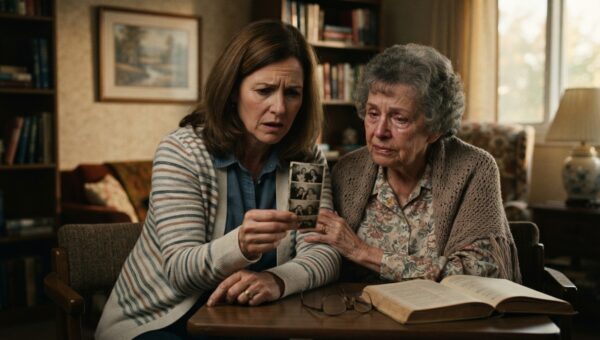
My knees gave and I sat down hard on the running board, the cold iron biting through my denim trousers while my fingers traced the printed headers on top of the stack. Department of Corrections. State Penitentiary at Brushy Mountain. Visitor Pass. Date: October 14, 2014. Date: October 21, 2014. Date: October 28, 2014. Every single Sunday, right down the line, stamped and punched by a guard’s initials in faded purple ink. Nine years of Sundays accounted for in little rectangles of cardstock, hidden behind the insurance papers of a Ford truck I thought I knew better than my own reflection.
Underneath the last pass lay a folded square of lined notebook paper with the blue lines smudged by sweat. It was Odell’s handwriting, that blocky, stubborn print he used for marking fence posts and lumber cuts, each letter standing straight up like a picket. He wrote: “I go so the boy who killed our son won’t sit in there alone.”
I sat there on that running board for a long time while the shadow of the machine shed stretched across the gravel, turning the weeds a dull, flat gray. My brain wouldn’t stitch the words together into anything that made sense. Julian Vance. That was the driver’s name. I remembered it from the small-type paragraph on page four of the county gazette nine years ago, a kid of eighteen who had spent his first night in a holding cell throwing up into a drain. I had pictured him as a monster back then, a wild animal with blood on his teeth, someone who deserved to rot in a hole so deep the sun never found it. And Odell, the man who wouldn’t let strangers track mud across his porch, had spent nine years driving two hours every Sunday to sit across a scarred plastic table from him.
“You didn’t know?”
That was what the Reverend Thomas asked me when I finally drove my Buick into town three days later to drop off Odell’s parish keys. He didn’t look surprised when I laid three of those blue passes on his walnut desk. He just looked down at his desk blotter like he’d been dreading this specific Tuesday since the fall of fourteen.
“He never said a word to me, Thomas,” I said, and my voice sounded thin and raspy, like dry corn husks rubbing together in a November fence row. “Not a syllable. He ate my biscuits every Sunday at one o’clock like he’d just come back from checking the lower pasture.”
The old man took off his wire-rimmed glasses and rubbed the bridge of his nose where the metal had left two red dents. “Odell came to see me the week after the funeral,” he said quietly. “He looked like a house that had been gutted by a chimney fire. He told me the trial was a waste of time because the boy was already dead inside. He said the courts could take the kid’s freedom, but nobody was going to give him a soul unless someone showed up to remind him he was still breathing. I told him he was crazy, Clara. I told him it would kill him piece by piece. He looked me right in the eye and said the only thing worse than losing one boy was letting two of them vanish from the earth.”
I didn’t answer him. I couldn’t. I just stood up, left the church keys on the corner of his desk, and walked out to the car before the tears could start, because once they started I knew I wouldn’t have the strength to drive home.
The journey out to Brushy Mountain took two hours and fourteen minutes, exactly the time Odell must have spent every single week while I sat on the front porch with my knitting, wondering why he always came back looking so tired. The highway cut through the ridges where the dogwood was just starting to pop white against the gray timber, the road winding down into the valley like a dirty ribbon. I had the glovebox note tucked inside my Bible on the passenger seat, and every time I hit a bump, I could feel it pressing against the leather cover like a heartbeat.
The intake room smelled of floor wax and stale cigarette smoke from the troopers outside. A young guard with a crew cut and a badge that read Miller looked over my driver’s license twice, then checked his ledger against the name I gave him.
“You related to the inmate, ma’am?” he asked, tapping a plastic pen against the counter.
“No,” I said. “I’m Odell Mercer’s wife.”
The guard stopped tapping. He looked up from his desk, his eyes softening behind his thick lenses in a way that made my throat tighten up. “Old Mr. Mercer,” he said, shaking his head slowly. “He missed three Sundays in all those years. Once when he had the pneumonia back in seventeen, and twice when the mountain road washed out after that spring flood. The boy, Vance, he wouldn’t come out of his cell those days. Sat on his bunk facing the wall until we told him Mr. Mercer would be back the following week.”
“He never missed,” I whispered.
“No, ma’am,” Miller said, sliding a visitor pass across the gray laminate. “He never did. Said the boy was just a fool who made a terrible mistake, and that God didn’t give up on fools just because the state locked the door.”
They led me back through two heavy steel doors that groaned on their hinges like wounded animals, down a hallway where the fluorescent lights flickered with a high, thin buzz. The visitation room was full of long metal tables bolted to the floor, most of them surrounded by young women with toddlers on their laps or old mothers holding plastic cups of lukewarm punch from the vending machine.
Julian Vance was already sitting at the corner table near the back window. He didn’t look like a monster. He looked like a man who had been carved out of dry pine, thin-shouldered and gray-faced, wearing an oversized orange jumpsuit that hung off his collarbones like a sack. When he saw me instead of the tall, stooped man in the faded flannel shirt he was expecting, he half-rose from the metal stool before catching himself and sitting back down with a sharp clatter.
I walked over, my heels clicking against the linoleum floor, and pulled out the chair across from him. I didn’t say anything for a second, and honestly that felt worse than shouting. My hands were shaking so bad I had to dig them deep into the pockets of my wool coat to keep him from seeing.
“You’re Odell’s missus,” he said. His voice was lower than I expected, raspy around the edges like he hadn’t used it much outside of brief answers to guards.
“I am,” I said. I pulled the rubber-banded stack of passes out of my coat pocket and laid them right in the middle of the scratched formica table between us, alongside the little square of lined paper. “I found these in his truck on Saturday.”
Julian looked down at the blue cards. He didn’t touch them. He just stared at that blocky handwriting on the note like it was a map written in a language he was still trying to puzzle out.
“He didn’t miss a Sunday,” Julian said, and his lower lip started to twitch just a little bit before he bit down on it hard. “Even when his truck broke down down in the hollow three years ago. He walked four miles up the ridge in the freezing rain just so I wouldn’t be sitting in here alone staring at that brick wall.”
“Why did you let him come?” I asked, and the words came out sharper than I meant them to, carrying nine years of quiet kitchen tables and empty hallways behind them. “Why didn’t you tell him to stay home where he belonged?”
Julian looked up at me then, and his eyes were the same watery, washed-out blue as Jesse’s used to be when he was little and scared of a thunderstorm. “I tried to, ma’am,” he whispered, and his hands came up to rest flat on the table, the knuckles swollen and white. “The first three times he drove out here, I told him to go to hell. I told him every bad thing I could think of. I told him he was sick in the head for sitting across from the man who put his boy in the ground. You know what he did?”
I shook my head, my throat so tight I couldn’t get a sound out.
“He just opened his thermos, poured two cups of that bitter black coffee, slid one across to me, and asked me how my math correspondence course was coming along,” Julian said, his voice cracking right down the middle. He didn’t try to wipe his face when the first tear spilled over and tracked down his cheek into the stubble on his jaw. “He told me Jesse was a good boy who liked to fix carburetors, and then he sat there for two hours listening to me talk about my dad’s old tractor until the guard told us our time was up. He didn’t forgive me, Mrs. Mercer. He never once said the word forgive. He just… he just wouldn’t let me disappear.”
The silence in that room got heavy then, heavier than the machine shed roof, heavier than all those years of Sunday dinners where I sat across from a man who was carrying the weight of two different worlds in his coat pockets. I looked at the young man sitting across from me, really looked at him, and for the first time since 2014, the hard, cold knot in my chest loosened just enough to let the air back in. Odell hadn’t been betraying our boy. He had been expanding him, stretching his memory out until it was big enough to cover even the wretched and the broken.
“He’s gone, Julian,” I said, and the words finally sounded real now that I spoke them out loud to a stranger in a prison jumpsuit. “He had a stroke on Tuesday morning. He didn’t suffer. He just went to sleep in his chair.”
Julian bowed his head, his forehead coming down almost to the cold metal surface of the table, his shoulders shaking beneath that orange cloth. He didn’t make a sound, just that small, hitching breath of a man who had finally run out of places to hide.
I reached out across the table, that scarred, ugly table where my husband had sat through nine years of winters and summers, and laid my palm over his rough, calloused hand. His skin was freezing cold, but when I squeezed it, he turned his fingers over and caught mine like a drowning man grabbing for a dock rope.
“He left his thermos at home,” I said quietly, looking out the reinforced window where the gray ridges met the sky. “It’s sitting on the kitchen counter right now, empty.”
Julian lifted his head, his eyes red and wet, looking at me with something like wonder. “Will you… will you come back next week, Mrs. Mercer?”
I sat there for a long moment, feeling the hum of the fluorescent lights overhead and the steady, familiar pull of the clock on the back wall. Outside those heavy steel doors, my truck was sitting in the visitor lot with the keys in the ignition and nine hundred miles of empty highway waiting to take me back to an empty house. But the Sunday route wasn’t a secret anymore. It was just a road, and it ran right through the middle of us.
“I reckon I will,” I said. “I’ll bring the coffee.”