I got it wrong from the very beginning, and I might as well say it right here before I lose my nerve. Twenty years of setting an extra place at a table where nobody ever sat will rot a person’s thinking. You start to believe your own stubbornness is some kind of virtue. You tell yourself you were just being strong, just being practical, when really you were just a terrified woman who didn’t know how to handle a nineteen-year-old girl with fire in her eyes and a baby on the way.
Arthur had been gone four years when Clara came into the kitchen on that miserable Tuesday morning in October 2005 and told me she was pregnant. The rain was hammering the tin roof of the back porch so hard we had to raise our voices just to talk across the linoleum. Arthur was the steady one. He would have poured us both a cup of black coffee, sat down at this very table, and figured out how to patch the world back together. But Arthur wasn’t here. It was just me, staring at the flour canister and feeling my chest turn to cold iron.
I looked at her belly, flat under her oversized sweater, and then I looked at her face, which was stubborn in that exact way her father’s used to be when he decided to build our barn by himself. I didn’t see a daughter who needed her mother.
I saw twenty years of lost sleep, ruined college funds, and gossip at the post office. I let fear do the talking for me. I told her the baby would ruin her life. I told her she had to choose between finishing her education or throwing everything away on a mistake.
“It’s not a mistake,” she had said, her voice shaking so badly she had to grip the edge of the Formica counter. “I’m keeping him, Mama.”
“Then you can’t stay under this roof,” I told her. My voice didn’t even sound like mine. It sounded cold, like a stranger’s voice coming out of the dark. “Give it up or get out.”
She didn’t cry. That was the worst part. She just looked at me for three long seconds, as if she were trying to memorize every line on my face so she could hate me properly later. Then she turned around, grabbed her heavy canvas duffel bag from the hallway, and walked out into the downpour with the infant car seat tucked under her arm.
I watched from the front window as she loaded it into her little blue sedan, the rain soaking through her jacket, before she backed down the gravel drive and drove away.
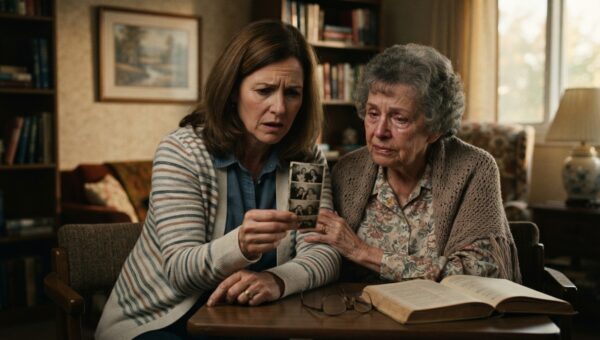
She sent one photo that first Christmas. It was a polaroid tucked inside a plain white envelope with no return address. Inside was a picture of a tiny baby boy wrapped in a blue blanket, sleeping on a flannel quilt I didn’t recognize. I stood right here in this kitchen, holding that square piece of glossy paper, and instead of calling her, instead of walking down the road, I opened the bottom drawer of the oak secretary desk and dropped it face down underneath a stack of old utility bills. Then I walked back to the dining room and set two plates instead of one.
I kept doing it every single night for two decades. A clean white plate, a heavy silver fork, a linen napkin folded just the way Arthur liked.
People in town stopped asking about Clara after the first few years because they knew the look on my face when they brought her up. They knew I had built a fortress out of my own pride and locked the door from the inside.
Last week the Tuesday afternoon sun was hitting the porch floorboards in that quiet, lazy way it does before the evening chill sets in. Someone knocked on the screen door. It wasn’t the mail carrier, and it wasn’t the neighbor bringing over zucchini from her garden.
I wiped my hands on my apron and walked down the short hallway, expecting another charity flyer or someone selling pest control. When I pushed the inner door open, I stopped dead.
A boy was standing there on the braided rug. He was maybe nineteen, wearing a faded red t-shirt with the emblem of the local volunteer fire department on the chest, and he was holding a green booklet of raffle tickets. But it wasn’t the raffle book that made my breath catch in my throat. It was his face. He had Arthur’s nose, the exact same slight hook at the bridge, and when he smiled sheepishly at me, apologizing for bothering me in the middle of the afternoon, it was as if twenty years of dust and silence had been blown right off the walls. He had my late husband’s crooked smile.
“Excuse me, ma’am,” he said, shifting his weight from one sneaker to the other. “We’re selling tickets for the annual equipment fund. Five dollars each, or twenty for the whole book.”
I couldn’t move. My hand went out and gripped the wooden door frame so hard my knuckles turned white. I stared at his eyes, which were that same peculiar shade of hazel Arthur used to have when he was teasing me about burning the biscuits.
“What’s your name?” I asked. My voice came out thin and raspy, like dry leaves scraping across concrete.
“Leo, ma’am. Leo Miller.” He blinked, looking a little confused by how hard I was staring at him. “My mom grew up two streets over, actually. She always said this neighborhood hasn’t changed a bit.”
“Two streets over,” I repeated, the words tasting strange in my mouth. For twenty years I had imagined her living three states away, in some crowded city where nobody knew her name, struggling alone because of my harsh words.
“Yes, ma’am. Right down on Elm Street, behind the old lumber yard,” Leo said, his smile fading just a bit as he noticed the tremor in my hand. “Are you okay? Do you need me to grab a glass of water or something?”
I didn’t answer him. Instead, I reached into the pocket of my apron, pulled out my coin purse, and shook every single dollar bill I had onto the little wooden table by the door. It came out to forty dollars. Exactly enough for the whole book of tickets. I didn’t care about the fire department, and I didn’t care about the raffle. I just needed him to stay on my porch for another thirty seconds so I could be sure he was real and not just some ghost conjured up by an old woman’s lonely kitchen.
“I’ll take the whole book, Leo,” I whispered, pressing the crumpled bills into his hand.
He looked down at the money, then back up at me, sensing there was something heavy hanging in the air between us. He hesitated, shifting the raffle book from one hand to the other, before reaching into his front pocket and pulling out his cracked smartphone.
“My mom doesn’t know I came by here,” Leo said, his voice dropping an octave as he tapped at his screen. “She never really talks about the past much. But she always told me stories about how things used to be before she moved out on her own. And she keeps your picture right by her bed.”
He turned the phone around so the screen faced me.
There it was. It was the studio portrait of me from 2004, taken right before Arthur passed away, back when my hair was still dark and I still knew how to smile without my lips tightening into a line. It was propped up on a small wooden nightstand next to a chipped ceramic lamp. Clara had kept it. Through every bitter winter, through every empty holiday, through twenty years of silence and stubborn exile, my face had been sitting quietly in her bedroom just two streets away.
Leo slipped the phone back into his pocket, gave me a gentle, worried nod, and thanked me for the forty dollars before turning down the steps and walking back toward the gravel drive.
The screen door banged shut behind him, leaving me alone in the hallway with the green book of raffle tickets in my hand.
I didn’t go back to the kitchen. I didn’t check on the roast in the oven. I walked straight down the narrow hall to the oak secretary desk, dropped to my knees on the hardwood floor, and pulled open the bottom drawer. Buried beneath thirty pounds of old electric bills, tax forms, and church bulletins was the plain white envelope from Christmas 2005. I pulled it out, opened the flap, and slid out the polaroid of the baby. Next to it was the studio portrait Clara must have taken with her when she walked out into the rain.
I sat there on the rug for a long time, listening to the old house settle around me, realizing how completely I had misjudged everything. I had spent two decades believing I was the guardian of some moral standard, when all I had really done was build a monument to my own stubborn fear. Clara hadn’t ruined her life. She had built a quiet, hardworking existence right under my nose, raising a fine, polite boy who sold fire department tickets with his grandfather’s smile, while I sat alone in a sterile dining room talking to an empty chair.
The sun had dipped below the fence line by the time I stood up. My knees popped, stiff from the cold wood, but I didn’t care.
I didn’t put on a coat. I didn’t pick up the phone to practice what I was going to say. I just walked out the front door, leaving it unlocked behind me, and started down the gravel drive.
The pavement of Elm Street felt hard beneath my old walking shoes as I turned the corner past the abandoned lumber yard. The air smelled of woodsmoke and damp autumn leaves, the exact same smell it had carried twenty years ago on the night I told my daughter to leave. Every step felt heavy, like I was wading through deep water, but for the first time in two decades, my chest felt light enough to breathe.
When I reached the small white house two streets over, the front porch light was already on, casting a warm, yellow glow across the flower beds. I walked up the two wooden steps, my hand trembling as I reached out and pressed the doorbell. Inside, I heard the faint chime of chimes, followed by the sound of footsteps on hardwood.
The lock clicked. The door swung open.
Clara stood in the doorway, older and careworn with faint lines around her eyes, holding a dish towel in her hands. She stopped breathing the second she saw my face. The towel slipped from her fingers and pooled quietly on the linoleum at her feet.
Nobody said anything for a second, and honestly that felt worse than shouting. She just stared at me, her eyes wide and disbelieving, taking in the old coat I had thrown over my apron and the way my hands were shaking.
“Mama?” she whispered, the word catching in her throat like she hadn’t used it in a century.
I looked past her shoulder into the warm, brightly lit kitchen where a young man was setting three plates down on a wooden table. Then I looked back at my daughter, swallowed hard, and finally found my voice.
“I brought the raffle tickets,” I said.
Clara stared at me for another long heartbeat, the tears finally spilling over her lashes, before she reached out, grabbed my wrist, and pulled me across the threshold.