The gravy boat on the sideboard had a small chip on the left handle that my aunt Helen had chipped back in nineteen-ninety-two during Thanksgiving, and I was staring straight at it when the world broke in half.
For two years, my life had been measured out in pill boxes and plastic spoons. Every Tuesday and Thursday, I drove out to my father’s house in the northern Michigan lake country, my trunk loaded with soft foods, low-sodium broths, and whatever fresh laundry I had folded at my kitchen table the night before.
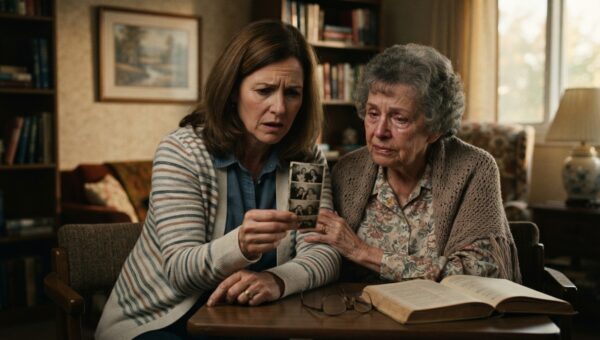
Dad sat in his plaid armchair by the picture window, staring out at the gray water of the bay with eyes that seemed to have forgotten everything we ever shared. He would mumble about things that happened forty years ago, lose the thread of a sentence halfway through, and lean his head against the upholstered wingback like a man made of dry paper.
Patricia had been the one to call me about the diagnosis. She had married Dad two summers prior, a quiet, neat woman with sharp eyes and a voice that never seemed to rise above a polite hum. “It’s progressing faster than the neurologist warned us,” she had told me over the phone, her tone dripping with a sorrow that felt just a fraction too rehearsed. “He wandered down to the dock twice yesterday, Diane. You really need to let me handle the daily schedule now. It’s too much for your own family.”
I had felt a sharp pinch of guilt, but I gave in. I stepped back from managing his checkbook, his medical appointments, and his daily care, trusting her because I wanted to believe she loved him. I brought him his meals. I spoon-fed him his applesauce when his hands shook too badly to hold the spoon. I kissed his forehead when I left, whispering that I would see him on Thursday.
That Thursday was supposed to be different. Thanksgiving with twenty-two family members packed into the old dining room, the radiators hissing, the smell of roasted turkey and sage filling every corner of the house. We had set up three folding tables end-to-end just to fit everyone. My son Ethan, nineteen and studying computer engineering at the state university, had arrived late from his dorm, carrying his backpack like it was made of lead. He didn’t take off his coat right away.
He just stood by the sideboard, his fingers hooked into his jacket pockets, watching Patricia cut slices of white meat while Dad sat beside her, his chin resting heavily on his chest in his usual posture of quiet absence.
Ethan reached into his pocket. He pulled out his phone, walked over to the small wireless speaker sitting next to the gravy boat, and tapped the screen. A sharp, clear chime echoed through the room.
“I need everyone to hear something,” Ethan said. His voice didn’t shake. It was flat, hard, and entirely devoid of the boyish hesitation I was used to.
He pressed play.
Dad’s voice filled the room. Not the gravelly, halting mumble I had been listening to for twenty-four months. It was strong, steady, and completely lucid. The man sitting at the head of the table, the man we had all treated like a fragile child, was speaking in full, complex paragraphs without a single stutter.
“Patricia, move the Schwab account before January,” the speaker declared, bouncing off the wallpapered walls. “The kids don’t check quarterly statements. By the time they notice, we’ll have the house in your name.”
A terrible, heavy silence dropped over the twenty-two people in that room. The hum of the refrigerator in the kitchen sounded like a roaring engine.
Then came Patricia’s voice from the tinny speaker, crisp and entirely unhesitating. “And Diane? What about her visits?”
Dad’s recorded voice chuckled. A dry, knowing sound that I had not heard since before my mother died. “If Diane asks, I forget. I always forget. That’s the beauty of it. She feels too guilty to look at the paperwork herself, and the doctors just sign whatever Patricia puts in front of them.”
At the main table, Patricia’s fork froze mid-air. The tines hovered an inch above a slice of turkey, droplets of amber grease clinging to the metal. She didn’t drop it. She just held her hand suspended there, her knuckles turning chalky white as her fingers locked around the silver handle.
Dad didn’t move his head at first. But the angle of his shoulders changed. The heavy, drooping slouch vanished in a single, rigid second. He straightened his spine, his neck snapping upward with a speed that made a mockery of every stiff, painful tremor he had performed for me over the last two years. He turned his head slowly, his eyes meeting Ethan’s across the room. There was no confusion in those eyes. There was only a cold, furious calculation.
“Turn that off,” Dad said.
His voice wasn’t weak. It carried across the room with the dry authority of a man who used to run a regional construction firm with three hundred men on his payroll. Every head at the tables turned toward him. Twenty-two pairs of eyes stared at the head of the table where a helpless old man had sat just thirty seconds before.
Nobody said anything for a second, and honestly that felt worse than shouting. My uncle Ray, seventy-one years old and built like an oak stump, pushed his chair back with a screech that made everyone jump. The metal legs gouged two deep gray lines into the hardwood floor.
“What did you just say?” Ray asked, his voice shaking with a rage that started deep in his chest.
Patricia finally set her fork down. It clattered against the fine china plate, the sound cracking the dead silence of the room like a pistol shot. She stood up so fast her linen napkin slipped from her lap and pooled around her ankles on the floor. Her face wasn’t pale; it was flushed with a hot, ugly red that crept up from the collar of her silk blouse.
“This is a prank,” Patricia said, her voice sharp and brittle. She pointed a trembling finger at Ethan. “That boy has been messing with audio software at his college. He built this. It’s a fake. You all know your father’s mind is gone.”
She looked around the room, her eyes darting from face to face, searching for a single ally among twenty-two people who had spent two years bringing casseroles, driving him to appointments, and holding back tears at family gatherings. She found twenty-two stone walls. Nobody nodded. Nobody agreed. My sister Sarah covered her mouth with both hands, staring at Dad as if a stranger had just climbed out of his skin.
Dad looked at Patricia, then down at his untouched plate of food. He didn’t look sorry. He looked annoyed, like a contractor whose blueprints had been spotted by a building inspector before the foundation could dry.
“Ethan,” I whispered. My own voice sounded like it belonged to someone else standing ten feet away. “Where did you get that?”
“Three weeks ago,” Ethan said, keeping his eyes locked on his grandfather. “I left my tablet on the coffee table in the study when I came over to help him fix the Wi-Fi. I went out to my car to grab my charging cord, and when I came back through the back door, I heard him talking in a normal voice. I checked my tablet later because it was still recording voice memos from a lecture I’d forgotten to turn off. The file was right there. I backed it up to three different drives before I came today.”
I just stood there because my brain kind of stopped working for a second. Two years of my life. Two years of carrying groceries, canceling my own dentist appointments, rescheduling client meetings at my accounting desk, sitting by his hospital bed while he pretended to drift off in the middle of a sentence. All of it was a play. A performance written to clear the board so Patricia could slide her name onto the deed of the house my grandfather built with his own hands in nineteen-seventy-eight.
“Diane,” Patricia said, taking a step around the corner of the table toward me. Her voice dropped into that soft, soothing tone she used when she wanted to convince me I was misremembering a conversation. “Don’t listen to him. You know how brilliant Ethan is with computers. They can make voices sound like anything now. Your father loves you. He wouldn’t, “
“Shut up, Patricia,” I said.
The words didn’t come out loud. They came out flat and low, but the entire room went so quiet you could hear the wind rattling the dry oak leaves against the storm windows outside.
I didn’t wait for her to answer. I turned away from the table, my boots clicking hard against the floorboards as I walked straight down the short hallway toward Dad’s private study. The door was closed, but the brass handle turned easily under my palm. The room smelled of old paper, pipe tobacco that he hadn’t smoked in three years, and floor wax.
The heavy oak desk had three drawers on the left side. The top one was locked, but the key had always hung on a small brass hook behind the heavy dictionary on the shelf. My fingers were shaking so badly I dropped the key twice before I managed to catch it against my palm. I slid it into the brass escutcheon and turned it until the lock gave a dull pop.
I didn’t need to dig through thirty folders. Right there on top, sitting under a leather-bound desk blotter, was a packet of fresh legal documents from the county courthouse, dated just four weeks ago. It was a quitclaim deed transferring the property title into a joint survivorship with Patricia, along with a stack of bank printouts showing three separate wire transfers totaling ninety-two thousand dollars moving out of Dad’s primary savings account into an account bearing Patricia’s maiden name.
At the bottom of the property transfer page, Dad’s signature was sharp, clean, and steady. Not a single tremor in the crossbars of the T’s. It was the handwriting of a man who signed checks for lumber yards and heavy machinery, not a man who forgot how to hold a fork.
Behind me, the study door creaked open.
I didn’t turn around. I held the papers up in my hand, the crisp white pages rustling in the quiet air of the room.
“January,” I said to the empty bookshelves. “You were going to clear the accounts before January.”
Dad stood in the doorway. He didn’t lean on his cane. He held it in his right hand like a walking stick, his posture straight, his shoulders square beneath his wool sweater. He looked old, yes, but he didn’t look demented. He looked like a man caught standing in a bank vault with a crowbar.
“Diane,” he said, his voice level and raspy from the tobacco he claimed he couldn’t remember buying. “Things are different now. Patricia understands how business works. You have your own life. Your own husband, your own house.”
“You let me cry over you,” I said, turning to face him. The space between us felt impossibly wide, filled with every Tuesday afternoon I had spent cutting his meat into small squares while he stared blankly at the wall. “Every week I drove out here thinking I was losing my father. I sat by your chair and worried myself sick wondering how much time we had left.”
“We have plenty of time,” he said, and for a second, a flash of that old, stubborn arrogance crossed his face. “The house is mine to leave to whoever I choose.”
“Not anymore,” I said.
I walked past him into the hallway, holding the papers against my chest like a shield. When I reached the dining room, the folding chairs were being pushed back. Uncle Ray was standing by the front door, his heavy coat already zipped up to his chin, his phone pressed to his ear as he talked quietly to our family attorney, Arthur Lindstrom, who lived just three miles down the road.
Patricia was gone from the head of the table. Her coat was off the hook in the mudroom, but her purse and her car keys were still sitting on the entryway bench.
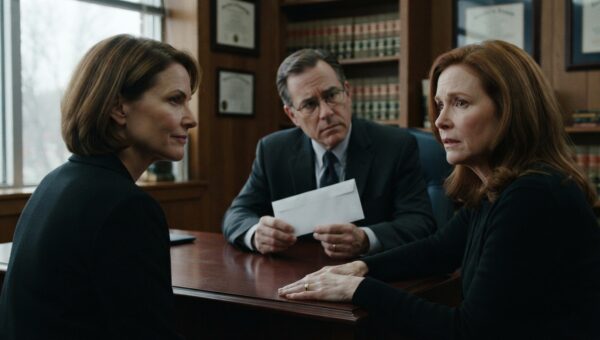
Arthur arrived twenty minutes later, his leather briefcase swinging at his side, his breath frosting in the cold air of the front porch as he stepped inside past twenty-two silent relatives. He didn’t even take off his overcoat. He walked straight into the study, reviewed the quitclaim deed, checked the routing numbers on the bank statements, and made two quick phone calls from his mobile.
By six o’clock that evening, the Schwab accounts had been hit with an emergency legal freeze under a petition citing suspected financial exploitation of an elderly dependent. The title transfer was blocked at the county recorder’s office before it could be processed on Monday morning. Patricia’s suitcase, which she had packed in a frantic rush while my cousins watched from the living room, sat by the front door like a piece of abandoned luggage left out for the trash truck.
She didn’t look at any of us when she walked out. She grabbed her leather bag, pushed past Uncle Ray without a word, and slammed the door of her sedan so hard the side mirror vibrated.
The house grew very quiet after everyone left. The twenty-two folding chairs were stacked back in the hall closet, their metal legs clinking together in the dark. The leftover turkey sat in a plastic container on the counter, untouched and graying at the edges.
Dad sat alone in his wingback chair by the window. The room was dark except for the amber glow of a single brass floor lamp by his elbow. He wasn’t looking at the bay anymore. He was staring straight ahead at the blank television screen across the room.
I walked into the kitchen, opened the refrigerator, and pulled out a small plastic tub of leftover mashed potatoes from the Thanksgiving feast. I scooped a portion onto a plain white ceramic plate, dropped a small pat of butter in the center, and heated it in the microwave for forty-0ne seconds until the edges steamed.
I carried the plate into the study and set it down on the edge of the polished mahogany desk, right where the quitclaim papers had been. I didn’t say anything about the fork. I didn’t cut the food into small pieces.
I left my car keys sitting on the corner of the desk, turned around, and walked out the front door, pulling it shut behind me until the heavy deadbolt clicked into place with a dry, final sound.