The gravel down the drive always crunched louder in the autumn when the ground started to freeze, a dry, rattling sound that used to tell me when Arthur was coming home from the tractor shed. I sat at the oilcloth-covered kitchen table with a mug of chicory coffee that had gone cold twenty minutes ago, staring at the blue glow of my laptop screen.
My eyes burned. My shoulders felt like they were knotted with old wire. Outside, the mesquite trees stood tall against the pale Arizona sky, dropping leaves that fluttered down like dry paper. I had spent three decades keeping my distance from everyone who shared my bloodline, convinced that the best way to handle a family that washes its hands of you is to wash yours right back. But thirty-one years is a long time to let a ghost sit at the edge of your memory.
Back in the winter of 1995, the world was a very different, very unforgiving place for an eighteen-year-old girl with a swelling belly and no safety net. I was living in a drafty rental house behind the feed store in a town that smelled constantly of diesel and dust. When I told the boy who put me there that I was carrying his child, hoping against hope that he would step up and be a man, he didn’t even look away from the television set.
He just reached for his can of soda and said, You’re a mistake I made. If you keep the baby, don’t expect a cent. He packed his duffel bag that same night and drove off, leaving behind thirty dollars on the Formica counter and a silence so heavy it made my teeth ache. I tried to make it work. I worked the cash register at the diner until my ankles swelled to the size of cantaloupes, but by the time my little boy was ten weeks old, I was watering down formula and crying myself to sleep every night in a room that felt like a prison. Surrendering him through that private agency felt like tearing my own ribs apart with my bare hands, but I did it because I believed I was giving him a fighting chance at a life I could never afford.
Years drifted by like tumbleweeds caught in a fence row. I met Arthur at the feed and seed cooperative where he managed the grain silos.
He was seventeen years older than me, steady as a stone wall, with kind gray eyes and calloused hands that knew how to fix anything from a broken baler to a broken heart. He couldn’t have children of his own, and when he found out about my past, he didn’t judge me. He just held me close and told me our life would be enough. We built a quiet, peaceful home out here in the desert, raising a few head of cattle and tending a garden that barely survived the summer heat. Arthur gave me safety, and for a long time, I let myself believe that safety was a fair trade for the piece of my soul I had left behind in that adoption office. But a mother’s heart doesn’t just turn off like a spigot. Every time I saw a little boy running through the grocery store parking lot with a red baseball cap, my chest would tighten.
I wondered if he had my nose, or his father’s stubborn jaw. I wondered if he ever looked up at the stars and felt the same hollow ache I carried around like a heavy stone in my pocket.
In the spring of 2026, the state finally loosened the digital seal on old closed-adoption registries, allowing birth parents to request archival placement dockets through a secure state portal. I didn’t tell Arthur right away. I waited until he drove into town for his weekly hardware run on a Tuesday morning at 8:15. When the front door clicked shut behind him, my fingers shook so badly over the keyboard I had to wipe them on my jeans twice before I could type my mother’s maiden name into the search bar. The system spun for a few seconds, fetching microfilmed files from thirty-one years ago that hadn’t seen the light of day since the Clinton administration. I expected to find an ordinary family name somewhere out of state, maybe in Ohio or Pennsylvania, people I would never meet or know. Instead, the first PDF document loaded onto my screen, and the text stared right back at me with terrifying clarity. The name of the adoptive father listed on the 1995 placement docket was Robert Miller, and the mother was Clara Miller. My mother’s older brother and his wife. My own aunt and uncle.
The room seemed to tilt on its axis. I stood up so fast my chair tipped backward and hit the linoleum floor with a sharp crack that echoed off the empty walls. My breath caught in my throat, and my hands went ice cold, the blood draining right out of my fingertips. It didn’t make any sense. My aunt Clara and uncle Robert lived just three towns over in a modest ranch house with green shutters where we used to gather for Sunday potlucks before the big family falling-out over my pregnancy. They had always been childless, a quiet, church-going couple who kept to themselves and grew prize-winning roses in their side yard. According to the document, they had adopted an infant boy through a private agency trust fund in the spring of 1995, an agency that my uncle had quietly helped finance through his agricultural shipping business. They had named him Caleb, giving him a slightly modified version of my grandfather’s middle name. Caleb was now thirty-one years old. He wasn’t some stranger lost in a distant city. He was my first cousin, raised by the very people who had watched my mother turn her back on me when I got into trouble, entirely unaware that the infant dropped into their arms by a discreet caseworker was actually their own flesh and blood.
I couldn’t sit there and stare at the screen anymore. The walls felt like they were closing in, the dry desert heat pressing against the windows as if demanding answers. I grabbed my car keys off the hook by the back door, my hands still trembling so violently I dropped the ring twice onto the concrete stoop. The drive down county road 42 took forty-five minutes, the old sedan kicking up dust clouds behind me as I pushed the speedometer ten miles past the limit. Every mile marker felt like a countdown to a confrontation I didn’t know how to handle. By the time I turned down my aunt Clara’s familiar gravel drive, the white paint on their porch railing was peeling in long ribbons, exactly where it had been peeling ten years ago. Aunt Clara was out in the side yard with a pair of pruning shears, snipping dead blooms off her rose bushes with a slow, deliberate rhythm. She looked older, her hair gone completely silver and pulled back into a neat bun, wearing her faded blue gardening apron with the deep pockets filled with twine and plant tags.
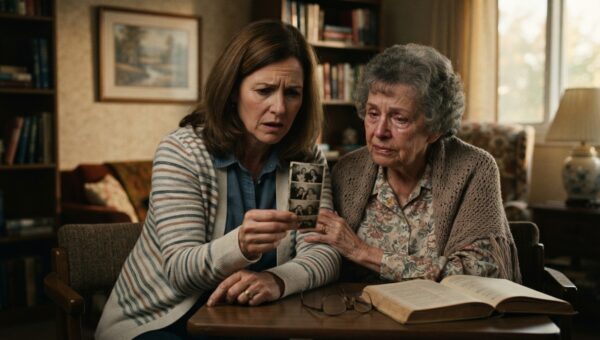
When she heard my car door slam, she straightened up slowly, shielding her eyes against the bright morning sun with the back of a weathered hand. She didn’t look angry; she just looked confused, watching me walk across the hard-packed dirt toward her with the manila folder clutched against my chest like a shield. I didn’t bother with pleasantries. I didn’t ask her about her knee or how the tomatoes were doing this year. I just pulled the certified adoption decree out of the folder, unfolded the yellowed paper with its crisp state seals, and held it out toward her. She took it from my hand, her bifocals sliding down the bridge of her nose as she squinted at the faded typewritten names from 1995. The color drained from her face so fast she looked like she had seen a ghost in broad daylight. She reached out and grabbed the edge of the wooden porch post to steady herself, her breath catching in a dry, ragged gasp. Nobody said anything for a second, and honestly that felt worse than shouting.
She looked down at the paper, then up at me, her eyes welling with sudden, heavy tears that spilled over her wrinkles without her even trying to stop them. We didn’t know, she whispered, her voice cracking so badly I could barely catch the words over the hum of a distant tractor. The agency man told us the mother was a young girl down in Tucson who had no one. He said the records had to be sealed tight for privacy. Robert and I just wanted a baby to love. We never dreamed in a million years… she couldn’t even finish the sentence. She just dropped her head against the rough wood of the porch post and began to cry with the deep, racking sobs of someone whose entire world had just been upended by a piece of paper. I stood there watching her, the fierce anger I had carried in my chest for thirty-one years slowly dissolving into something heavy and hollow. She wasn’t a villain in this story. She was just another casualty of a family that preferred secrets over messy truths, a woman who had raised my son with all her heart, believing he was a gift from a stranger when he had been sitting at family reunions in spirit all along.
Caleb was out working at the county extension office that morning, but Aunt Clara insisted on calling him home right then and there. Her hands shook so badly she dropped the landline receiver twice before she managed to punch in his mobile number. She didn’t tell him why; she just told him his aunt Clara needed him here right now, her voice tight with an urgency that brooked no argument. I sat at their kitchen table, the same table where I used to eat sugar cookies when I was ten years old, watching the second hand sweep around the face of the electric wall clock. Every tick sounded like a hammer blow against my ribs. When the front door finally opened twenty minutes later, heavy boots stepped onto the linoleum, and a tall man with broad shoulders and dark, unruly hair walked into the kitchen. He had my grandfather’s high forehead and the exact same way of tilting his chin when he was trying to figure something out. He was thirty-one years old, wearing a faded work shirt with dust on the cuffs, holding his truck keys in one hand.
He stopped dead in the doorway when he saw me sitting at the table, looking from my pale face to his mother’s tear-streaked cheeks with a frown of deep concern. Mom, what’s going on? Who is this? he asked, his voice low and steady, carrying that familiar timber I had only ever imagined in my daydreams. Aunt Clara couldn’t speak; she just sat down at the table and buried her face in her apron, leaving the manila folder lying open between us on the laminate surface. I stood up slowly, my legs feeling like lead weights, and pointed down at the certified document with its official state stamps and signatures. It took him a long time to read it. He stood under the overhead fluorescent light, his eyes scanning the lines of text over and over again, the confusion on his face slowly giving way to an absolute, stunned stillness. He didn’t drop his keys, and he didn’t yell. He just set them down very carefully on the counter beside the toaster, as if afraid he might break something if he moved too fast.
He looked up at me then, his dark eyes searching my face with a hunger that matched my own, looking for pieces of himself in the stranger standing across the room. You’re my mother, he said, and it wasn’t a question, just a quiet statement of fact hanging in the warm kitchen air. I nodded because my voice had completely abandoned me, a thick knot forming in my throat that made it impossible to speak. He didn’t step back, and he didn’t turn away. He walked across the small kitchen in two long strides and pulled me into his arms, burying his face in my shoulder just the way a little boy would when he was scared. His jacket smelled of outdoor dust and fresh pine, and as I wrapped my arms around his broad back, holding him tight for the first time in thirty-one years, the thirty-year ache in my chest finally broke. We stood there in that quiet kitchen for a long time, neither of us saying a word, letting the years of absence fall away between us like dead leaves in the wind.