PART 1
Odis handled the money for forty-one years. I never once saw a bank statement. Whenever the mail came in with those thick envelopes from the investment firm or the credit union, I handed them straight to him across the breakfast table, and he tucked them into his leather briefcase without opening them in front of me. He said figures gave me headaches, and I let him believe it because, for a long time, it was easier than arguing about numbers.
We lived a quiet life in the same brick ranch house we bought back in 1985. Odis worked as a logistics manager for the county, and I kept a vegetable garden in the backyard and volunteered at the library on Thursdays. We never took extravagant vacations, but we always had Sunday roast and enough put away in our retirement account that Odis promised would keep us comfortable until we were eighty.
Then the property tax notice came in the mail yesterday afternoon.
It was addressed directly to me, which was unusual because the county usually sent everything to Odis’s attention. I opened it before he got home from his weekly breakfast with the retired county guys at the diner. I unfolded the yellow paper, scanning down to the escrow calculation line, and my stomach dropped. The escrow short. A deficiency of nearly four thousand dollars due by the end of the month, or the county would place a lien on the parcel.
I didn’t panic right away. I assumed it was just a clerical error at the county assessor’s office, or perhaps a miscalculation with our homeowner insurance hike. I walked over to the desk in the den, picked up the landline phone, and dialed our bank’s local branch. A pleasant woman named Sarah Miller answered. When I gave her our account numbers and explained the tax notice, she tapped away at her keyboard for a moment.
“Let me pull up the escrow ledger, Mrs. Miller,” Sarah said, her voice dropping into that polite, professional cadence people use when they are about to deliver bad news.
I waited, listening to the faint hum of the refrigerator in the kitchen.
“Well, Mrs. Miller,” Sarah said, clearing her throat softly. “Your escrow account is indeed empty, but that is because the primary checking and retirement accounts tied to it have been drawn down significantly over the past six months.
Your current balance across all holdings is sitting at nine thousand, twelve dollars.”
I frowned, gripping the receiver tighter. “Excuse me, Sarah? You must be looking at a savings sub-account. Our main retirement portfolio had two hundred and fourteen thousand dollars in it back in the spring.”
There was a heavy pause on the line. I could hear the faint click of a mouse.
“No, ma’am,” Sarah said gently. “There was a lump-sum wire transfer of two hundred thousand dollars executed back in April, followed by several smaller automated withdrawals totaling five thousand a month through the summer. The remaining balance as of this morning is nine thousand, twelve dollars.”
I sat down hard on the wooden chair by the desk. The room tilted slightly, the walls seeming to pull inward. Two hundred and fourteen thousand dollars. Gone.
I thanked Sarah, set the phone back on its cradle, and walked into the kitchen.
I put both hands flat on the oak table until the room stopped spinning and the floor felt solid beneath my shoes again.
That evening, when Odis walked through the back door carrying his jacket and smelling faintly of coffee and pipe tobacco, I had dinner waiting on the stove. We sat down at the table just like we had every evening for four decades. He unfolded his napkin, ladled gravy over his potatoes, and didn’t look up from his plate.
“How are our savings doing?” I asked, my voice as easy as pie.
He didn’t look up. He just chewed his bite of roast beef, swallowed, and reached for the salt shaker.
“Same as always,” Odis said, waving a hand dismissively. “Don’t worry your head about it.”
PART 2
I watched his hand reach for the salt shaker, steady and unbothered. Forty-one years of watching that exact hand butter toast, sign birthday cards, and pat my shoulder when my mother passed away. For forty-one years, I had treated him as the anchor of our existence, the steady hand that kept the roof over our heads and food on our plates. And all the while, he had sat across from me in this very room, lying without a blink about a lifetime of security that had just vanished into thin air.
I didn’t scream. I didn’t flip the dinner plate onto his lap or start crying hysterically. Something inside me simply froze over, turning all that warm, conditioned domestic trust into cold, sharp glass.
“That’s good,” I said quietly, looking down at my own untouched plate. “I’m glad to hear it.”
He ate his dinner with a hearty appetite, chatting idly about how the county was repaving the frontage road near the fairgrounds and how his tomatoes were coming along. I nodded at the right intervals, murmured in agreement when he expected it, and played my part to perfection. But my mind was racing through every drawer, every file cabinet, and every hidden corner of the house where a man might try to hide the wreckage of two hundred thousand dollars.
The next morning, right after Odis pulled out of the driveway to go meet his brother down at the hardware store, I walked straight into his small home office. It was a room I rarely entered, respecting his private workspace the way he always insisted a marriage required. I walked up to his heavy oak desk. The top drawer was locked, but Odis had always been predictable. For thirty years, the spare key had hung on a small brass hook behind the winter coats in the hall closet, disguised among the dry-cleaning tags.
I found the key, unlocked the drawer, and pulled out the file folder labeled “Taxes & Estates.”
Inside was the graveyard of our financial life. There were no bank statements from our main credit union; those had obviously been redirected to a paperless online portal only he accessed. Instead, there were printed notices from an online brokerage firm I had never heard of, statements from a commodities trading platform, and three separate demand letters from a regional bank in the city regarding a margin call on a leveraged account.
I turned the pages with trembling fingers. The wire transfers didn’t go toward medical bills or home repairs. They went toward high-risk currency speculation and options trading—wild, desperate gambles placed over the past fourteen months, chasing losses in a market Odis knew nothing about. Attached to the latest statement was a receipt for a cashier’s check dated two weeks ago, draining the final remnants of our emergency fund to pay off an overdue debt collection agency.
He hadn’t just lost our retirement. He had bet our house, our peace, and forty-one years of quiet stability on a fool’s errand, and he had planned to let the county foreclose on us rather than admit he failed.
PART 3
I sat at his desk for an hour, photographing every page of those statements with my phone. Then I put the folders back exactly as I found them, locked the drawer, hung the key on the brass hook in the closet, and drove straight down to the bank.
Sarah Miller met me in a private glass-walled office away from the teller counter. I laid my phone and my notes on her desk, along with my driver’s license and our marriage certificate.
“Sarah,” I said, my voice completely steady. “I need to freeze every joint account my husband and I hold. I want the remaining nine thousand dollars transferred immediately into an individual account in my name only, and I want all automated lines of credit revoked as of this second.”
Sarah looked at the documents, her eyes widening as she connected the pieces. “Mrs. Miller, a joint account requires both signatures to dissolve entirely, but under our emergency fiduciary protection protocols for financial endangerment—”
“Do whatever your protocols allow,” I interrupted, leaning forward. “Do it now.”
It took two hours of paperwork, phone calls to the bank’s legal department, and a very firm conversation with a branch vice president who recognized the validity of my claims. By noon, the remaining funds were secured in a new account that Odis could not touch, and formal notices of revoked joint authorization had been dispatched to every credit card and line of credit linked to our name.
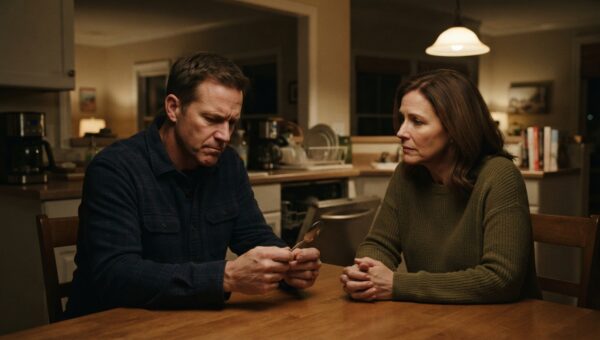
When Odis came home that evening at five o’clock, he walked through the back door with his usual cheerful whistle. He hung up his jacket, washed his hands at the kitchen sink, and sat down at the table. There was no dinner waiting on the stove tonight. Instead, the kitchen was dead silent.
I sat at the opposite end of the table. In front of me lay the printed property tax notice, a copy of the bank freeze confirmation, and three color printouts of the brokerage statements I had photographed from his desk drawer.
Odis noticed the silence first. He stopped halfway to his chair, his smile faltering. “Martha? What’s all this?”
He sat down slowly, his eyes dropping to the papers spread across the wood.
“Two hundred and fourteen thousand dollars, Odis,” I said, my voice cutting through the quiet kitchen like a knife. “That’s what Sarah at the bank told me yesterday when I called about the escrow short on the property tax notice. And then I went into your desk and found the rest of the story.”
The color drained from his face so fast he looked like a statue carved out of chalk. He opened his mouth, but no sound came out. He reached out a shaking hand toward the brokerage printouts, as if trying to push them away.
“I can explain,” he whispered, his voice cracking. “It was an investment. I thought… I thought I could double it before we retired, leave us set up for the nursing home, make sure we never had to—”
“You didn’t invest, Odis. You gambled,” I said, cutting him off completely. “You took forty-one years of my life, my work in that garden, every penny we saved while I sewed my own winter coats, and you threw it away on computer screens.”
He slumped back in his chair, suddenly looking very old, very small, and entirely defeated. “What are we going to do?”
“We are going to sell this house,” I said evenly. “We are going to take whatever equity is left after paying off the tax lien, divide what little cash remains, and you are going to find a small apartment across town. Because I am done not looking at bank statements.”
ENDING
He didn’t argue. He didn’t raise his voice or tell me not to worry my head. He just stared down at his empty hands resting on the edge of the table where we had shared breakfast every morning for four decades. I stood up, walked over to the counter, and picked up a thick black library ledger I had brought home from my volunteer desk. I set the ledger squarely in the center of the kitchen table, right on top of his brokerage statements, and clicked my pen shut with a sharp, echoing snap. I told him dinner was over, turned off the overhead light, and walked down the hallway to the guest bedroom, closing the door behind me with a firm, final click.