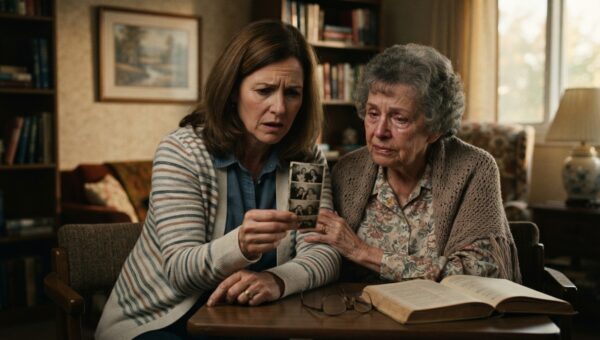
The classroom smelled of damp construction paper and spilled apple juice, the exact same heavy, comforting odor it had carried for the past fourteen years. I was wiping down the blue rectangle table with a damp sponge, watching the last speck of purple glitter stubborn itself into the wood grain. Five years. That was the number that lived behind my ribs like a dull ache.
My only son Owen had been nineteen when the state troopers knocked on my door in the middle of a November downpour, telling me his sedan had drifted off Route 9 and caught fire before anyone could pull him out. I didn’t even get to see him. They handed me a heavy metal box of ashes and a charred backpack with a melted zipper, and I spent every day since then keeping myself upright by teaching five-year-olds how to hold their crayons correctly.
Principal Miller had poked his head in around ten o’clock that morning with a small hand tucked against the shoulder of a new boy in a green corduroy jacket. He had honey-brown hair that flopped over his forehead and wide, nervous eyes that reminded me instantly of someone I used to pack lunch boxes for.
“This is Theo,” Principal Miller had said, his voice dropping into that gentle, administrative register we all use for kids who are scared on their first day. “He’s joining us starting today. Be nice to him, everybody.”
I smiled down at the boy, kneeling so we were at eye level, and that was when I saw it. Right beneath his right eye, sitting on the soft skin of his cheekbone like a crescent moon pressed into dough, was a tiny, faded birthmark. It was the exact shape of a birthmark my Owen had carried since the day he was born in the old county hospital. I stood up too fast, my knees clicking, and my breath caught somewhere between my throat and my lungs. I told myself it was just a coincidence because people share features all the time, but the shape was too exact, a little half-moon fingerprint stamped onto the skin.
By three o’clock, the afternoon bell rang with its usual metallic clatter, and the room dissolved into a flurry of tiny windbreakers and mismatched sneakers. I walked the line of children out to the front chain-link fence, my hands sweating against my clipboard.
The parents were clustered by the asphalt, shifting from foot to foot against the autumn wind, waiting for their little ones to be handed over. I scanned the crowd automatically, but my eyes kept darting back to the little boy in the green corduroy jacket who was clutching the strap of his tiny dinosaur backpack.
Then he broke away from the group, his sneakers squeaking against the dry leaves on the pavement.
“Mama!” he shouted, his voice ringing clear and bright across the schoolyard.
I looked up, following his small, darting figure toward the edge of the parking lot where a woman with dark hair pulled back in a loose clip was kneeling down to catch him. She stood up as he crashed into her arms, and the afternoon sun hit the side of her face. Something in the way she tilted her head, the sharp angle of her jawline, and the quiet, protective way she gathered the boy against her chest made the world tilt on its axis.
Her name was Clara, according to the enrollment paperwork I had glanced at that morning, but as I stood frozen by the gate, my fingers digging into the wood of my clipboard, I knew I had never seen her before in my life. Yet she was holding a child who had Owen’s smile, Owen’s birthmark, and Owen’s exact tilt of the head.
The next three days passed in a gray, humming blur. I couldn’t sleep, and every time I looked at little Theo building towers out of wooden blocks during free play, my hands would start to shake so badly I had to hide them in the pockets of my cardigan. I noticed the way he held his yellow crayon with his thumb wrapped underneath, exactly the way Owen used to hold his pencils when he was learning to write his name. It wasn’t just a resemblance anymore. It was a ghost walking around my room in a size-five sneaker, laughing with a voice that echoed through the hollowest parts of my chest.
On Thursday afternoon, I stayed late on purpose. I waited until every other parent had collected their child and the playground was entirely empty except for the custodian pushing a broom across the rubber mats. I walked out toward the sidewalk where Clara was standing by an old blue sedan, buckling Theo into his booster seat. She looked up as my footsteps crunched on the gravel, her expression polite and guarded, the way mothers look when they think a teacher is about to report a behavior problem.
“Mrs. Hayes,” she said, her voice softer than I expected, with a slight drawl I didn’t recognize. “Is everything all right with Theo? Did he have a hard time today?”
“No,” I said, my throat feeling dry like sandpaper. “No, Theo is a wonderful boy. He’s very smart. He does great with his letters.”
She closed the car door gently, making sure the latch clicked, and turned to face me with her hands resting on the pockets of her jacket. “Oh. Good. He was a little nervous about starting at a new school, being from out of town and all.”
“Where did you move from?” I asked, and even to my own ears, my voice sounded tight, stretched too thin over a frame that was about to snap.
She blinked, her dark eyes narrowing just a fraction as she tried to read my face. “Up north. Near the state line. My husband got a job at the lumber mill down here. It’s… it’s a big change for us, honestly.”
“Your husband,” I repeated, the words tasting like metal. “What’s his name?”
Clara stepped back half a step, her hand lingering on the top of the car door. “Owen. Why are you asking me this, Mrs. Hayes? Is something wrong?”
The name dropped between us like a stone down a deep well. My knees felt weak, and I had to reach out and steady my hand against the cold metal roof of her car.
“My son’s name was Owen,” I whispered, and the quietness of the schoolyard suddenly felt heavier than anything I had ever carried. “He died five years ago in a car crash on Route 9. They told me he didn’t make it. They gave me a box of ashes.”
Clara stared at me, the color draining entirely from her face until she looked almost translucent in the late-day light. She didn’t move, and neither did I, both of us suspended in the terrible space between what we knew and what was actually true.
“Route 9,” she said, her voice dropping to a harsh, ragged whisper. “Near the old bridge? The night of the November storm?”
“Yes,” I managed to choke out.
Clara covered her mouth with her hand, her eyes suddenly shining with bright, hot tears that she didn’t try to wipe away. “Oh God,” she breathed. “Oh God. You’re his mother.”
She didn’t explain it all right there on the sidewalk, but she asked me to follow her to a small diner down on the corner of Main Street where the coffee sat in thick ceramic mugs that smelled of old bleach. We sat in a vinyl booth near the back, the neon sign of the diner casting a pink glow across the table between us. Clara told me everything in a rush of broken sentences, her hands trembling as she wrapped them around her coffee cup.
Five years ago, she had been driving home late during that terrible storm when she saw a sedan crumpled against a pine tree off the shoulder of Route 9, smoke pouring from the engine block. She had pulled her car over, run through the freezing mud, and dragged an unconscious nineteen-year-old boy out of the front seat just seconds before the gas tank blew. He didn’t have a wallet on him because his backpack had been thrown into the brush and burned beyond recognition, containing someone else’s discarded gear he must have picked up at a campus sale. When he woke up weeks later in a regional trauma center two counties away, the brain trauma had wiped his memory clean. He didn’t know his name, where he came from, or who his mother was.
“The hospital staff made a mistake with the John Doe files,” Clara told me, her voice breaking as she looked down at the scratched laminate table. “And when he finally recovered enough to leave, he had nobody. I took him in. We rented a little place together, and over the years, bit by bit, he started over. He remembered how to fix engines, he remembered how to laugh, but his past was just gone. A total blank slate. We had Theo three years ago, and we built a quiet life because we thought that was all there was left for us.”
“He’s alive,” I said, and the words felt so huge they barely fit inside the small booth. “My boy is alive.”
“He is,” Clara whispered, looking up at me with tears cutting tracks through the dust on her cheeks. “And he’s living just three miles from here. He doesn’t know you’re here. If I bring this up to him like this, it’s going to break whatever fragile peace he’s built in his head. But you’re his mother. You have every right.”
“I don’t want to break anything,” I said, and for the first time in five years, I felt a strange, terrifying warmth spreading through my chest. “I just want to see him.”
Two days later, on a Saturday morning when the sun was bright enough to make the maple leaves look like stained glass, Clara brought him to a quiet corner of the community park down by the river. I sat on a green wooden bench near the duck pond, my fingers tightly clutching an old leatherbound copy of *A Child’s Garden of Verses* that I had kept in the bottom of my cedar chest ever since Owen was six years old. It had his name written in blue crayon on the inside cover, spelled out with a backwards N just the way he used to do it.
I heard their footsteps crunching on the gravel path before I saw them. I looked up and saw a tall man with broad shoulders and a slight limp walking toward the bench, holding little Theo by the hand. He looked older, weathered by years of quiet labor, and the faint, silvery scar of a burn traced along the hairline behind his left ear. He stopped about ten feet away, his expression cautious and confused, looking at me the way a stray animal looks at someone holding out a hand with an open palm. Clara stayed back near the oak trees, giving us space.
“Hi, Mom,” Clara had told him to call me, or at least she had told him a woman named Evelyn wanted to meet him because she had known him before the accident, but as he stood there looking down at me, I knew he didn’t remember any of it yet.
“Owen,” I said, and my voice cracked right down the middle.
He stopped, his hand dropping loosely to his side as he stared at my face. He looked at my eyes, then down at the worn leather book resting on my lap, and then back up again. A strange, troubled frown creased his forehead, the exact same expression he used to wear when he was trying to solve a hard math problem on the living room floor.
“I’m sorry,” he said, rubbing the back of his neck with a calloused hand. “Clara said you had something to show me. Something from… before.”
I didn’t say anything. I just held out the book, opening it carefully to the first page where the blue crayon letters sat faded and stubborn against the yellowed paper.
Owen stepped closer, slowly, as if he were afraid the ground might give way beneath his boots. He reached out a long, hesitant finger and touched the clumsy, backwards N on the page. He stood there for a long time, staring down at those childish letters while the wind rustled through the dry grass around us, carrying the cold, clean smell of the river.
Then his breathing hitched. He squeezed his eyes shut for a second, his hand pressing flat against his forehead as if he were trying to push away a heavy door that had been bolted shut for half a decade. When he opened his eyes again, the confusion was gone, replaced by something deep and overwhelming that reached all the way across the empty years between us.
“The kitchen table,” he whispered, his voice trembling as the memories started flooding back through the cracks. “The green lamp. You used to read that to me when I had the flu.”
“I did,” I choked out, standing up from the bench and stepping into the space between us.
He didn’t say anything else. He just reached out and pulled me into his arms, burying his face in my shoulder just the way he used to do when he was a little boy, holding on so tightly I could feel the steady, living beat of his heart against mine. Across the lawn, little Theo was chasing a stray soccer ball toward the riverbank, shouting with laughter, while Clara stood under the golden autumn leaves watching us with quiet, tearful grace. The grief that had hollowed me out for five years didn’t vanish, but it finally had room to breathe, resting softly in the afternoon sun where my son’s familiar smile finally reached all the way to his eyes.