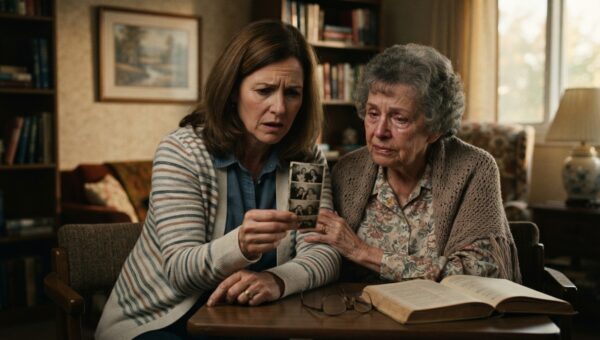
My father made me promise on his deathbed: “Take care of your mother.”
I didn’t know back then that those six words would cost me the better part of twelve years, four empty savings accounts, and every drop of patience I had left in my bones. When he passed away in the spring, leaving behind a small house with a crumbling foundation and precisely twelve hundred dollars in a battered metal lockbox, my three brothers did what they always did when life required heavy lifting.
They backed away. Julian packed his bags and moved two states over for a job in commercial real estate that seemed to consist entirely of golf outings. Calvin stayed in town but developed a sudden, chronic allergy to phone calls. And Toby, the youngest, just drifted from one couch to another like dandelion fluff, waiting for someone else to pay his cell phone bill.
Mother sat in her floral armchair with her ankles crossed, dabbed at her eyes with a lace handkerchief, and looked at me with those soft, helpless gray eyes. She said she couldn’t possibly manage the property taxes on her own. She said the grocery prices were criminal. She said a mother never expects to outlive her husband, let alone her dignity. So I took a second shift at the paper mill. I started driving out to her place every Tuesday with a trunk full of canned goods, a stack of paid utility notices, and a checkbook that bled a little more every month.
For the first four years, it was just the routine bills. Property insurance, oil for the furnace, the dentist appointments she kept putting off until her gums bled. Then came her hip replacement, followed by shingles, followed by a gallbladder scare that nearly put her under for good. Every single time, Julian sent a text asking how she was holding up, while Calvin mailed a Hallmark card with twenty bucks inside it. Toby didn’t even bother with the card. I covered the gaps. I didn’t do it because I wanted medals or because I expected a gold watch at the end of the rainbow. I did it because of the dirt on my father’s casket and the weight of that bedroom promise.
By the time the calendar rolled around to 2018, the math had gotten ugly. I had already sunk nearly ninety thousand dollars into keeping her afloat while her pension stayed flat and inflation ate through whatever savings my father had left behind.
One afternoon, after paying a three-thousand-dollar contractor bill for a roof leak that threatened to cave in her spare bedroom, I sat down at her oval kitchen table with a yellow legal pad and laid out the ledger.
She watched me write, her fingers twisting the edge of a knitted doily until her knuckles went gray.
“You’re keeping track of every cent, aren’t you?” she asked. Her voice wasn’t angry. It was just tired.
“Somebody has to,” I said, not looking up from the columns of figures. “Julian hasn’t sent a check since the Clinton administration. Calvin is three months behind on his own child support. If I don’t write it down, Mom, there won’t be anything left to keep the lights on next winter.”
She reached out and laid her hand over my pen, stopping the ink. “I don’t want you to ruin your own life for mine. Let me sign something. Just so you know I see what you’re doing.”
That was the afternoon she signed the promissory note. We didn’t hire a fancy lawyer with leather-bound portfolios. We drove down to the title company by the hardware store, paid a notary twenty-five dollars, and drew up a formal, binding agreement for two hundred thousand dollars, using the house itself as collateral. It wasn’t about distrust. It was about reality. It was about acknowledging that my brothers were never going to contribute a nickel, and that the entire financial survival of our family was resting on the back of my work shirts.
I put that paper in a blue accordion folder along with every canceled check, every medical invoice, and every grocery receipt going back to the day my father died. And then I went back to work.
Last spring, the big collapse happened. Pneumonia turned into sepsis, and for six terrifying days, the hospital monitors in the intensive care unit sounded like a metronome keeping time with her fading breath. Julian showed up on day four, wearing an expensive silk tie and smelling faintly of bourbon, stood at the foot of her bed for twenty minutes, and then had to catch a flight back to Boston. Calvin visited once, complained about the hospital parking fees, and left before the nurse could give him an update. Toby didn’t show up at all; he sent a heart emoji on a group chat that I was funding the data plan for.
When she finally pulled through, the doctors said she couldn’t live alone anymore. That meant three months of intensive rehabilitation at the Maple Grove facility, followed by twenty-four-hour in-home nursing care for the transition back. The bills arrived in fat white envelopes with window cutouts. Forty-five thousand dollars out-of-pocket after the insurance company finished playing its favorite game of administrative dodgeball. I cleared out my retirement account, cashed in the remainder of my savings bonds, and paid every last line item.
Total investment over twelve years: $200,000 flat. Not a penny more, not a penny less.
She recovered slowly, her steps hesitant as she walked with a metal walker across her braided rugs, but her mind came back as sharp as a tack. She started talking about the future again, about settling affairs, about keeping the peace among her boys. I figured the accounting would happen naturally. I figured that when the time came, the house would be signed over to me to clear the ledger, and my brothers could finally face the fact that adulthood has a price tag.
I was wrong.
Last Tuesday afternoon, Mother gathered all four of us in her living room. Julian flew in from Boston, looking prosperous and smelling of lime aftershave. Calvin brought a box of stale doughnuts from the gas station, and Toby showed up twenty minutes late with his sneakers untied. I sat on the edge of the floral sofa, my boots still caked with dried mud from the morning shift at the mill.
Mother cleared her throat, smoothed down the front of her cardigan, and looked around the circle with a serenity that made my teeth ache.
“I’ve been thinking a lot about the house and the land,” she began, her voice steady and deliberate. “And I’ve decided how things are going to be handled when I’m gone. I went down to the county office last week and updated my will. Everything is being divided equally. Twenty-five percent to each of you boys. Clean and simple. No hard feelings.”
The silence in the room wasn’t quiet. It had a heavy, greasy weight to it, like an engine running low on oil.
Julian smiled, leaning back against the arm of the love seat. “That sounds fair, Ma. Always did appreciate a woman of vision.”
Calvin nodded around a mouthful of jelly doughnut. “Can’t argue with that. Equal shares for the whole team.”
Toby didn’t say anything, but he grinned like a dog that had just found an unattended steak on the counter.
I sat there for a long moment, watching the dust motes drift in the shaft of sunlight coming through the sheer curtains. My hands were rough, the skin around my fingernails permanently stained with grease from the machinery, and my back still ached from hauling the heavy oxygen tanks up her front steps two months ago.
I looked straight across the coffee table at her. “Mom, I’ve spent two hundred thousand dollars taking care of you over the last twelve years.”
She didn’t flinch. She just adjusted her glasses and gave me that soft, maddening little tilt of the head she always used when she wanted to dismiss something unpleasant.
“Well,” she said, her voice dropping into that gentle, scolding register she used when we were kids. “Your brothers are family too. Blood is blood, and fair is fair.”
The youngest brother, Toby, let out a short, wet laugh. He didn’t even look at me when he said it. “Fair is fair, bro. You chose to spend your money. Nobody put a gun to your head.”
That was the exact second the machinery in my head stopped grinding. The twelve years of missing birthdays, the double shifts at the mill, the nights sitting in vinyl hospital chairs while my brothers slept in their own beds, the promises made to a dying man who trusted us to do right. It all compressed down into a single, hard point behind my eyes.
I didn’t yell. I didn’t slam my fist on the table. I just stood up, reached down to the floor beside my boots, and pulled out the blue accordion folder.
The room went very still. Julian stopped smiling. Calvin stopped chewing his doughnut.
I unclasped the brass button with a sharp click that sounded entirely too loud in the quiet house. I pulled out a thick stack of papers, squared the edges against the table with a dry rustle of paper, and slid the top document across the polished oak directly in front of my mother.
“Twelve years of receipts,” I said, my voice barely above a whisper. “Bank routing transfers from my account to yours. Canceled checks for your heating oil, your groceries, your property taxes, and every single dollar of that forty-five-thousand-dollar hospital bill from April.”
I laid one final piece of heavy parchment down right on top of the pile.
“And here is the promissory note. Signed by you in 2018. Notarized down at the title company. Two hundred thousand dollars, with this house named as primary collateral.”
Mother went entirely gray. Her jaw dropped an inch, and her hands started to shake so badly she couldn’t lift her teacup.
“Where did you get that?” she whispered. The calm, matriarchal facade cracked right down the middle, leaving behind something small and scared.
“You signed it after your surgery,” I said, looking right into her eyes. “When you promised to pay me back because you knew damn well Julian and Calvin weren’t going to lift a finger.”
Julian leaned forward, his face turning blotchy red. “What is this nonsense? You can’t just draw up secret papers behind our backs! That’s our inheritance you’re messing with!”
“Shut up, Julian,” I said without looking at him.
Mother looked frantically toward the doorway, where her attorney, Arthur Vance, had been standing quietly in the hall, waiting for the family discussion to finish before filing the paperwork. She had brought him in to witness her new will division, assuming it was just a formality.
“Arthur,” she gasped, her voice thin and ragged. “Look at this. He’s trying to steal the house.”
Arthur Vance stepped into the light of the living room, adjusting his spectacles. He was an old man who had handled wills in this county since before my father was buried, and he didn’t rattle easily. He walked slowly to the table, picked up the notarized document, and spent a long minute reading every line, checking the embossed seal from the title office, and scanning the signature at the bottom.
The room held its breath so hard you could hear the refrigerator humming in the kitchen down the hall.
Arthur laid the paper back down on the wood, looked straight at my mother, and said, “This is a fully executed, legally binding lien against the property, registered with the county clerk six years ago. Before any estate division can happen, before a single square foot of this land is split between your sons, this two-hundred-thousand-dollar debt has to be satisfied in full.”
Julian stood up so fast his chair tipped over backward onto the hardwood floor with a sharp crash. Calvin stared at the papers like they were written in ancient Greek. Toby just sat there with his mouth open, looking like someone had pulled the plug on him.
Mother looked up at me, her eyes swimming with a desperate, pathetic realization. “You can’t do this to your own family.”
“I kept my promise to Dad,” I said, sliding the heavy folder back into its case and snapping the brass clasp shut. “The rest of you can figure out what family means on your own time.”
I turned my back on the living room, walked out the front door into the sharp afternoon sunlight, and left the house behind without looking back once.