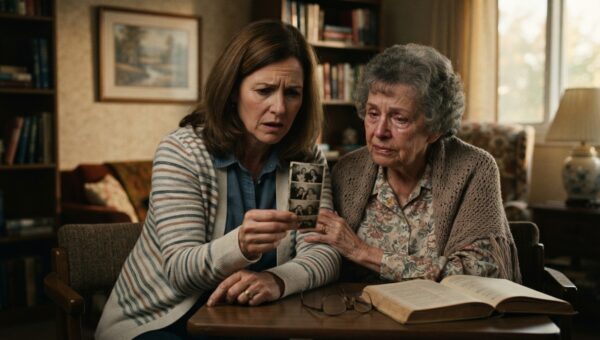
There are two wills in Mr. Vance’s office, and both of them are mine. The first I signed back in the autumn of 2022, leaving this house to my granddaughter Amara, who moved in right after my hip surgery and has not missed a single meal or a single medical drive since. The second I found in Devon’s desk from 2019, leaving the very same house to him.
Both are notarized. Both have my signature at the bottom. I wrote the first one when Devon was coughing up black dust because he spent three weeks crawling over the rafters with a staple gun and a bucket of tar while the rain poured through our ceiling. I wrote the second one when Amara was helping me stand from the cold linoleum of the bathroom because my bones had decided to turn against me. My lawyer says the 2022 document legally controls the deed, but Devon has already filed to contest it. Amara hasn’t asked for a single thing, and she is in the kitchen right now chopping carrots for broth like the world isn’t tilting right out from under her feet.
The hearing is scheduled for the middle of next month down at the county courthouse. Mr. Vance sat behind his mahogany desk last Tuesday, tapped the corner of his yellow legal pad against the wood, and told me I had to explain which person I actually meant to favor.
He looked at me over his half-moon reading glasses with that practiced, weary patience lawyers get when they deal with old people who can’t keep their paperwork straight.
“The court needs a clear intent, Martha,” he said, and his voice sounded thin and dry like corn husks. “You can’t give the same four walls away twice to two different generations. The law requires a singular disposition.”
“I have to say which child I chose,” I told him, staring at the little brass paperweight shaped like a lighthouse on his blotter, “and the truth is I chose both, and the law says that is not an answer, and I…”
I didn’t finish the sentence because my throat tightened up right there in the quiet office, smelling of old carpet and floor wax. Mr. Vance just sighed and wrote a little note on his pad. He didn’t understand that a house isn’t just a rectangular piece of dirt with lumber nailed to it.
A house is a museum of survival. Every room holds the memory of a crisis where someone pulled me back from the edge of ruin.
Back in 2019, before my joints started grinding down to powder, our retirement savings were shrinking and the old roof above the back bedroom gave up during a three-day nor’easter. The ceiling plaster came down like wet gray oatmeal right over the spare bed. Devon didn’t call a contractor because we didn’t have four thousand dollars to spare for strangers. He bought three bundles of architectural shingles on credit at the lumber yard, hoisted a heavy aluminum ladder into the mud by the hydrangea bushes, and climbed up there every morning at dawn in a freezing mist.
I remember watching him from the kitchen window while the wind rattled the single-pane glass. He was sixty-eight years old at the time, his knees clicking louder than the kitchen clock, hauling eighty-pound bundles of fiberglass up that extension ladder one by one until his hands were raw and blistered.
When he finally crawled back through the upstairs window on the fourth evening, his face was the color of wet slate and he couldn’t straighten his fingers for an hour.
“We’re dry,” was all he said to me when he came down to the kitchen, dropping his hammer onto the linoleum with a heavy thud.
That night, while he was snoring softly with his arm flung over the quilt, I drove down to the local notary public in my old Buick and signed the first will. I didn’t tell him about it because men of Devon’s generation think talking about death is like inviting it into the parlor, but I wanted him to know that the roof he saved would always be legally his to inhabit. I wanted him to feel secure in the shell he patched together with his own aching joints.
Then came 2022. The hip replacement surgery went sideways with an infection that kept me bedridden for six weeks at community general. When I came home, I couldn’t climb the two wooden steps to the porch without crying out, and Devon was struggling just to remember his own blood pressure pills, let alone lift me when my legs buckled. Amara packed up her small apartment across town, put her community college classes on hold, and moved into our spare room with two suitcases and a yellow laundry basket.
She didn’t make a big speech about family duty. She just walked through the front door, took the car keys from the hook, and quietly took over the machinery of our daily lives.
“Sit down, Grandma,” she said that first morning, sliding a warm mug of chamomile tea across the table before I even managed to pull my robe tight. “We’re going to get this sorted out together.”
For the next two years, Amara was the one who drove me to Portland for physical therapy through the ice storms, who measured out my antibiotics with steady fingers, and who scrubbed the bathroom floor when my unsteady hands spilled medicine or water. She learned how to cook low-sodium meals that didn’t taste like cardboard just to keep Devon’s blood pressure down, even when he grumbled about the lack of salt. When I looked around the house during those hard months, I didn’t see walls or shingles; I saw Amara’s tennis shoes lined up by the back door, ready to run any errand at a moment’s notice.
Out of that fierce, swelling gratitude, I drove down to Mr. Vance’s office again on a Tuesday afternoon in November. My hip didn’t ache quite as badly then, but my heart felt heavy with the realization that Devon and I were nearing the end of our road, and Amara was the one holding the lantern. I told Mr. Vance I wanted to update the paperwork. I wanted to make sure she had a roof over her head when we were gone, someone to protect her the way she was protecting us.
“Does Devon know about this change?” Mr. Vance had asked me then, peering over his glasses.
“He’s busy with his garden and his workshop,” I told him, which was my coward’s way of saying no. “Let’s just get it on paper.”
And so the second will was filed right next to the first one in the metal cabinet, two legal ghosts waiting for the day I wouldn’t be around to keep the peace between them.
The trouble started last week when Devon went looking for an old title for the lawnmower in the bottom drawer of the maple filing cabinet in his den. He didn’t find the lawnmower papers, but he found the carbon copy of the 2022 will with Amara’s name written across the principal beneficiary line in clear, unshakeable ink.
The confrontation didn’t happen with shouting or slammed doors, which somehow made it worse. Devon just walked into the kitchen while I was paring apples at the counter, laid the folded paper flat next to the cutting board, and stared at me with eyes that looked smaller and older than they had a month ago.
“Thirty-four years I kept the water out of this house, Martha,” he said, his voice shaking just enough to make the silverware rattle in the drawer below. “Thirty-four years of paying taxes and hauling wood and patching the foundation. Amara is a good girl, but she’s got her whole life ahead of her. This was supposed to be our place.”
“It is our place, Devon,” I said, putting the paring knife down because my fingers wouldn’t stop trembling. “I’m still sitting right here.”
“Not according to Mr. Vance,” he muttered, turning around and walking out to the back porch without another word.
He didn’t yell at Amara. He didn’t even mention it to her when she came home from the grocery store with two bags of fresh produce swinging from her arms. But I saw the way he sat at the end of the dining table that evening, chewing his toast in heavy silence, refusing to look at the girl who was buttering his bread. The tension in the house became so thick you could almost feel it in your teeth, a cold, gray fog that settled into every corner of the hallway.
Amara sensed it right away, of course. Young people are quieter than we give them credit for, and she knew the silence wasn’t about the weather or the price of heating oil.
“Grandpa seems upset,” she said to me softly on Friday night while we were folding laundry in the back bedroom. “Did I do something wrong with the bills?”
“No, honey,” I told her, folding a pillowcase with more precision than it needed. “You didn’t do anything wrong.”
“Because if it’s about the house,” she continued, her hands pausing over a stack of dish towels, “I never asked for any of this. I just wanted to make sure you and Grandpa had a clean place to live without having to hire outside help you can’t afford.”
That was the exact moment the trap closed around me. Both of them were right. Devon was right because he had traded his youth and his sweat equity to build the walls around us when we had nothing. Amara was right because she had given up her twenties to be my nurse, my driver, and my companion when my body broke down. The law wanted me to pick one of those sacrifices and declare it more valuable than the other, as if love could be measured on a balance scale with a thumb on the pan.
On Sunday morning, before the sun had even cleared the ridge behind the town, I heard the heavy scrape of Devon’s boots on the back deck. I got up, pulled my wool cardigan over my nightgown, and walked out to the small wooden table where he sits with his morning coffee and his seed catalogs.
He looked up as the screen door squeaked, his white hair uncombed and his flannel shirt buttoned crooked.
“You up early,” he said.
“I don’t sleep much anymore,” I told him, pulling out the opposite chair and sitting down. The wood was damp with morning dew. “Devon, we need to talk about Mr. Vance’s office.”
“There’s nothing to talk about,” he said, looking out toward the vegetable patch where the frost was sparkling on the old tomato cages. “I put my blood into those shingles. Every time it rains hard, I still hear the leaks we didn’t fix in ninety-eight. If I’m not on that deed, then everything I did here didn’t matter.”
“And what about Amara?” I asked, keeping my voice as level as I could manage. “When I couldn’t get off the floor of the bathroom two years ago, where were you, Devon? You were asleep in the next room because your own back had given out. She picked me up. She carried me. If she hadn’t been here, I’d be sitting in a nursing home right now eating mush out of a plastic bowl.”
He didn’t look at me. His jaw worked slowly, chewing on words he wasn’t ready to say out loud.
“I’m not trying to throw her out,” he muttered finally, his voice rough around the edges. “I just… I don’t want to feel like a ghost in my own kitchen while I’m still breathing.”
“She doesn’t want you to be a ghost either,” I said. “She loves you. But she also needs a place to land when her own turn comes to take care of things.”
We sat there in the cold morning air for a long time, listening to the crows cawing in the cedar trees down by the creek. I reached across the weathered table and laid my hand over his knuckles. His skin felt like old parchment, dry and freckled with age, but his fingers twitched and then turned over to catch mine in a firm, familiar grip.
By Monday afternoon, Mr. Vance had agreed to come out to the house instead of making us go back down to his sterile office in town. He sat right at our dining table with his briefcase open, drinking a cup of coffee Amara had poured for him without asking any questions.
“There are other ways to skin a cat, Martha,” Mr. Vance said, tapping his pen against a fresh set of papers. “We don’t have to play winner-take-all. We can set up a life-estate trust. Devon retains full residential rights and control of his workshop for the rest of his natural days, and the title transfers cleanly to Amara upon the final passing of both elders. Everyone’s contribution gets recognized on the ledger.”
Devon was quiet for a long moment, reading the clauses line by line with his reading glasses slipping down the bridge of his nose. He looked over at Amara, who was standing quietly by the kitchen sink drying a glass with a flour-sack towel.
“You okay with that, girl?” Devon asked her, his voice a little gruff.
Amara put the glass down, wiped her hands on her apron, and walked over to the table. She looked at her grandfather, then down at the paper, and gave a slow, steady nod.
“I just want to make sure you both have a place,” she said softly. “I’m not trying to rush anybody out.”
Devon let out a long breath that sounded like air escaping from an old bicycle tire, and then he picked up the heavy black pen Mr. Vance offered him. He signed his name right beside mine on the new agreement, his hand steady and deliberate.
The legal contest was dropped the next morning before it ever reached the judge’s docket. The courthouse didn’t need to hear our story because we had finally managed to write an ending that didn’t require erasing anyone from the page.
Now the house feels different when I walk down the hallway. It isn’t a battlefield anymore, and the two wills are locked away where they belong, replaced by a single document that holds both of our lives inside its margins.
Amara is standing by the stove right now, stirring a heavy pot of root vegetable soup that smells of parsnips and thyme, the steam rising past the kitchen window where Devon’s garden spade leans against the fence and her own walking cane rests quietly by the back door.