PART 1
I couldn’t stand my uncle growing up. Everyone in the family knew Artie and I never got along, and after years of bitter arguments over his stubborn, blunt ways, I swore I would never have anything to do with him again.
He was my father’s older brother, a gruff, retired carpenter who lived in a drafty house near the edge of town.
He spoke in short, barking sentences and never apologized to anyone for anything. When I was younger, I mistook his rigidity for cruelty. After a final, explosive argument six years ago over how he treated my father at Thanksgiving, I walked away for good.
Then everything changed.
Six months ago, Uncle Artie was diagnosed with terminal pancreatic cancer. When the news hit the family, his four adult children, Julian, Cynthia, Brian, and Megan, made a brief, theatrical show of concern. They set up a shared group chat, posted family photos online, and visited his house just long enough to check his financial papers. But as soon as they realized his liquid bank account held only around $40,000, their visits dwindled to absolute zero. They stopped showing up. His own children only called when they needed money or wanted him to cover a bill.
One rainy Tuesday afternoon in October, my mother called me crying. She said Artie was back in the hospital, completely alone, and the nurses couldn’t get a single one of his kids to answer their phones.
I didn’t want to go. I sat in my driveway for twenty minutes with the engine idling, telling myself it wasn’t my burden. But my conscience wouldn’t let me leave an eighty-two-year-old man to face a stark hospital room by himself.
When I walked into room 412, Artie looked shockingly small under the white hospital blankets. His rough, calloused hands were still, and his eyes were sunken. He didn’t yell at me. He didn’t barking out orders. He just looked up, cleared his throat, and said quietly, “You came.”
“I came,” I replied, taking a hard plastic chair beside his bed.
That afternoon turned into six months of quiet, steady caregiving. While Julian and his siblings were busy planning their vacations and making excuses about work schedules, I became the only person who sat beside Artie’s hospital bed. I changed his water ice cups, spoke with the attending doctors, listened to his long, rambling stories about his youth in the lumber yards, and stayed until his final breath.
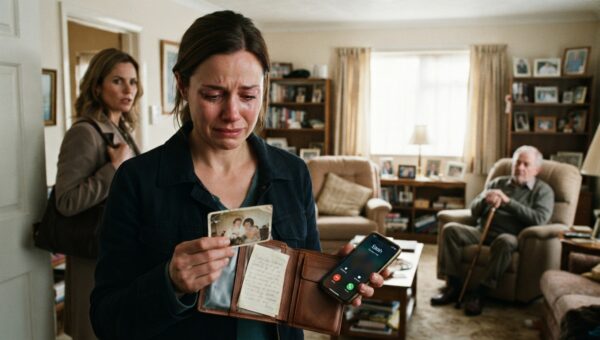
The day he died, he was holding an old, faded photograph of his four children when they were small. Tears leaked quietly from the corners of his eyes, soaking into his pillow. He couldn’t speak anymore, but he squeezed my hand once with whatever strength he had left, looked at the closet where his heavy, dark wool work coat hung, and closed his eyes for the last time.
Two weeks later, we gathered in the mahogany-paneled conference room of Mr. Geller, Artie’s longtime estate attorney.
Julian, Cynthia, Brian, and Megan sat on one side of the table, dressed in expensive black clothes, whispering among themselves and casually checking their watches. They hadn’t attended the memorial service I arranged, but they certainly made time for the reading of the will.
Mr. Geller adjusted his spectacles, cleared his throat, and unfolded the legal documents.
“Your father’s estate consists of his primary checking account, containing a total balance of $40,000,” Mr. Geller stated calmly. “Per the explicit terms of his last will and testament, this liquid sum is to be divided equally among his four biological children: Julian, Cynthia, Brian, and Megan. Each of you will receive a cashier’s check for exactly $10,000.”
Julian leaned back in his leather chair, a satisfied smile spreading across his face. “Ten grand each. Not bad for a cranky old man who spent his life hoarding nails.”
Then Mr. Geller turned his eyes toward me.
“To my nephew,” Mr. Geller read, his voice steady and formal, “I leave only one specific personal effect: my heavy wool working coat.”
Julian burst out laughing, slapping his palm against the mahogany table. “Dad’s final prank! Enjoy that smelly old jacket, cousin. You spent six months wiping his chin for a rag!”
Cynthia and Brian joined in, giggling and shaking their heads. “At least you can wear it when you clear out his trash,” Megan smirked.
Mr. Geller reached behind his desk, picked up the dark, heavy wool coat Artie had worn for thirty years, and handed it across the table to me.
I ignored their cruel laughter. My hands were trembling as I took the familiar, heavy garment into my lap. The fabric smelled faintly of cedar, machine oil, and old pipe tobacco. I slid my fingers along the stiff lower hem, feeling for a tear or a loose thread, and that was when my palm bumped against something unnaturally solid stitched deep inside the left interior breast lining.
PART 2
The moment my fingers touched the heavy, rectangular shape concealed inside the coat’s thick lining, my entire body went cold. It wasn’t padding or extra wool. It was a firm, solid object sewn securely into a hidden interior pocket behind the tartan lining.
Julian was still chuckling, signing his receipt form for his $10,000 disbursement check. “Honestly, you should take that thing straight to the dumpster on your way out. It smells like a damp basement.”
“Mr. Geller,” I said, keeping my voice as flat and controlled as possible, “did my uncle leave a seamstress kit or any additional written instructions with this?”
Mr. Geller didn’t smile. Instead, he took a pair of small, sharp legal scissors out of his top desk drawer and set them on the blotter in front of me.
“Your uncle gave me very specific directions,” Mr. Geller said quietly, looking directly at the four siblings. “He instructed me to hand over his coat only after the public bank balance was formally divided and accepted by his named liquid heirs. He also requested that you open the interior seam right here in this room.”
The room went dead silent. Julian stopped spinning his expensive pen. Cynthia frowned, her eyes narrowing as she looked from Mr. Geller to the heavy coat in my lap.
I picked up the small scissors, slipped the point under the reinforced black thread along the inside breast seam, and carefully snipped the stitches one by one. The lining parted, revealing a heavy brass key stamped with the number 412, a small leather-bound ledger, and a thick, wax-sealed Manila envelope addressed directly to my name in Artie’s sharp, sloping handwriting.
“What is that?” Julian demanded, leaning forward, his confident demeanor vanishing instantly. “What did he put in there?”
I reached inside and pulled out the contents. The envelope was thick and heavy. I broke the wax seal and slid out a stack of crisp, original legal documents alongside a handwritten letter.
Mr. Geller folded his hands over his desk blotter. “What you are holding,” the attorney explained, “are the original recorded deeds and non-probate transfer-on-death certificates for your uncle’s real estate assets, as well as the master key to his safety deposit box at First National Bank.”
Julian stood up so fast his heavy leather chair skidded backward against the carpet. “What real estate assets? He lived in a rented house! He didn’t own anything!”
“He didn’t own his residential home,” Mr. Geller corrected calmly. “He rented that cottage to keep his living overhead minimal. However, forty years ago, Artie purchased the two-acre commercial workshop parcel on Industrial Parkway, completely debt-free. Three years ago, he refused an offer of $550,000 for that property.”
PART 3
Cynthia gasped, her hand flying to her mouth, while Brian and Megan sat frozen in their seats. Julian’s face turned completely red, the vein in his temple bulging as he pointed a finger at the attorney.
“That’s impossible!” Julian shouted. “We’re his children! If he had a half-million-dollar property, it belongs to us! That $40,000 was supposed to be his entire estate!”
“Your father was a very deliberate man, Julian,” Mr. Geller said, his voice dropping into a hard, professional register. “Two years ago, when he realized none of his children had any interest in his life beyond his wallet, he restructured his entire holding portfolio. He maintained a modest checking account of $40,000 specifically as a test of your devotion. He told me, ‘If my children care about me, they will come when I am sick. If they only care about my money, $40,000 will be enough to satisfy their greed.'”
Mr. Geller then pointed to the documents sitting in my hands.
“Six months ago, while my client was fully competent, he executed a valid, irrevocable survivorship deed vesting full legal title of the commercial workshop parcel directly to his nephew. Because this transfer was completed outside of the probate estate, it does not form part of the public will you just signed.”
Julian turned on me, his hands clenched into fists. “You manipulated him! You sat by his bed for six months just to crawl into his will! We are taking you to court! We’ll contest the whole thing!”
I looked down at the handwritten letter in my hands, unfolding the yellowed notebook paper. Artie’s writing was clear and deliberate.
I read the letter aloud, my voice echoing off the mahogany walls:
“To my nephew:
We spent years arguing because we were both too stubborn to admit we were made from the same rough cloth. But when the darkness came, you were the only one who stood by my bed. You didn’t ask about my bank accounts. You didn’t check my drawers. You just held my hand and listened to an old man talk about his regrets.
My children wanted my money, so I gave them exactly what they valued: a handful of paper cash to divide and fight over. But to you, I give my true life’s work. The shop on Industrial Parkway was built with my own two hands. Take it, build something honest with it, and wear my coat when the winter gets cold. You earned it by being a real man.”
When I finished reading, the silence in the conference room was absolute. Julian looked at Mr. Geller, his breath coming in ragged gasps. “We’re challenging this. We’re hiring a lawyer.”
Mr. Geller adjusted his papers with a crisp snap. “You are welcome to spend your $10,000 checks on legal fees, Julian. But I must inform you that the will you signed ten minutes ago contains a strict no-contest clause. If you launch a groundless legal challenge against the survivorship deed, you will forfeit your $10,000 cash inheritance immediately, and under state law, the deed transfer is already recorded and final.”
Julian looked at his three siblings, but none of them spoke. They sat staring at their $10,000 checks, the sudden realization of what their superficiality had cost them settling into the room like lead. Without saying another word, Julian grabbed his coat, turned on his heel, and walked out of the office, his siblings trailing silently behind him.
ENDING
An hour later, I drove out to Industrial Parkway.
The afternoon sun was cutting through the grey winter clouds, casting long, warm light across the red brick façade of Uncle Artie’s commercial workshop. I pulled my car into the quiet driveway, stepped out into the cold air, and slid my arms into the heavy wool coat.
It was large on my shoulders, but the weight of it felt solid, warm, and protective against the bitter breeze.
I walked up to the front heavy wooden door, took the brass key marked 412 from my pocket, and slid it into the lock. It turned with a smooth, heavy click.
Inside, the vast workshop smelled of freshly sawn pine, varnish, and decades of honest labor. Rows of heavy steel tools were hung neatly along the pegboards, and long workbenches stood swept clean, bathed in the amber light streaming through the high windows. In the back corner stood a finished oak dining table Artie had crafted years ago, untouched and flawless.
I walked over to the sturdy brass hook mounted behind the front door, slipped the heavy wool coat off my shoulders, and hung it up carefully.
For years, I thought my uncle was just a hard, unforgiving man who drove everyone away. But standing in the middle of his quiet shop, I realized the truth. He was a man who worked forty years to build something lasting, waiting to see who loved him for his heart rather than his wallet.
I walked over to the main workbench, ran my fingers over the smooth, planed wood, and picked up a brass tape measure resting beside his old notebook. I put the brass key into my own front pocket, took a deep breath of the pine-scented air, and looked out the broad front window into the bright afternoon sun, knowing that his legacy was finally in safe hands.