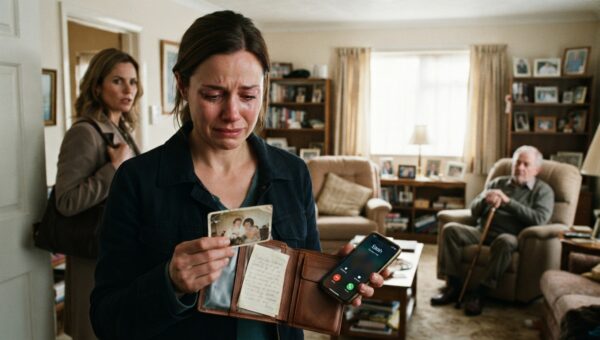
The smell of damp concrete and old cedar always lingers in a house that has stood through six decades of Alabama summers. When Arthur passed away at ninety-one, the air in that place felt different. It was heavy, weighted down by the finality of an empty armchair and a lifetime of collected papers that nobody really wanted to sort through.
For three days after the funeral, my husband, Wayne, and his brothers, Jerry and Dale, sat around the kitchen table arguing over the probate papers with the loud, easy confidence of men who believed the world owed them an inheritance. The math they worked out on the back of yellow legal pads looked clean enough on the surface. A four-hundred-twenty-thousand-dollar brick home on the north side of town and eighteen thousand dollars in savings accounts, divided neatly into three equal piles. No fuss, no court battles, just a tidy conclusion to a long life.
Wayne poured himself another cup of coffee from the stained pot and tapped his pen against the form. “We sell the house as-is, split the cash three ways by Friday, and we’re done,” he said, sounding like a man delivering a verdict rather than grieving his father.
I didn’t say anything. I just looked down at my hands, which were stained with newsprint and dust from clearing out the hall closet upstairs.
Twelve years ago, that same kitchen table had looked very different. I remembered the afternoon the grandmother, Martha, walked out of this house with a single suitcase and a look in her eyes that I had never quite managed to shake. She didn’t shout. She didn’t cry. She simply packed her clothes while Arthur sat in the corner staring at his boots, refusing to lift his head.
Back then, the family told everyone she had gone to live with her sister up in Huntsville because of her nerves. Arthur never corrected them, but he stopped sitting at the head of the table after that day. He grew quieter, shrinking into himself until he was mostly just silence and old flannel shirts.
On the fourth morning, while the brothers were out at the diner arguing over real estate commissions, I went down to the cellar. The steps were steep and uneven, worn down in the middle by decades of heavy boots carrying canned peaches and winter squash.
The basement had always been Arthur’s domain. It was where he kept his old woodworking tools, jars of rusted nails sorted by size, and a heavy wooden workbench that smelled of linseed oil.
I was looking for the spare storm window latches Wayne had asked about, but my eye caught something strange near the foundation wall behind the old fruit shelves. Someone had built a false panel out of plywood, painted to match the gray concrete block.
I pushed the panel aside. Behind it sat a heavy steel safe, bolted directly into the concrete floor with four thick anchor bolts. It wasn’t one of those small digital boxes you buy at the hardware store. This was old commercial steel, painted olive drab, with a heavy brass dial that looked like it belonged on a ship.
My hand brushed against the side of the workbench, and I noticed an old family Bible resting on the shelf, its spine cracked and held together with gray cloth tape.
I didn’t even know why I picked it up, except that Arthur had kept it in the same spot for as long as I had known him. When I lifted the heavy front cover, something slipped from the yellowed pages and hit the cement floor with a dull clink.
It was a brass key, held in place by a strip of yellowed masking tape.
My breathing felt too loud in the empty cellar. I knelt down on the cold floor, the dampness soaking through the knees of my slacks, and tried the key in the safe’s small brass lock. It turned with a heavy, oiled click that echoed off the stone walls.
The door swung open with surprising ease.
Inside, stacked neatly in two rows, were fourteen gold bars. Each one was small, about the size of a deck of cards, stamped with serial numbers and assay marks that caught the dim light of the overhead bulb. I reached out and touched one. It was ice cold and impossibly heavy, carrying a dense, dull weight that didn’t feel like normal money. Beneath the bars rested a folded sheet of lined paper covered in Arthur’s shaky, deliberate handwriting.
I unfolded the paper, my fingers leaving smudges on the faded ink.
“For my grandson Marcus ONLY,” the top line read. “Do not let your father or brothers touch this. They don’t deserve it after what they did to your grandmother.”
I sat back on my heels, the cold floor biting through my clothes, and read the rest of the letter twice. Arthur had spent the last decade quietly converting his cash reserves into gold, bypassing the banks entirely so his sons couldn’t touch a dime of it through probate. He had hidden it away to right a wrong that had festered in this house for over a decade.
My mind raced back to Marcus. He was twenty-four now, working as an apprentice electrician down in Mobile, living in a small apartment with a secondhand couch and a stack of trade school textbooks. He had always been quiet around his uncles, keeping to the edges of family gatherings, watching them with a guarded, watchful look that I used to think was just shyness.
I pulled my phone from my pocket, my fingers shaking slightly as I dialed his number. It rang three times before he picked up.
“Aunt Clara?” Marcus said, his voice sounding distracted by the hum of machinery in the background. “Is everything okay with the estate? Dad told me they were signing the papers today.”
“Marcus,” I said, keeping my voice low. “I’m down in your grandfather’s basement.”
There was a pause on the other end of the line, the background noise dropping away as if he had stepped into a quiet hallway. “Why are you down there? Grandpa’s stuff is all upstairs.”
“I found the safe, Marcus. The one bolted to the floor behind the shelves. I found the key in his Bible.”
Another long silence stretched across the line, heavy and tight. When he spoke again, his voice dropped an octave, tight with a warning I had never heard from him before.
“Grandpa told me when I was twelve,” Marcus whispered. “He made me promise.”
“Promise what, Marcus?” I asked, looking down at the gold bars glinting in the dark.
He went quiet for a long moment, and I could hear him swallow hard over the connection. “Never tell Dad. Because Dad is the reason Grandma left. And she left because Dad and Uncle Jerry helped, “
He stopped. The rest of the sentence hung in the air between us, tangled in the hum of the cell tower miles away.
“Helped what, Marcus?” I pushed, my voice dropping to a harsh whisper. “Talk to me.”
“They cleared out her personal savings account,” Marcus said, the words tumbling out fast now, as if he had been holding them behind his teeth for twelve years. “Grandma had a separate inheritance from her father, about ninety thousand dollars in bonds and cash that she kept in a credit union in Montgomery. Dad and Uncle Jerry were deep in that failing construction supply venture back then. They told her it was just a short-term bridge loan for inventory. They had her sign papers while she was on medication after her hip surgery. When she found out they had drained the whole thing and defaulted on the note, she packed her bags that very afternoon. She told Arthur she couldn’t live under the same roof as thieves. Dale knew about it too, he just sat there and let them do it.”
The cellar walls seemed to tilt inward for a second. The tidy math of the three-way estate split, the grieving sons, the respectable funeral, it all fractured into sharp pieces. Arthur hadn’t just been an old man tidying up his affairs. He had been guarding a secret, keeping a silent tally for a wife who never came back and a grandson who was old enough to understand what integrity meant.
“They never gave it back,” I said, more to myself than to him.
“Grandpa tried to cover the debt himself, but he couldn’t liquidate the farm fast enough without losing everything,” Marcus said, his voice thick. “He told me on my twelfth birthday down here in this exact basement. He handed me a pocketknife and made me swear I wouldn’t say a word until he was gone. He said his sons had traded their honor for quick cash, and he wasn’t going to let them have the last word.”
I looked down at the fourteen gold bars, each one stamped with numbers that didn’t exist on any probate ledger. At current market rates, those fourteen bars came out to roughly one hundred fourteen thousand dollars. Exactly enough to restore what had been stolen from Martha, adjusted for time, sitting quietly under the floorboards while her sons planned how to divide the rest of his estate.
“Don’t say anything to your father yet,” I told Marcus, my hand resting firmly on the cold steel edge of the safe door. “I’m handling this.”
“Aunt Clara, what are you going to do?” Marcus asked, panic edging into his tone.
“I’m going to finish cleaning the basement,” I said, and hung up.
Thirty minutes later, the gravel in the driveway crunched under the tires of Wayne’s pickup truck. I heard the heavy front door slam shut, followed by the sound of boots on the hardwood floor as Wayne and Jerry walked into the kitchen, talking loudly about the real estate agent’s fees.
“Clara?” Wayne called out, his voice echoing down the stairwell. “Where are you? We need you to look over these final distribution forms before we call the title company.”
I stood up from the cellar floor, brushing the dust from my knees. I closed the heavy steel door of the safe, leaving the key in the lock, and walked slowly up the wooden stairs into the bright kitchen.
Wayne was standing by the counter, holding a cup of coffee, looking more relaxed than I had seen him since his father drew his last breath. Jerry was sitting at the table, thumbing through a stack of papers with a self-satisfied smirk.
“There you are,” Wayne said, smiling slightly as I walked into the room. “We’ve been calling you. Let’s get these papers signed so we can list the property on Monday.”
I didn’t walk over to the table. I stayed by the doorway, my hands resting in the pockets of my cardigan.
“There’s something down in the basement you boys forgot to inventory,” I said.
Wayne frowned, his smile slipping just an inch. “What are you talking about? We cleared out the workshop last year. There’s nothing down there except old lumber and junk.”
“Not junk,” I said, my voice steady in the quiet kitchen. “Fourteen gold bars. And a letter addressed to Marcus, signed by your father.”
The kitchen went dead still. Jerry’s hand froze over the legal pad, his pen hovering just above the paper. Wayne’s face didn’t go white like it does in the movies; instead, his jaw tightened, the muscle ticking hard near his ear. He set his coffee cup down so hard a brown splash spilled across the laminate counter.
“What did you say?” Wayne asked, his voice dropping into that low, dangerous register he used when he thought he was losing control of a room.
“You heard me,” I said, looking right into his eyes without flinching. “You and Jerry cleaned out Martha’s savings twelve years ago. You broke her heart, you drove her out of this house, and you thought your father never knew. But he knew every single detail. He spent the last ten years turning his money into gold so you vultures couldn’t touch it. And it doesn’t belong to the estate.”
Jerry stood up so fast his chair scraped loudly against the linoleum floor. “That’s a lie,” he stammered, his face flushing red. “The old man was out of his mind the last few years. He didn’t know what he was signing or what he had down there.”
“He knew enough to hide it behind a false wall and tape the key inside his Bible,” I said. “And Marcus knows the rest of it. Every last detail about the credit union notes in Montgomery.”
Wayne took a step toward me, his hands clenched into fists at his sides. For a second, I saw the exact look his father must have spent decades enduring, the entitlement of a man who believed his mistakes were someone else’s burden to carry.
“That house and everything in it is part of the estate,” Wayne said, his voice tight and trembling with suppressed rage. “We divide it three ways. That’s the law.”
“The law doesn’t cover assets that were never part of probate, Wayne,” I said quietly. “And if you want to test that in court, we can ask a judge to subpoena the credit union records from twelve years ago. I’m sure the probate judge would love to hear how ninety thousand dollars of Martha’s independent funds mysteriously vanished into your supply company account right before she left.”
Wayne stopped dead in his tracks. The silence in the room stretched out, thick and heavy, louder than any shouting match could ever be. Jerry looked from Wayne to me, his mouth opening and closing like a fish out of water, realizing just how close they were to total ruin.
“You wouldn’t,” Wayne whispered, the arrogance finally draining out of him, leaving behind something small and bitter.
“I already called Marcus,” I said. “The gold is his. Grandfather’s orders. You take your third of the house and your third of the eighteen grand in the bank, and you keep your mouth shut about the rest. Because if you make one move toward that basement, I’ll file the papers myself.”
Wayne didn’t answer. He turned away, walking over to the window that looked out over the overgrown backyard, his shoulders slumped beneath his flannel shirt. Jerry sat back down slowly, burying his face in his hands.
That evening, the sun went down behind the tree line, casting long, orange shadows across the kitchen floor. The house was quiet again, the kind of quiet that doesn’t feel peaceful, but honest. Down in the cellar, the heavy metal door of the basement safe stood open and empty, its contents gone, while the worn family Bible rested closed on the workbench beside a single set of keys waiting to be handed over to Marcus.