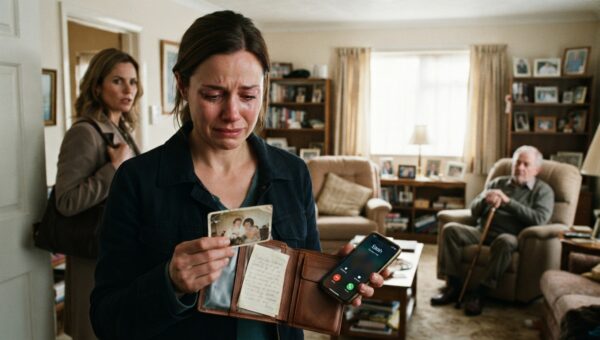
My father died on a Tuesday in November, and the linoleum in that hospital room was the coldest gray you can imagine. Before the nurse even pulled the sheet up over his face, he squeezed my hand with what little strength he had left and made me promise the one thing he cared about. “Take care of your mother,” he rasped, his eyes fixed on mine like he was handing me a heavy anchor.
I nodded, not knowing that anchor would drag behind me for the next twelve years of my life.
For the first four years, it was just small things. Rent checks that cleared before her Social Security hit, groceries delivered from the local store because she didn’t like driving after dark, and the endless copays for her blood pressure medicine. My three brothers were supposed to be part of the picture, but they lived in different states, or they had new families, or they were simply too busy building their own lives to answer a phone call on a Sunday afternoon. Whenever I brought them up, Mom would wave her hand and sigh about how hard things were for boys with such big ambitions. So I kept my mouth shut, picked up my checkbook, and paid the difference.
By year eight, the small things turned into heavy ones. Mom had a bad fall in her kitchen that required hip replacement surgery and three months in a rehab facility downtown.
The bills piled up faster than autumn leaves, and my own savings account began to look like a dry creek bed. I had to drain the money we had set aside for my daughter’s braces just to cover the surgical shortfall that Medicare wouldn’t touch. That was the week I drove out to her house on Elm Street, sat her down at the Formica kitchen table, and told her we needed to put something in writing to protect the money I was sinking into her care.
She cried, of course, Dabbing at her eyes with a crumpled tissue while she signed her name at the bottom of the page with a shaking hand. It was a formal promissory note for two hundred thousand dollars, secured by the deed to the house itself, written up by a paralegal friend of mine to keep things legal and clean. She knew as well as I did that my brothers hadn’t sent a single dime since the funeral, and she felt guilty enough to sign it without a fight.
At least, she felt guilty until the stitches came out and she went back to pretending her sons were just misunderstood angels who would visit any day now.
The final bill hit three months ago when her heart started acting up again, landing her in the cardiac unit for a week followed by specialized home nursing. That single crisis cost forty-five thousand dollars out of pocket, pushing my total tally past the two-hundred-thousand-dollar mark since Dad passed away. I didn’t even blink when I handed my credit card to the hospital billing clerk. I just thought about my promise to Dad, and I paid the debt because nobody else was standing in that hallway.
That brings us to last Saturday afternoon in that same living room, with the dust motes dancing in the sunlight coming through the sheer curtains. Mom had called a family gathering under the guise of discussing her winter travel plans, but when I walked in and saw Mr. Harrison, her longtime attorney, sitting by the corner secretary with a thick manila envelope in his lap, I knew what kind of meeting this really was.
My three brothers were already there, sitting on the floral sofa like they owned the place, drinking iced tea and laughing about some football game from the weekend before.
Mom cleared her throat from her armchair, looking smaller than she used to, though her jaw had that stubborn set I knew too well. “I’m glad you’re all here,” she said, folding her hands in her lap. “I’ve been doing a lot of thinking about the future, and about this house. I want everything to be fair when I’m gone.”
I sat down on the edge of the ottoman, feeling a dull ache behind my eyes from working a double shift the night before. “What do you mean, Mom?”
“I’ve decided to divide the estate equally,” she announced, her voice trembling just a little bit before she found her footing. “Twenty-five percent for each of you. You, and your brothers. It’s the only right thing to do.”
The silence in the room wasn’t quiet at all; it hummed with the weight of twelve years of empty bedrooms and ignored phone calls. My oldest brother, Daniel, gave a slow, satisfied nod, while the middle one, Greg, crossed his arms and looked at the ceiling like he was waiting for applause. But it was Dennis, the youngest, who couldn’t keep his mouth shut. He gave me a sharp, mocking grin and leaned forward. “Fair is fair,” Dennis smirked. “Blood is blood, after all.”
Something inside me didn’t snap so much as it finally settled into place, heavy and cold as iron. I didn’t yell, and I didn’t throw my glass of tea against the wall, though a part of me wanted to. I just stood up slowly, smoothed down the front of my shirt, and reached into the canvas tote bag I had left resting by the door.
“Mom, I’ve spent two hundred thousand dollars taking care of you,” I said, my voice sounding stranger and quieter than I expected in the stuffy room.
Mom looked away, staring hard at the floral pattern on the rug. “Well, yes, but your brothers are family too. They have their expenses.”
I pulled out the blue leather folder, its edges worn from years of being shoved into glove compartments and desk drawers, and laid it flat on the coffee table right in front of her. “I didn’t bring feelings today, Mom. I brought paperwork.”
Dennis let out a nervous little laugh that died halfway out of his mouth. “What is this, a tax audit?”
“It’s twelve years of receipts,” I told him, not even looking his way. I flipped the cover open to reveal the color-coded tabs, the bank routing slips, the wire transfer receipts from the credit union, and the itemized pharmacy bills stapled in neat chronological order. “Every rent payment. Every grocery run. Every copay for the heart medication you all pretended didn’t exist.”
Mom turned pale, the color draining right out of her cheeks until she looked like chalk against the dark upholstery of the chair. “Where did you get that?” she whispered, her hands clawing instinctively at the fabric of her dress.
I pulled out the final document from the back pocket of the folder, sliding the stiff white paper across the polished wood until it stopped right against the edge of her teacup. “You signed it after your surgery in 2018,” I said, my voice steady as a plumb line. “When you promised to pay back the money you borrowed against this house.”
Mom stared at the signature at the bottom of the page like it was a ghost she hadn’t expected to see in broad daylight. She didn’t touch it. She just looked up at Mr. Harrison with terrified, pleading eyes, pushing the paper toward him with a trembling fingertip. “Mr. Harrison, look at this. Is this… is this real?”
Mr. Harrison adjusted his glasses, picked up the document with careful, deliberate movements, and scanned the legal language with the practiced eye of a man who had seen every kind of family disaster the county had to offer. The room went so quiet you could hear the refrigerator humming down the hall. My brothers had stopped smiling, their eyes darting back and forth between the lawyer’s face and the paper in his hands.
Mr. Harrison lowered the page, folded it neatly along the original crease, and looked right at Mom over the top of his frames. “This is a fully executed promissory note, Mrs. Miller,” he said, his voice completely flat and professional. “It is witnessed, notarized, and properly filed as a primary lien against the deed of this property for the sum of two hundred thousand dollars, plus accrued interest.” He turned his gaze toward the three brothers. “Before any estate can be divided into equal shares, creditors holding secured liens against the primary asset must be paid in full from the proceeds of the sale.”
Dennis jumped up from the sofa, his face turning the color of a bruised plum. “That’s ridiculous! That’s our family home! She can’t just hand the house over to her!”
“She didn’t hand it over,” I said, looking right at him for the first time. “She borrowed against it because none of you were answering your phones when the ambulance bill came due.”
Greg stood up too, his hands shaking as he pointed a finger at the folder on the table. “You manipulated her! You trapped an old woman into signing away our inheritance!”
“I spent twelve years keeping her out of a state-funded nursing home while you were all too busy to visit on her birthday,” I snapped back, the quiet restraint finally cracking around the edges. “I kept the lights on, I bought the groceries, and I paid the surgeons. Where were you when she needed someone to sit in the recovery room for fourteen hours straight?”
They didn’t have an answer for that. They just stood there stammering about fairness and legal rights and how families aren’t supposed to keep score, as if my bank statements hadn’t been keeping score for them every single month since Dad died.
Mom sat in her armchair with her head bowed, staring at her empty teacup, looking smaller and older than she had a moment before. She didn’t look at my brothers, and she didn’t look at me. She just gave a very small, tired nod that told me she knew the bill had finally arrived and there was no one left to pay it.
Mr. Harrison closed his leather portfolio with a sharp, definitive snap that seemed to echo off the walls. I reached down, picked up my blue leather folder, and tucked it securely back under my arm. Without another word to any of them, I turned around, walked out the front door into the bright afternoon sunlight, and left them all sitting there with their empty hands.