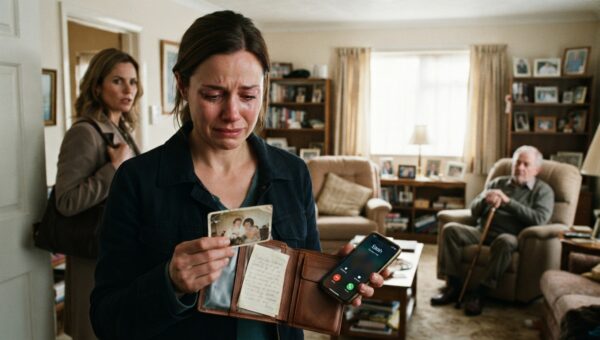
Six thousand eight hundred dollars. That was the bill the county hospital handed me after George stopped breathing in his sleep on a Tuesday night in November.
The linoleum in that room had that greasy yellow look that never quite came clean no matter how many times the orderlies ran a mop over it. George had lived two houses down from me out on the county road for twenty-eight years, and when his heart finally gave out, I was the only one left with a set of keys to his truck and his porch.
There wasn’t any family left to call. His sister went down in the floods back in ninety-eight, and his wife had passed before we ever moved out to the red dirt flats.
So the responsibility landed squarely on my shoulders like a wet canvas tarp. I didn’t have six grand sitting in a coffee tin under the mattress, not on a retired welder’s pension, so I loaded up the back of his old Dodge with his Delta table saw and his good chisels.
The morning air was biting cold when I pulled into Callahan’s pawn shop down on Fourth Street. The brass bell above the door gave that thin, tinny rattle that hadn’t changed since Reagan was in office.
Mr. Callahan looked older than the building itself, his fingers permanently stained with grease and vinegar from cleaning old silver. He didn’t say much while I laid the saw on the counter, just ran a thumb over the cast-iron top and nodded once to show he knew what it was worth.
“Funeral’s that high, is it, Ray?” Callahan asked, his voice like two gravel stones grinding together in a pocket.
“Higher than that once the plot gets dug,” I told him, leaning my palms against the scarred laminate. “Just give me enough to settle the county bill and I’ll call it square.”
Callahan didn’t reach for the cash drawer right away. Instead, he turned around and walked over to the tall oak filing cabinet behind the register, the one with the sticky bottom drawer that always needed a swift kick to shut.
He pulled out a thick, red leather folder with frayed corners and dropped it right on top of the saw table with a dull thud. The cardboard edges were yellowed and bowed from years of humidity.
“Before you hock the tools, Ray, you better look at this,” Callahan said. “George brought this in every December like clockwork.”
I stared at him, my hands still flat on the cold metal. “George didn’t pawn anything.
He had his pension and what little he made doing sharpenings out of his shed.”
“Your home one’s ring loan each Christmas,” Callahan said simply, flipping the folder open.
My breath caught on the smell of old wood and metal and dry paper that came off those pages. Inside were twelve distinct pink carbon-copy receipts, stacked in neat chronological order from the bottom up.
Every single one of them was dated between December tenth and December twentieth, stretching all the way back to the winter after the mill closed down. The loan amounts weren’t large, usually two or three hundred dollars at a time, but the math added up across the years until my throat felt tight and dry.
The payments totaled three thousand two hundred and forty dollars. George had never mentioned a loan to me, and we drank coffee together on my porch at least three mornings a week.
“Why would he borrow against his mother’s ring?” I asked, my voice sounding thin even to my own ears. “He had the savings book.”
“He didn’t keep the cash, Ray,” Callahan muttered, turning another page in the ledger. “He walked out of here every time with an envelope of folded bills and came back three months later to redeem the piece before the interest bit hard.”
I didn’t know what to say to that, so I just stood there because my brain kind of stopped working for a second. The shop was dead silent except for the electric hum of the soda machine by the door.
Callahan reached into the pocket of the folder and slid out a photograph, laying it face up on the glass beside the table saw. It was a polaroid taken outside some housing project with peeling white paint, showing a young woman in a faded denim jacket holding a heavy-set baby with a round, serious face.
She couldn’t have been more than twenty-two, her hair pulled back in a sloppy clip, looking tired down to the bone. On the back of the photograph, written in George’s blocky, uneven welder’s handwriting, were five words: She must keep this until she can stand.
I turned the snapshot over twice, trying to find a name or a return address, but there was nothing else on the back. My thumb brushed the edge of the paper, and I realized my hand was shaking just a little bit.
“Who is she, Mr. Callahan?” I asked, looking up into the old man’s clouded eyes.
“Don’t know her name,” Callahan said, pulling a final receipt from the very front pocket of the folder. “George never used names in the book. He just called it the account for the girl on Elm Street.”
He pointed a thick, square finger at the final receipt, the one dated just three days before George stopped breathing. Under the customer’s name, George hadn’t written his own; he had scrawled a single line that looked like it had been written by a man whose hands wouldn’t steady.
The ink was slightly smeared where his palm had dragged across the paper before the carbon could dry. At the bottom of the slip, right above the signature line, was an unfinished sentence that didn’t make any sense at first glance.
Tell her I promised her faht, it read. The last word just trailed off into a wavy line where the pen had slipped out of his fingers or he simply ran out of breath.
“Her father,” I said out loud, the pieces finally starting to click together in a way that made my chest ache. “He meant her father.”
Callahan didn’t answer. He just reached into his drawer and pulled out a small velvet box that hadn’t been listed with the tools, sliding it across the counter toward my knuckles.
Inside the box sat the heavy gold home ring with the worn-down family crest, gleaming in the fluorescent light like it had never spent a single night in a pawn shop drawer.
“He paid the balance off in full on that last Tuesday,” Callahan said softly. “Told me he wouldn’t be needing the loan anymore because he was done borrowing. Take the ring, Ray. And take the folder. I reckon that debt belongs to you now.”
I walked out of that shop five minutes later with the saw still sitting on the counter and the red folder tucked inside my jacket like a hot brick. The wind had picked up off the flats, carrying that sharp, metallic smell of coming snow that always makes your joints ache before the freeze sets in.
I drove straight back to my place, but the house felt too empty with just the ticking clock on the wall and George’s empty porch staring at me through the window. I laid the folder out on my oilcloth kitchen table and spent an hour staring at the address written faintly on the back of an old utility envelope stuck in the pocket.
Fourteen-B West Elm Street. That was over on the other side of the tracks, past the grain elevator where the yards used to be before the company pulled out.
By two in the afternoon, I had my coat back on and the keys to the Dodge in my palm, even though every part of my brain told me to mind my own business. George was gone, and whatever ghosts he had been running from for twelve years were his business, not mine.
But then I thought about that photograph of the girl with the heavy baby, standing out in the cold without a coat that fit right, and I knew I couldn’t just leave the ledger sitting in a drawer.
The drive over took less than ten minutes, but the town looked different from this side of the tracks, smaller and more tired, with gray curtains pulled tight against the gray November light. Number Fourteen-B turned out to be the back unit of a converted Victorian house that had been carved up into apartments sometime back in the seventies.
The paint was peeling off the porch railing in long, curling strips of white that looked like dried salt. I walked up the three wooden steps, my boots sounding loud on the hollow boards, and knocked twice on the green metal door.
Nobody answered right away, but I could hear the faint sound of a television playing inside, some morning game show with a studio audience laughing at nothing. I knocked again, harder this time, until the lock clicked and the door swung open about four inches against a brass chain.
A young woman peered out through the gap, her eyes red-rimmed and suspicious, holding a toddler with a runny nose against her hip. She looked just like the girl in the polaroid, only older now, with dark circles under her eyes that no amount of sleep was going to fix.
“If you’re with the utility company, I told the lady yesterday I’m mailing the check on Friday,” she said before I could get a word out.
“I’m not from the utility company,” I told her, keeping my hands where she could see them so she wouldn’t slam the latch. “My name’s Ray. I live down the road from George. George Miller.”
The woman went completely still behind the door, the small child wriggling against her shoulder and reaching out a sticky hand toward my jacket zipper. The only sound for five seconds was the tinny voice of the game show host talking about a new set of kitchen appliances.
“George?” she whispered, her voice cracking right in the middle of the syllable. “Is he… did something happen to George?”
“He passed away on Tuesday night,” I said, feeling the words taste like dust in my mouth. “In his sleep. He didn’t suffer.”
She didn’t cry, and she didn’t drop her head. She just stood there holding the baby tighter until her knuckles turned white against the child’s sleeper.
“He didn’t come by on the first of the month,” she said, her voice dropping down to almost nothing. “I kept looking out the window because he always brought the groceries right before the cold snap hit. I figured he was just getting old.”
“He was old,” I agreed, shifting my weight from one boot to the other. “He was seventy-four.”
She unhooked the chain then, the door swinging wide open to let the smell of boiled potatoes and cheap laundry soap drift out into the hallway.
“Come inside,” she said, stepping back into the cramped living room where a small electric heater was humming in the corner. “Don’t just stand out there on the stoop where the neighbors can stare.”
I stepped inside and wiped my boots on the frayed braided rug by the door while she settled the toddler down on a stained plaid sofa with a plastic toy. The room was warm, almost too warm, but it was clean in the way that people who have very little try to keep things from falling apart.
I reached inside my coat and pulled out the red leather folder, laying it gently on the small laminate kitchen table beside a half-empty box of saltines.
“He left this down at Callahan’s,” I told her, keeping my eyes on the grain of the cheap table. “Twelve years of receipts. And the ring.”
I set the small velvet box down right beside the folder and flipped the lid open so the gold caught the light from the single bare bulb hanging over the table. She looked down at the ring, and I saw her shoulders finally drop an inch, like she had been holding her breath since Tuesday morning.
“My daddy worked with George at the old planing mill back before it burned down,” she said quietly, her fingers tracing the edge of the red folder without opening it. “When my daddy got sick, right before he died, he couldn’t leave us anything. Not a dime. We were going to lose the roof over our heads before I even brought the baby home from the clinic.”
She stopped and looked up at me, her eyes shining with tears that she wasn’t bothering to wipe away.
“George came to the hospital the day before my father passed,” she continued, her voice steadying out. “He told my dad not to worry about a damn thing. He said he’d see to it that we stayed on our feet until the girl could stand on her own two legs.”
“He kept his word,” I said. “Every December for twelve years. He pawned that ring every winter so he could bring you cash without making you feel like you were taking charity. He was too stubborn to just hand you a check.”
“I knew it was him,” she whispered, a small, tired smile touching the corners of her mouth. “Even when he pretended the church group sent it or some anonymous fund from the county. I’d smell that old pipe tobacco on the brown paper bags every single time.”
She reached out and picked up the photograph from inside the folder, turning it over to look at George’s messy handwriting on the back.
“What’s that last part mean?” she asked, pointing at the unfinished line about her father. “Tell her I promised her faht… what?”
“Father,” I told her, the realization settling into my bones with the weight of a heavy timber. “He meant he promised your father he’d see you through it. He just didn’t get the last letter written down before his hand gave out.”
We sat there in that small kitchen for a long time, neither of us saying much more while the afternoon light faded out of the narrow window facing the alley. She told me her name was Clara, and that the little boy was named after her father, and that she finally had a steady job working the register down at the pharmacy on Main Street.
When I finally stood up to leave, Clara tried to push the velvet box back across the table toward me, shaking her head hard.
“I can’t take his mother’s ring, Ray,” she said. “That belongs with his family, or back in the shop where it came from.”
“George kept that ring in a pawn shop drawer every December for your sake,” I told her, pushing the box back toward her fingers and closing her hand over it. “He didn’t want it back. He wanted you to have it once the standing part was done.”
She looked down at the closed box in her palm and didn’t say another word, just nodded once with her chin trembling.
I walked back out to the Dodge through the gathering dusk, the wind biting through my jacket now that the sun had dropped behind the grain elevators. The drive home was quiet, the engine ticking as it cooled down in the gravel driveway while I climbed the porch steps in the dark.
Inside the house, I turned off the overhead light and walked over to George’s old wooden desk by the front window.
I set the empty red leather folder down in the center of the blotter, right where he used to clean his glasses every evening after supper. Beside it, I placed the final receipt from Callahan’s, smoothing out the creased paper with my thumb until it lay flat against the green felt.
Outside, the first dry flakes of December snow were starting to dust the wooden windowsill where George used to sit and watch the county road.