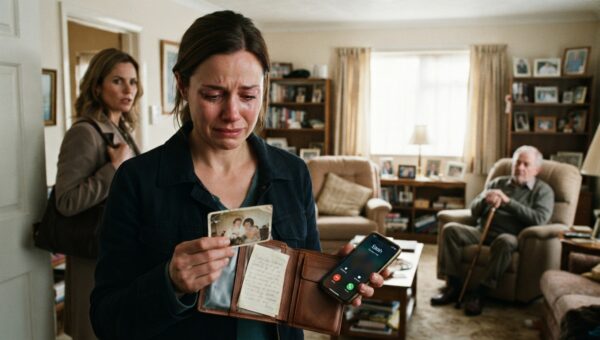
I still have the receipt for the groceries I bought that first Tuesday in June, folded up inside the back pocket of my church ledger. It says $384.12. I remember standing right there in the checkout aisle of the Hannaford in Millinocket, staring at the total while the cashier waited for my debit card, thinking about how my pantry was supposed to be my own.
Brenda had called me three days earlier with that soft, hurried tone she only used when she needed something she was too proud to ask for. She wanted me to take Mabel for the summer. Mabel was eight, she was Brenda’s new husband’s girl from a previous match, and I had met her exactly twice at awkward family cookouts where she sat in the corner like a stray cat.
I grumbled about it. I told Brenda down the telephone line that I had my garden to put in, that my joints weren’t what they were back when I raised three kids alone, and that I didn’t see why a child who wasn’t even my blood needed to disrupt my porch-sitting weather. Brenda didn’t argue. She just breathed out a long, tired sigh and said she didn’t have anywhere else to put her while they sorted out the custody paperwork with the other side of the family.
I gave in because I always gave in, but I let Brenda know I was doing her a favor. I carried that little private grievance around like a heavy wool blanket in July, feeling put-upon every time I heard footsteps on my squeaky hallway floorboards.
Mabel arrived on a Friday afternoon carrying a blue canvas gym bag that smelled faintly of mothballs and damp wool. She didn’t look around. She didn’t ask where her room was or where the television remote lived. She just set her bag down by the front door, squared her small shoulders, and waited for instructions. For the first seven days, I barely heard her voice. She ate her toast in three neat, silent bites, chewed with her mouth firmly closed, and pushed her chair back in without scraping the linoleum. When I tried to give her a peach out of the basket on the table, she flinched so fast her elbow knocked her milk glass over.
She didn’t cry. She just froze, her little hands flat against her thighs, waiting for a yell that never came. I told her it was fine, that accidents happen, but she spent the next twenty minutes on her hands and knees with a dish towel, scrubbing the same square inch of floor until the wax was dull.
The turning point happened on the seventh night. The house had gone quiet except for the hum of the refrigerator and the crickets outside the screen door. Mabel was sitting at the edge of the braided rug in the living room, staring at a small tear in the braiding. I sat in my armchair with my knitting basket, watching the way her fingers kept picking at the same loose strand of jute. I thought about how much groceries cost now, and then I thought about how thin her wrists looked inside the sleeves of her oversized pink sweater.
I laid my knitting down on the cushion and told her she didn’t have to be so quiet in this house, that she could make all the noise she wanted. She looked up at me with those pale, washed-out eyes, and asked the question that made the air go out of the room.
She asked if I had a rule about how long she was allowed to stay. My heart gave a strange, heavy squeeze against my ribs. I told her this was her home for the summer and she could stay as long as she needed. She looked down at the braided rug again, her fingers going very still. She whispered that her other grandma had a timer. When it beeped, she went to the garage.
The floor seemed to drop right out from under my chair. I asked, gently, what else happened in that garage, and Mabel whispered that the woman said if she told anyone, her daddy would be punished, punished, so she never did. A cold dread filled me right up to my throat. I didn’t yell. I didn’t make a sound. I just looked at this little girl who had learned how to make herself invisible so a grown woman wouldn’t lock her away with a plastic kitchen timer.
I waited until Mabel was tucked into the spare room upstairs, breathing in that slow, shallow rhythm of a child who hasn’t felt safe enough to sleep deep in months. I walked down the dim hallway to the rotary wall phone by the pantry, my fingers shaking so badly I dropped the receiver twice before I got the numbers right. I called Child Protective Services. I told the woman on the other end of the line what an eight-year-old child had just whispered to me about a timer and a garage in a town forty miles south of here, and I told her I wasn’t letting that kid go back. I knew what I was starting. I knew it was a betrayal of whatever fragile peace my daughter had managed to keep with her husband’s family, but standing there in the dark with my knuckles white against the wallpaper, I knew I didn’t care about peace anymore.
The next morning, I called Brenda and told her to get herself over to my kitchen table before noon. When Brenda walked through that screen door, she looked like she hadn’t slept since May. I didn’t waste time softening the edges. I told her everything Mabel had said, word for word, while the girl was out on the back porch watching a bluejay pull worms out of the damp dirt. Brenda dropped her car keys right onto the laminate counter and put her hands over her face. She told me she had suspected the other grandmother was strict, that the woman was bitter about the custody arrangement after Mabel’s mother passed away, but she swore she never imagined anything like a timer or a locked garage. She kept saying she didn’t know, she honestly didn’t know, and her voice broke in a way that made me remember she was my girl, no matter how old she got.
By Monday afternoon, a caseworker named Arthur came out to the house. He was a quiet man with kind eyes and a battered leather briefcase that smelled like stale coffee. He sat at my kitchen table with a yellow legal pad, talking to Mabel in low, patient tones while I stood by the sink making weak tea. Mabel didn’t look at Arthur at first, but after he pulled a small wooden puzzle out of his pocket and set it between them, her fingers started moving again. She told him about the gray plastic timer with the magnetic back that stuck to the side of the deep freeze in her other grandmother’s unheated garage. She told him how thirty minutes meant she had to stand facing the workbench without moving, and sixty minutes meant she had to sit on the cold concrete floor with her knees pulled up to her chin. She told him about the part that mattered most to her, the part that had kept her mouth shut all spring. Her other grandma told her that every time she made a sound or cried while the timer was running, her daddy would lose another day of his life at the paper mill. A child believes things like that because nobody has told them the world is wider than their kitchen.
The investigation moved faster than I expected once the state got their boots on the ground. The local authorities went out to that house on Wednesday morning. Brenda’s husband came over that evening, red-faced and shaking, having just found out what his own stepmother had been doing to his little girl while he was out working double shifts to pay off their truck. He sat on my front porch steps with his head in his hands, weeping like a boy who had just lost everything. I didn’t offer him coffee. I didn’t pat his back. I just looked at him and told him he should have paid closer attention to who he left his child with, but I let him sit there because Mabel needed to see her father was still breathing and still whole.
By July, the legal protections were locked down tight. The other grandmother was cut off from any contact under court order, facing an elder-abuse and child-welfare inquiry that was moving through the county courts like a slow-moving threshing machine. The family on that side tried to make noise, tried to call it old-fashioned discipline and family business, but Arthur and the state attorneys shut them down with paperwork and cold facts. They didn’t have room for excuses once the case file was opened and the details of that garage came to light.
Mabel didn’t change overnight. Trauma doesn’t wash off just because you move forty miles away and get a clean room with yellow curtains. For the first month, she still checked the corners of every room. She still ate her meals in total silence, and she still flinched if someone dropped a fork on the linoleum. But she started spending her afternoons out in the dirt with me. We didn’t talk much at first. We just worked side by side, turning over the dark, rich loam behind the barn and getting our fingernails packed with black earth.
By August, the change had settled into her bones. She started asking for pancakes on Saturday mornings instead of just plain toast, and she laughed out loud when the old yellow lab chased his own tail near the well-pump. The weight of the world she had been carrying around on her small shoulders had finally been set down somewhere she couldn’t reach it anymore.
Yesterday afternoon, the sun was sitting low over the tree line, turning the maple leaves the color of old copper. Mabel and I were out by the garden patch, finishing up the last of the marigold planting. We had an old galvanized trash can sitting near the shed where I kept the broken tools and rusted iron we didn’t use anymore. Buried deep at the very bottom of that can, covered in a few shovelfuls of damp garden soil, sat an old cracked digital kitchen timer I had found rattling around in the back of my junk drawer. Mabel had dropped it in there herself after we took the batteries out, watching the little liquid crystal screen fade out until it was just dead plastic. We didn’t say anything about it. We just pushed the dirt over it with our trowels, wiped our hands on our jeans, and walked back toward the kitchen together as the evening air turned cool and sweet.