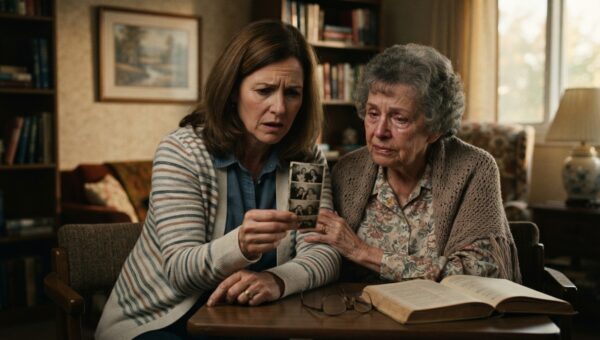
The cedar chest in the spare bedroom has not been opened since the winter of 1974. I keep it shoved against the baseboard behind a spare quilt and an old metal folding chair, buried under dust that smells of dry cedar and old cardboard.
I went straight to it after Luke left my house. My hands were shaking so badly I dropped the brass key twice on the hardwood floor before I managed to turn the lock.
Luke had come over around two in the afternoon to drop off some groceries, just like he does every Tuesday after his shift at the county yard. He took off his muddy work boots by the door, walked over to the counter, and leaned against the laminate edge while I poured him a cup of coffee. He looked tired. He always looks tired lately with two toddlers under three running around their little house on Elm Street, but this was a different kind of tired. It was the look of a man carrying something heavy that he didn’t know how to set down.
“Mom,” he said, blowing on the black coffee. “Rachel found her birth parents.”
I didn’t think much of it at first. Rachel was adopted out of state when she was an infant, and she had started doing one of those mail-in DNA kits a few months back just to satisfy her curiosity about her medical history.
I wiped down the counter with a damp sponge and told him that was good for her, seeing as everyone seems to be doing it these days to find out if they are part Irish or German.
“She already found them, Mom,” Luke said, and his voice dropped flat.
I turned around with the sponge in my hand. “And?”
He sat down at the table and looked at his hands, calloused and gray with grease from the diesel engines he fixes all day. “Mom, her birth mother’s maiden name is the same as yours. Same town. Same year.”
The room tilted. The linoleum under my slippers seemed to drop an inch, and the sound of the refrigerator humming in the corner turned into a low roar in my ears. I looked at my son, sitting there with his shoulders hunched in his flannel shirt. Then I looked past him at the framed wedding photo hanging on the wall by the pantry.
Rachel was smiling in that picture, her chin tilted up just slightly, with those high cheekbones and that stubborn little cleft in her chin that I had spent thirty years trying not to look for in mirrors.
I knew then, before I even opened the chest upstairs, why I had always felt a strange, cold prickle at the back of my neck whenever Rachel walked into my house. It wasn’t personality clashes or the normal friction between a mother-in-law and a daughter-in-law. It was blood recognizing blood across a chasm I had spent a lifetime pretending didn’t exist.
Upstairs in the spare room, I lifted the heavy lid of the cedar chest. At the very bottom, beneath a yellowed christening gown I had never used and a bundle of letters from my late husband, sat a flat brown envelope tied with a faded piece of cotton string.
My fingers felt clumsy and thick as I untied the knot. Inside were the discharge papers from the county hospital in the winter of 1974, typed on onionskin paper that crinkled like dry leaves.
Name of mother: Clara Miller. Date of birth: November 14, 1954. Town: Pine Ridge, Illinois. Registration number 488-B.
I sat down hard on the edge of the twin bed and stared at the numbers until they blurred together. I was nineteen years old back then, terrified of my father’s belt and the whispers of a small town where everyone knew everyone’s business before church let out on Sunday morning. They put me in a car, drove me two counties over, and told me it was for the best. They told me the baby would go to a good family and I could go back to school like nothing ever happened. I went back to school. I married a good man years later, had Luke, and buried that first child in the darkest corner of my memory where nobody could dig her up.
Except a spit tube in a plastic vial had dug her up forty-eight years later.
Luke was still sitting at my kitchen table when I came back down the stairs with the onionskin paper folded in my palm. He didn’t ask what I found in the chest. He just looked at my face and knew the answer before I spoke a single word.
“She’s coming over tonight,” Luke whispered, staring down at his coffee mug. “She wanted to come with me, but I told her I needed to talk to you first.”
“Does she know?” I asked, and my voice sounded thin, like dry paper tearing.
“She knows the name matches,” Luke said, rubbing the back of his neck. “She doesn’t know about you. Not yet. She just thinks it’s a weird coincidence. One of those genealogical loops where people from the same small town share a surname.”
We sat in silence for a long time. The clock on the wall ticked off the seconds with a heavy, wooden sound that seemed to measure out the distance between what our family was twenty minutes ago and what it had become now. My son was married to the girl I had surrendered in a cold delivery room behind a curtain of hospital gauze before Nixon resigned. The horror of it didn’t come with lightning or shouting. It came in a cold, heavy wave that settled right in the middle of my chest and stayed there.
“We have to tell her,” I said finally.
“How?” Luke looked up at me, his eyes wide and panicked, the same look he had when he fell out of the old oak tree in the front yard and broke his collarbone. “How do you tell your wife that her mother-in-law is her actual mother? How does that even work?”
“I don’t know,” I said, and for the first time in front of my son, I let my voice crack. “I honest-to-god don’t know, Luke.”
Rachel arrived at 5:15. She drove her little silver sedan up the gravel driveway, parking right behind Luke’s truck, and hopped out with a plastic container of leftover potato salad she had promised me earlier in the week. I watched her through the kitchen window. She walked with that same slight hitch in her left step, the one I had tried to fix in myself when I was a teenager by walking books balanced on my head.
When she opened the front door, she was smiling. “Hey, Clara,” she said, kicking off her sneakers. “Luke looks like he saw a ghost. Did you guys get into an argument about the truck parts again?”
She set the potato salad on the counter and looked between us. The smile faded from her face slowly, the way water drains out of a basin when you pull the plug. She saw the onionskin paper lying flat between the salt shaker and the napkin holder. She saw Luke staring at the floor.
“What is that?” Rachel asked, her voice dropping an octave. She looked at me, and for a terrifying second, I felt like I was looking into a looking glass from forty years ago. “Clara? What’s going on?”
I didn’t move from my chair. My hands were flat on the oilcloth table cover, pressing down until my knuckles turned white.
“Sit down, Rachel,” I said, and the room went completely still.
She sat down across from me, right where Luke had been sitting. She looked at the paper again, her eyes scanning the typed lines, the hospital stamp from November 1974, and the faded signature at the bottom that matched the one on my driver’s license in the next room.
“This is from Pine Ridge,” Rachel said, her voice small and confused. “That’s… that’s where my adoption file starts. How do you have this?”
I couldn’t look at her face anymore, so I looked at her hands resting on the edge of the table. They were my hands. Same long fingers, same pale skin, same small scar across the knuckle of the left index finger where I had caught it in a screen door when I was twelve.
“I didn’t know when I met you,” I said, and the words felt like broken glass coming up my throat. “I swear to God, Rachel, I didn’t know. If I had known, I never would have let…”
Rachel stopped breathing. I could see it in the way her chest locked up. She reached out and touched the edge of the yellowed paper, her fingers trembling against the onionskin. She looked from me to Luke, then back to me, searching our faces for some kind of joke, some cruel trick that families play when they’ve been cooped up together too long.
“No,” she whispered. “That’s not… that’s impossible. That’s a coincidence. People have the same name.”
“It’s not a coincidence,” I said softly. “Registration number 488-B. Baby girl Miller, born at 4:12 in the morning during the ice storm. I remember the ice on the windows, Rachel. I remember the nurse holding you up for two seconds before they took you down the hall.”
The kitchen grew very quiet. The refrigerator hummed, clicked off, and left us sitting in a silence so heavy it felt physical. Rachel didn’t scream or cry. She just stared at the table, her hands resting near the corner of the wedding photo propped against the sugar bowl.
The realization sat between the three of us like a third person, cold and undeniable. We didn’t try to fix it that night. You can’t fix forty years of blind history with a conversation over a kitchen table. But as the sun went down behind the ridge and the kitchen got dark enough that I had to reach up and pull the chain on the overhead light, Rachel didn’t get up and leave. She stayed in her chair.
She reached across the laminate surface, her fingers brushing against mine, hesitant at first, then firm. We sat there in the yellow light, the three of us, looking not at the past we couldn’t change, but at the two little children sleeping quietly in their beds down on Elm Street, safe in a world that hadn’t ended yet.